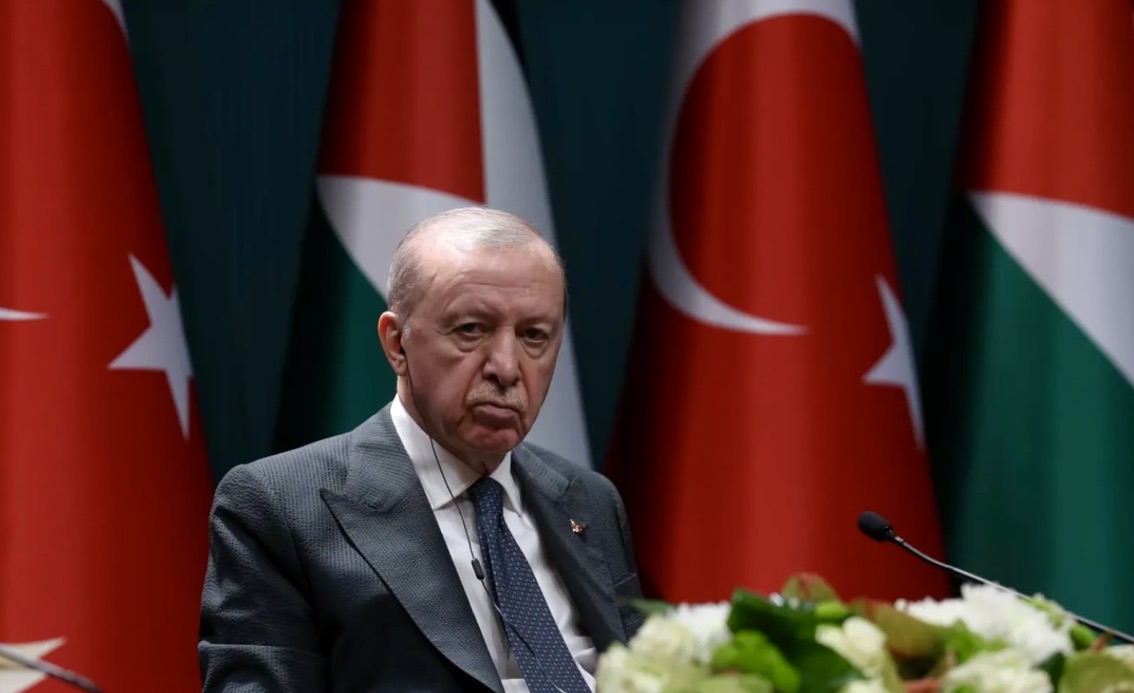
MOSCOW (Realist English). Recently, Turkish President Recep Tayyip Erdoğan once again stated that Ankara is ready to act as a mediator in resolving the conflict in the Gaza Strip. The Turkish leader noted that the path to peace in the region lies “through the creation of an independent Palestinian state within the 1967 borders, with its capital in East Jerusalem.”
On the surface, this sounds decent and appealing, and such an approach aligns with the interests of most Arab and Muslim states. However, behind this statement lies nothing more than Ankara’s desire to remind the region and the international community of its presence. Erdoğan is flattered by the prospect of continuing to play the role of one of the leaders of the Muslim world and a “gatherer” of the lands of the former Ottoman Empire.
Historically, Palestine was part of the Ottoman Empire for exactly 400 years – from 1516/1517 to 1917, until the region was occupied by British forces during the First World War.
It is obvious that any mediation presupposes the equidistance of the mediator from the parties to the conflict and its position, as it were, “above the fray,” without any direct or indirect interference in the conflict. In this case, even an uninformed observer can see that Turkey initially supported the radical Palestinian groups Hamas and Islamic Jihad (banned in Russia) in their armed struggle against Israel.
Istanbul hosts the headquarters of Hamas, where functionaries and militants of the group, which is banned in Israel and several other countries, receive Turkish passports, financial and material assistance. Periodically, Turkish authorities initiate the dispatch of so-called international humanitarian flotillas to break through the Israeli naval blockade of the Gaza Strip. All this is reinforced by rabid anti-Israeli propaganda and the freezing of diplomatic and other relations with Israel. Erdoğan has gone so far as to declare that he is ready to wage open war with Israel.
For a long time, Turkey did not condemn the attack by Palestinian radical militants on border Israeli territories on 7 October 2023, when over 1,200 civilians were brutally murdered and about 200 hostages were taken. Ankara’s position on this issue changed only two years later. Only in July 2025 did Turkey, together with a number of Arab countries, sign a declaration at UN‑sponsored events, in which it for the first time condemned the Hamas attack on Israel of 7 October 2023 and called on the group to relinquish control over Gaza.
As is well known, Trump’s widely publicised 20‑point peace plan for Gaza “misfired” – it has not been implemented beyond the first point on a ceasefire. Israel and Hamas cannot agree on what comes first and what comes second: should Hamas first disarm, and then Israeli forces lift the blockade on the sector, or vice versa? In chess terms, the position is a stalemate – neither side intends to concede. Hamas leaders also demand Israel’s prior recognition of the State of Palestine.
Netanyahu’s government has taken a rather tough stance on the Palestinian issue. In Jerusalem, they believe that under the current circumstances, the very idea of creating a Palestinian state has lost all meaning, since, in Israel’s assessment, such a state would inevitably fall into the hands of Palestinian radicals and become a puppet of Iran. In that case, the threat to Israel’s national security would sharply increase. Allegedly, the time for creating a Palestinian state formation has been hopelessly lost, and there will never be a 23rd Arab state on the map of the Middle East.
Such a position of the Israeli authorities contradicts Hamas’s demands and the views of the Turkish leadership outlined above, and is, in essence, the “stumbling block” in resolving the Palestinian issue peacefully. It is unlikely that Israel will agree to Erdoğan’s participation as a mediator in any new negotiation process on the Palestinian problem. Most likely, Egypt, Jordan or the UAE, with which Jerusalem already has diplomatic and other relations, could lay claim to this role.
Recently, Ankara’s proposals to continue playing the role of mediator in resolving the Ukrainian crisis have also become highly problematic. It is unlikely that Istanbul can be considered a convenient neutral venue for negotiations between representatives of the Russian Federation and Ukraine, as was the case in previous years. This is hindered by the activation of military and military‑technical cooperation between Turkey and the Kyiv regime, and Ankara’s support for the territorial claims of the Ukrainian authorities against Russia.
In addition to the regularly supplied drones with weapons, missiles, shells and the construction of a drone factory in Ukraine, according to a notification from the US State Department, Turkey plans to re‑export to Ukraine American long‑range systems and ammunition currently in its arsenal: 12 M270 MLRS launchers, 70 ATACMS (M39) ballistic missiles, more than 2,500 M26 cluster rockets and 47,000 203‑mm artillery shells.
The projects of “Greater Turan” and “Greater Circassia” circulated in the Turkish media, forums of Crimean Tatars and other nationalities originating from the North Caucasus in Istanbul with the participation of the top Turkish leadership, attempts to spread the activities of the Organisation of Turkic States and its branches such as TURKSOY (culture) and the Turkic Academy (science) on the territory of the Russian Federation – all this can be regarded as nothing other than unfriendly acts towards Russia.
Thus, Turkey is increasingly losing the right to act as a mediator in regional conflicts due to its ambiguous foreign policy and direct involvement in conflicts on the side of one of the participants.
Stanislav Ivanov is a leading researcher at IMEMO RAS and a Candidate of Historical Sciences, writing exclusively for Realist English.