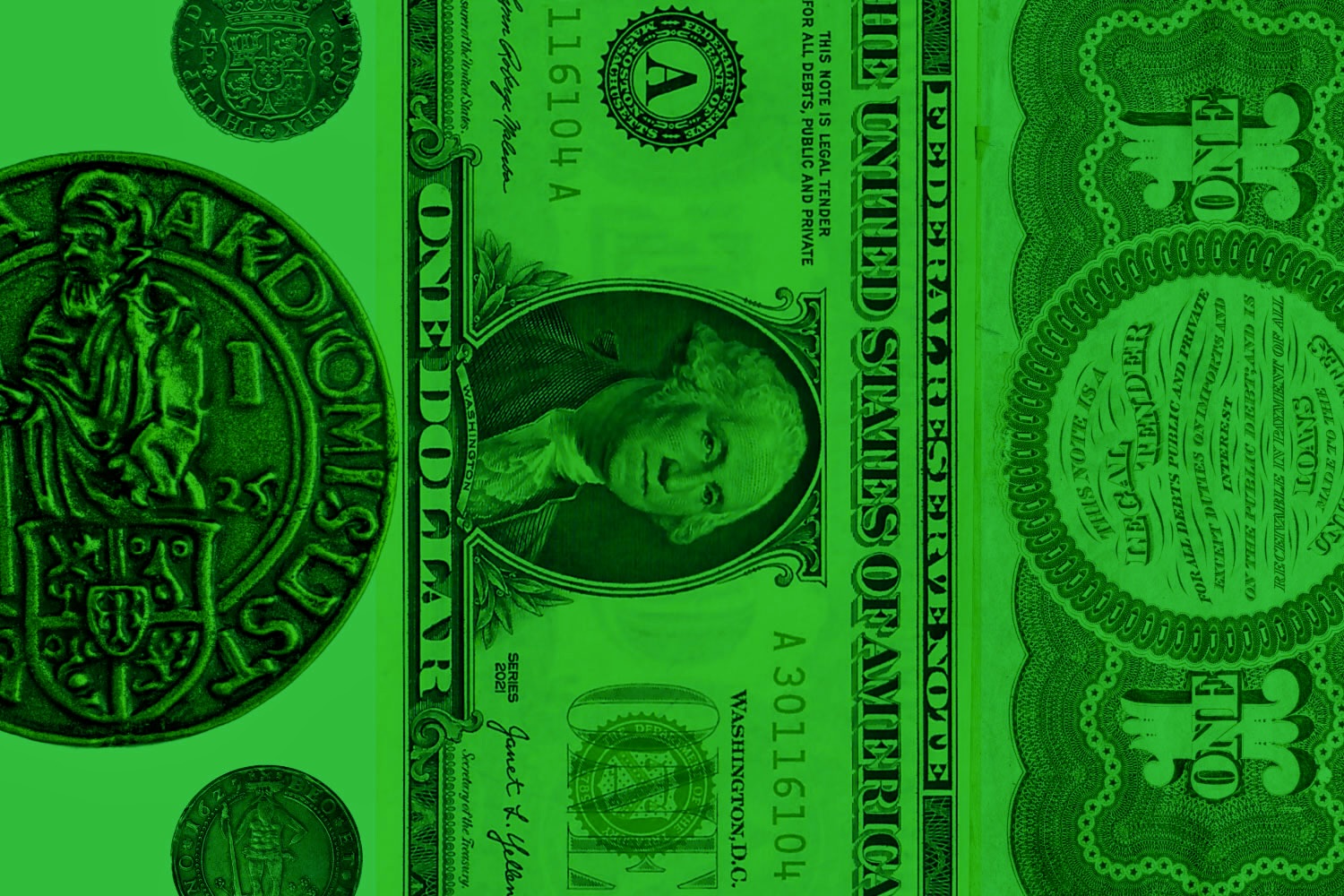
WASHINGTON (Realist English). The United States did not invent the dollar, does not control it to this day, and never has. This currency was an “accident” that arose on the streets of a Bohemian town at the beginning of the 16th century.
This is the conclusion reached by historian and journalist Brendan Greeley in his new book, “The Almighty Dollar: 500 Years of the World’s Most Powerful Money,” published in May 2026.
Foreign Policy reviewer Chloe Hadavas calls Greeley’s work “eye-opening, educational, exhaustively reported, and very fun to read.” The reviewer herself admits to having read the book twice.
The Dollar’s Predecessor: The Silver Thaler from Bohemia
As Greeley discovered, the dollar did not originate at the US Mint, but in the mines of St. Joachim in Bohemia (modern‑day Czech Republic). In the early 1520s, they began minting a high‑fineness silver coin there — the joachimsthaler. The name was quickly shortened to “thaler,” which then transformed into “dollar.”
What matters is that these coins were not minted by decree of an emperor or king, but by private entrepreneurs outside any national monetary system. Nevertheless, they were readily accepted throughout Europe — because they were predictable, of high quality, and plentiful.
Spanish Silver and the American Colonies
The idea was quickly copied. Spanish “pieces of eight” became the de facto global means of payment for centuries. American colonists were keeping accounts in dollars long before the United States came into being. Temporary banknotes issued in the province of Maryland in the 1760s were naturally denominated in dollars.
The Eurodollar: When Europe Started Printing Its Own Dollars
Of particular interest is Greeley’s account of the eurodollar – dollars that European banks began creating in the late 1950s without asking permission from the Federal Reserve System. These were not counterfeits, but fully legitimate money, born of global demand beyond US jurisdiction. The eurodollar market took off due to differences in interest rates, but for the reviewer, something else is more important: “The dollar, in whatever guise it took, was never a sovereign creation.”
The Dollar Does Not Work for America – It Works for the World
The book’s key thesis, as quoted by the reviewer:
“The dollar is not America’s currency. It works for the world – for now. But it does not always work for America.”
According to Greeley, on many occasions the dollar has served international trade better than it has served ordinary Americans. The 2008 debates over bailing out Wall Street versus Main Street are merely the latest manifestation of a centuries‑old pattern.
What the Book Does Not Cover
Greeley barely touches on the dollar’s future as a global reserve currency and only briefly mentions cryptocurrencies, noting their similarity to past temporary monetary substitutes. The reviewer considers this a strength rather than a weakness: “The number of words written about the supposedly doomed fate of the dollar surely outweighs the number of dollars in circulation, yet the dollars still circulate.”
The main virtue of the book, in the reviewer’s opinion, is the chance to learn exactly how “the thing that makes the world go round was made, is made, and gets around.” The reviewer admits she will probably read the book a third time.
The Dollar’s Share in 2026: Key Indicators
The role of the US dollar in 2026 can be described as a state of “neither peace nor war”: amid global geopolitical turbulence and the war in the Middle East, the US currency temporarily strengthened its position and set historical records in international payments, yet at the same time an irreversible structural erosion of its status in long‑term reserves continues. The world is moving toward a multicurrency system in which the dollar remains the primary, but no longer the sole, dominant pole.
The data confirm this duality: in March 2026, the dollar’s share in SWIFT international payments reached a record 51.1%, the highest since 2023, but this jump was largely driven by a “safe‑haven effect” amid the military conflict. At the same time, the dollar’s share in global reserves has been steadily declining.
Here is how the indicators compare in 2026:
| Indicator | Value | Trend / Features |
| International payments (SWIFT) | 51.1% in March 2026 (record level) | Short‑term growth due to conflict; 49.25% in February |
| Foreign exchange reserves (IMF COFER) | 56.9% (Q1 2026) – lowest since 1995 | Share fell from 73% in 2000 to ~57% |
| Global government debt denominated in USD | ~60% | Dollar maintains position thanks to market depth |
Gold
Today (around 30% of reserve holdings) has already overtaken the euro (around 21%) and become the second‑largest reserve asset.
Long‑Term Erosion: “De‑Dollarization” Gains Momentum
Despite local surges, the structural decline in the dollar’s role continues.
- Collapse in reserve share: The dollar’s share in global foreign exchange reserves has fallen from 73% to about 57% over the past 25 years. By the end of the first quarter of 2026, this indicator hit its lowest level since 1995.
- Scale of capital outflow: Between 2020 and 2026, about $3.2 trillion were shifted out of dollar reserves. Experts call this process “crash de‑dollarization,” emphasising its rapid, rather than evolutionary, character.
- Gold versus the euro: The rise in gold’s popularity is particularly telling. By 2026, gold’s share in reserve holdings had reached about 30%, officially overtaking the euro, whose share has stagnated just above 20%.
BRICS and Alternative Systems: From Rhetoric to Infrastructure
BRICS countries (especially Russia and China) continue their strategic course away from the dollar, but are focusing on the gradual creation of an alternative financial infrastructure.
- Russia and China: Nearly 99% of bilateral trade has been shifted to settlements in rubles and yuan. An illustrative example: Iran has begun charging transit tolls for tankers through the Strait of Hormuz in yuan.
- Energy shift: Saudi Arabia (up to 41‑45% by March), Iraq (over 60%) and the UAE have started settling oil payments in yuan.
- India’s position: New Delhi opposes radical de‑dollarization within BRICS, as many trade agreements remain dollar‑denominated.
- Digital infrastructure: China’s CIPS system is gaining momentum, and BRICS members are developing the BRICS Pay platform, creating an alternative to SWIFT.
War as a Catalyst: Why the Dollar Soared in 2026
Contrary to forecasts, the US‑Israeli war with Iran (starting in February 2026) led to an unexpected strengthening of the dollar. Geopolitical instability and a sharp spike in oil prices triggered a flight from riskier assets into the most liquid safe haven – the US currency. This created a paradoxical situation: military action boosted demand for the dollar in the short term.