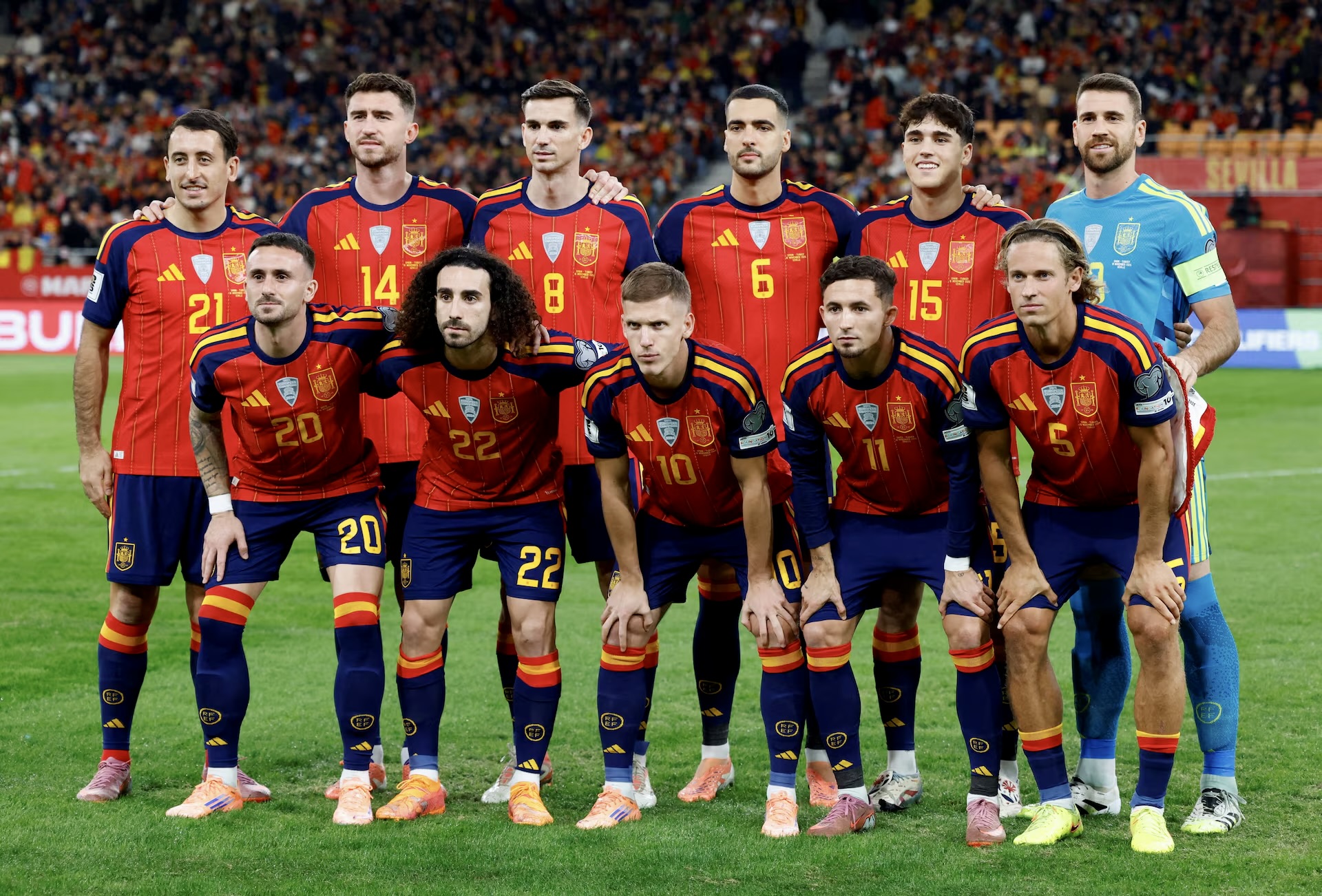
DALLAS (Realist English). Spain’s national team has reached the final of the 2026 World Cup, defeating France 2–0 at the stadium in Texas.
This is La Roja’s first final since 2010 — and everything surrounding Luis de la Fuente’s squad increasingly resembles the script written 16 years ago in South Africa. But despite the superficial similarities in style and circumstances, this Spain side is an evolution, not a copy.
Road to the Final: Striking Parallels
The comparison with the 2010 championship team is natural — and not just because of the final result. Both teams entered the tournament as reigning European champions (2008 and 2024). Both started the group stage in Group H — and both had their share of problems.
In 2010, Spain sensationally lost to Switzerland in the opening match; in 2026, they drew 0–0 with Cape Verde. In both cases, the opening result drew a barrage of criticism in the Spanish press.
It goes further: in the Round of 16, both sides faced Portugal and won by the same scoreline of 1–0. In the semi‑final, the opponent in both cases was the reigning world vice‑champion. And finally, both squads had eight players from Barcelona — both in 2010 and in 2026.
From Tiki‑Taka to Vertical Football: Evolution of Style
The main difference lies in how Spain controls the game. Vicente del Bosque’s 2010 team became the symbol of “tiki‑taka”: endless short passes, possession around 60–70%, patiently unlocking the opposition’s defense. Opponents were worn down mentally and physically, with goals often coming late in the match.
This Spain side is faster, more vertical, and more aggressive. They still value possession, but they seek space in one‑touch or two‑touch combinations, using pace on the flanks and sharp runs into the final third.
As one CNN analyst put it, “the tedious, positional football that many countries and clubs had learned to neutralise is a thing of the past. It has been replaced by a dynamic, wide‑player‑driven, exciting brand of football.”
Key Stars: Yamal Instead of Xavi and Iniesta
The 2010 team did not rely on a single superstar — they had the best midfield triangle in football history: Xavi, Iniesta, Xabi Alonso, and Busquets dictated the tempo of any match.
This squad also possesses an elite midfield — Rodri, Pedri, Gavi, Fabián Ruiz, and Zubimendi form one of the tournament’s strongest midfield lines.
However, in 2026, Spain has an individual who can decide a moment on his own — 19‑year‑old Lamine Yamal.
In the semi‑final against France, it was he who won the penalty that Mikel Oyarzabal converted, and then created several more dangerous chances. Yamal has become the symbol of a new generation — younger and hungrier than the legendary 2010 side.
Defense: The Unchanging Foundation of Success
Defense remains the main constant of Spanish football. In 2010, La Roja conceded only two goals throughout the tournament and won all knockout matches 1–0. The defensive line of Piqué–Puyol–Capdevila and goalkeeper Casillas was called one of the best in World Cup history.
This team has gone even further: before the semi‑final against France, Spain set a record by not conceding for 649 consecutive minutes. Over the whole tournament, only one goal has gone past Unai Simón — from Belgium’s De Ketelaere.
In the semi‑final, the French attack with Mbappé, Dembélé, and Olise had an xG of 0.01 by the 35th minute — statistics that leave no doubt about the quality of Spain’s defense.
Squad and Tactics: Balance of Youth and Experience
Luis de la Fuente uses a 4‑3‑3 formation that brought success at Euro 2024. In goal is Unai Simón, backed up by David Raya and Joan García. In defense, 19‑year‑old Pau Cubarsí of Barcelona stands out, alongside experienced Aymeric Laporte and Marcos Llorente.
The midfield is Rodri, Pedri, and Gavi, while the attack features Yamal and Nico Williams on the flanks. At the point is Mikel Oyarzabal, who scored the winning goal in the Euro 2024 final and now scored a brace in the World Cup semi‑final.
Notably, Spain’s squad contains no players from Real Madrid — while eight players represent Barcelona.
Road to the Final: Numbers and Facts
Spain approach the final as one of the tournament’s main favourites. Along the way, they defeated Uruguay, Saudi Arabia, and Cape Verde in the group, and then Portugal, Belgium, and France in the knockout rounds.
The Spaniards set a new scoring record for the national team at a single World Cup — 13 goals in six matches (the previous record was 11 goals at the 1986 World Cup). They have conceded just one goal — the best defensive record among all teams in the tournament.
In the final on July 19, Spain will face the winner of the England vs. Argentina semi‑final. For de la Fuente and his team, this is a chance not only to repeat the achievement of 2010 but to do so in a completely different footballing style — more dynamic, more entertaining, and perhaps even more effective.
As the manager said after the victory over France: “We can’t wait for the final. We won’t settle for today. Our goal is to win the World Cup.”
The coincidences with 2010 are curious — but no more than that. This Spain is not trying to copy the past. They are rewriting it in their own way.