NEW YORK (Realist English). Ruchir Sharma, Chairman of Rockefeller International and a columnist for the Financial Times, has published an article titled “AI is not enough to arrest China’s decline,” in which he warns that Beijing’s bet on artificial intelligence will not save the economy from a systemic crisis.
In Sharma’s view, there are “other, more powerful forces putting pressure on the country’s economy,” and it is these forces — not technological backwardness — that will determine China’s long-term trajectory.
China’s Economic Pain: Not in AI, but in Real Estate
Sharma has repeatedly emphasized that the root of China’s problems lies far beyond the technology sphere. As one analytical review of his speeches notes, “China’s economic pain, however, lies less in AI and more in its real estate market crisis.”
In his public appearances, Sharma calls China’s real estate sector an “ideal storm” — overleveraged developers, a housing market bubble, and falling demand for new properties create a systemic threat. This crisis remains the main brake on Chinese economic growth, and no technological breakthroughs can compensate for it.
This is the key difference between China and the United States: while America is making “one big bet on AI,” China is trying to use AI as a patch on much deeper economic wounds.
US vs. China: Different Approaches to AI
Sharma draws attention to the fundamental difference in the strategies of the two superpowers. While America has focused on creating foundational models — essentially, “producing five slightly different versions of ChatGPT” — China has taken a different path.
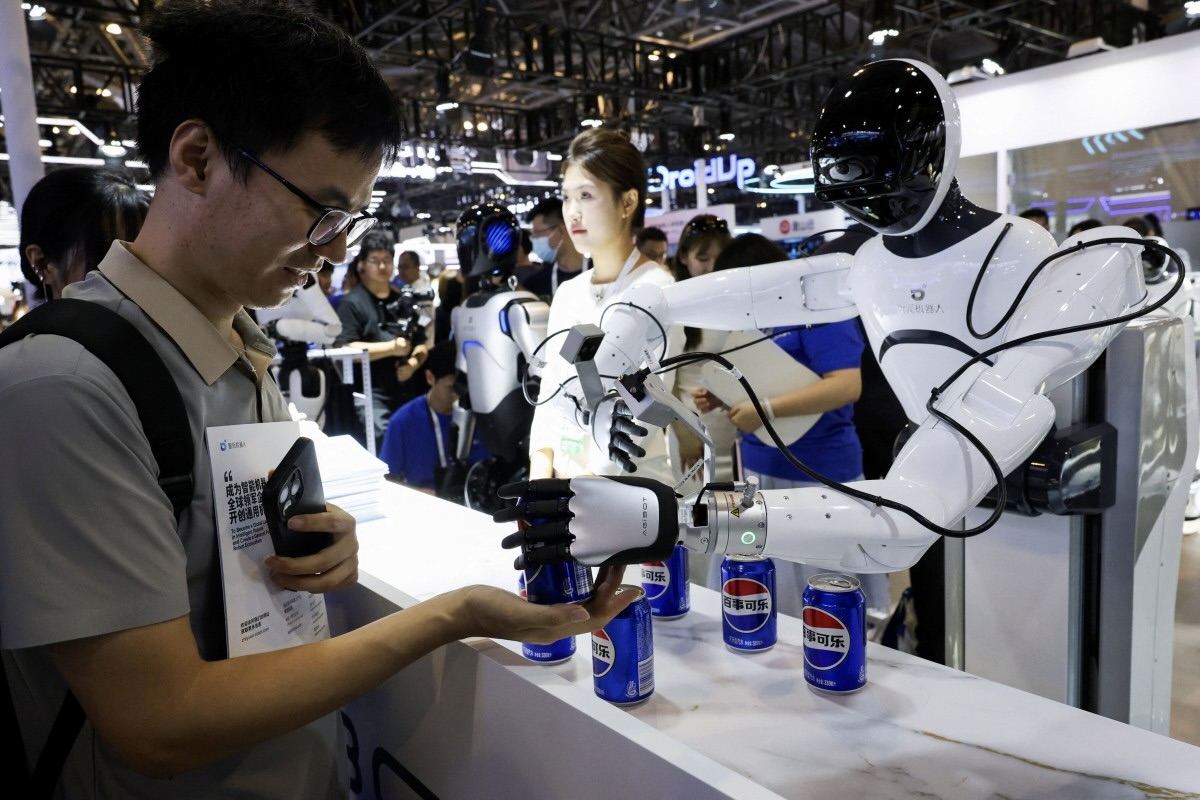
China’s strategy, according to Sharma, lies in “creating hundreds of models and use cases, mostly centered around robotics and automation.” In the long term, this approach not only realizes a futuristic vision of what AI should do, but also has the potential to impact the physical world.
However, as Sharma stresses, even this pragmatic approach does not solve the main problem: the scale of AI investment in China is incomparable to the scale of losses in traditional sectors of the economy.
Why Sharma Would Not Bet on China
At the Express Adda event in April 2026, Sharma explicitly stated why he “would not bet on China.” The investor’s arguments boil down to several key points:
- Structural real estate crisis — a sector that was the engine of the Chinese economy for decades has become its biggest burden.
- Demographic decline — China is aging faster than it can robotize production, and AI cannot replace millions of disappearing workers.
- Technological constraints — US export controls have cut China off from access to advanced chips critical to AI development, and Chinese AI developers face a lack of mature alternatives to American software.
- Insufficient scale of investment — even with all the hype around Chinese AI, the volume of investment in this sector remains insufficient to turn the tide in the broader economy.
AI Bubble and Risks to Global Markets
Sharma also warns about global risks tied to the AI mania. In an interview with Nikhil Kamath, he stated: “We are in an AI mania. Every problem in the world is being solved with AI, at least on paper.” He draws alarming parallels with the dot-com bubble of 1999–2000.
By his estimate, “AI companies accounted for 80% of US stock market gains in 2025.” This means that the US stock market has become dangerously dependent on a single technological narrative. As Sharma put it, “America is now one big bet on AI.”
At the same time, AI enthusiasm, in his words, “papered over structural cracks” in the US economy, including a budget deficit exceeding 6% of GDP and public debt exceeding 100% of GDP.
What Next?
Sharma consistently holds the position that technological revolutions by themselves do not rescue economies from fundamental imbalances. China, in his view, faces a challenge that cannot be solved simply by deploying AI: the country must simultaneously deal with a real estate crisis, demographic decline, and technological constraints.
As noted in an analysis of his views, “the US is effectively betting its growth cycle on a single technological revolution.” China, on the other hand, is trying to use AI to solve problems with much deeper roots. The question is whether the Middle Kingdom can carry out the necessary structural reforms before the AI bubble bursts, robbing it of its last hope for a technological leap.