

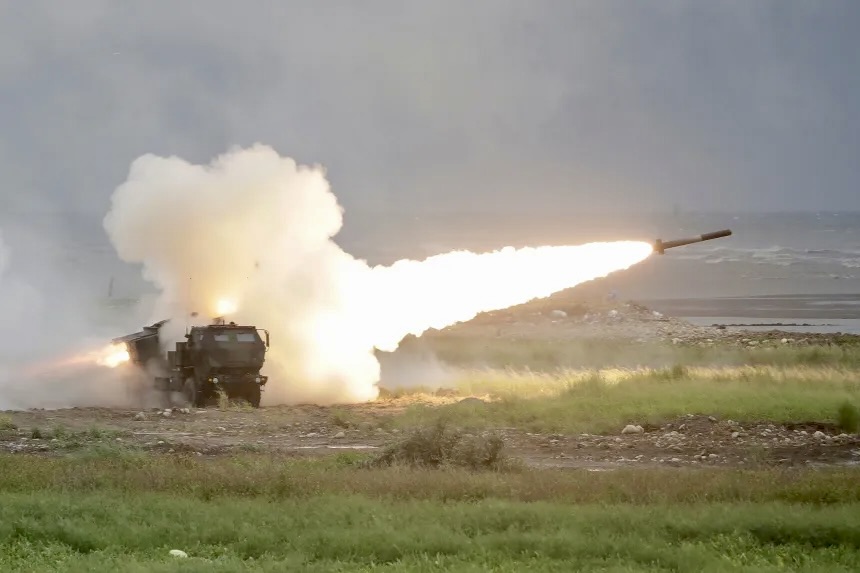
TAICHUNG (Realist English). Taiwan’s armed forces have conducted their first live-fire exercise using US-supplied HIMARS multiple launch rocket systems in the waters of the Taiwan Strait, which separates the island from mainland China. The drills took place on June 10 along Taiwan’s western coast and formed part of preparations for a potential military conflict with the People’s Republic of China.
The military used reduced-range training rockets that splashed down in the strait not far from the shoreline. Despite their limited range, the launches were widely viewed as a symbolic signal to Beijing that Taipei is prepared to employ American-made weaponry in the event of a crisis.
Rehearsing a Chinese Invasion Scenario
The exercise was conducted on the second day of large-scale military maneuvers along Taiwan’s west coast. In addition to HIMARS systems, 155-mm self-propelled howitzers participated in the drills. Troops practiced rapid deployment, precision strikes, and maneuver-based defense operations in response to a simulated Chinese amphibious landing.
A key element of the exercise was the “shoot-and-scoot” tactic, considered one of the most effective methods of fighting a numerically superior opponent. After receiving a firing order, HIMARS crews moved into position, launched their rockets, and left the area in less than three minutes.
According to Taiwanese Army Sergeant Wang Ming-hui, the training will continue:
“Given the current threat posed by the enemy, we will continue HIMARS training with unwavering determination to defend Taiwan.”
America’s Strategy of Asymmetric Defense
The High Mobility Artillery Rocket System (HIMARS) is a central component of Taiwan’s new military strategy, strongly encouraged by the United States. Rather than attempting to match China ship-for-ship, aircraft-for-aircraft, or tank-for-tank, Taipei is investing in mobile precision-strike weapons capable of inflicting significant damage on a much larger adversary.
Mounted on a wheeled chassis, HIMARS launchers can quickly relocate after firing, making them difficult to detect and destroy.
Taiwan’s representative to the United States, Alexander Yui, told CNN that the direction of the launch was determined by geography:
“We’re an island; we can only shoot east or west, so they chose west.”
Rising Tensions Around Taiwan
Beijing considers Taiwan an inseparable part of China and has not ruled out the use of force to bring the island under its control. Chinese military aircraft and naval vessels operate near Taiwan almost daily, and in recent years the People’s Liberation Army has conducted large-scale exercises simulating blockades and invasion operations.
The United States does not officially recognize Taiwan as an independent country but opposes any attempt to change its status by force and remains the island’s principal arms supplier.
Future Deliveries May Face Uncertainty
Last December, Washington announced plans to supply Taiwan with an additional 82 HIMARS launchers as part of a major military assistance package. However, the future of the deal remains uncertain.
According to US media reports, implementation of the package was temporarily suspended following President Donald Trump’s meeting with Chinese President Xi Jinping in Beijing in May.
If the deliveries resume, Taiwan will significantly strengthen its asymmetric defense capabilities and expand its ability to strike amphibious assault forces before they reach the island’s shores.
For China, the live-fire exercise serves as further evidence that Taipei continues to accelerate its military buildup with Washington’s support, adding to tensions in one of the world’s most volatile geopolitical flashpoints.