

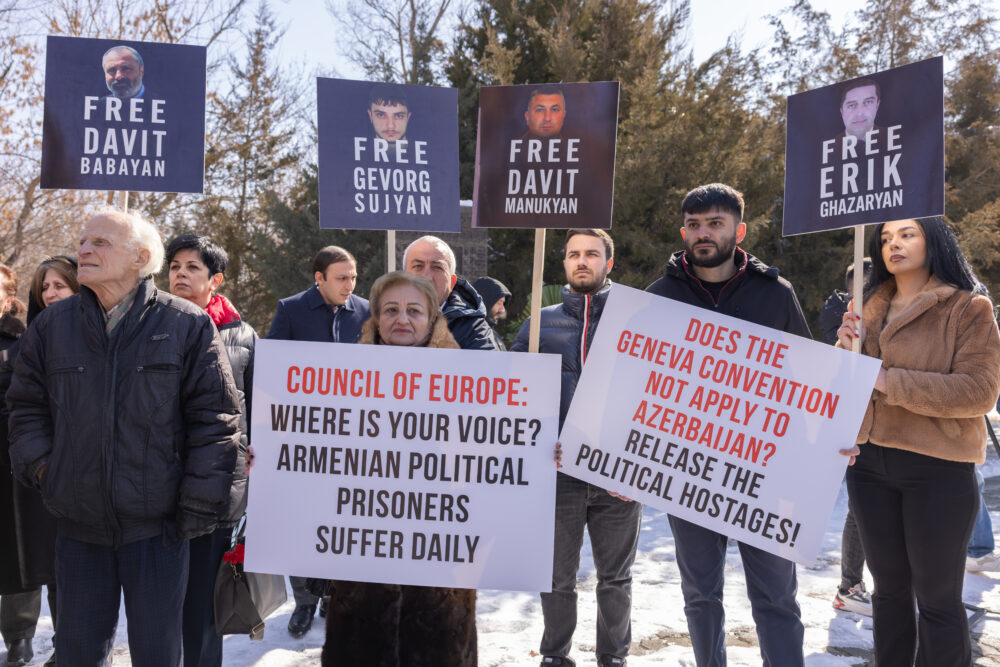
BAKU (Realist English). International human rights organizations and individuals have stepped up efforts to draw attention to the fate of Armenian political prisoners illegally held in Azerbaijan.
Amnesty International, Human Rights Watch, the Council of Europe and the Socialist International unanimously condemn the “fabricated” trials of the former leadership of Nagorno‑Karabakh (Artsakh) and call for their immediate release. Meanwhile, the prisoners themselves are making desperate appeals from their cells.
Amnesty International: ‘A real mockery of justice’
The organization called the sentences “a real mockery of justice,” stressing that the trial of former Artsakh State Minister Ruben Vardanyan was the culmination of a series of show trials of ethnic Armenians. According to Amnesty, the trials were held in closed sessions, and the charges were read out in a language the defendants did not understand. The annual report published on April 22 also noted that the Azerbaijani authorities had not provided adequate protection to victims of the conflict and continued to suppress dissent.
Human Rights Watch: torture and ill‑treatment
Human Rights Watch (HRW) has documented numerous cases of torture and ill‑treatment of Armenian prisoners of war. In its reports, the organization cites survivor testimonies of systematic beatings, electric shocks and cigarette burns after capture. HRW called on Baku to immediately investigate these war crimes and release all remaining prisoners.
PACE and OSCE: ‘Political prisoners’ without the right to defence
Representatives of the OSCE Parliamentary Assembly and the Council of Europe stress that the convicted Armenians fully meet the criteria for “political prisoners.” OSCE PA deputy Lilit Galstyan directly stated that these trials have nothing in common with even the minimum standards of international law.
The Council of Europe Commissioner for Human Rights, Michael O’Flaherty, is in close contact with the situation, but monitoring is difficult: the Azerbaijani authorities continue to deny representatives of the European Committee for the Prevention of Torture (CPT) access to Armenian detainees.
Socialist International: call for good will
The Socialist International expressed “outrage and deep concern” over the imposition of long prison terms and called on Baku to continue constructive dialogue by releasing all remaining Armenians in captivity, which would be “a significant gesture of good will.”
Voices from the US and Europe
The Armenian Assembly of America condemned the verdicts as “fundamentally unfair,” noting that these sentences create a contradiction between the rhetoric of peace and Baku’s actual actions. Christian Solidarity International filed an official complaint with the UN, pointing to a conflict of interest of a member of the Working Group on Arbitrary Detention whose decisions may have been biased due to ties with Azerbaijan.
Ruben Vardanyan’s appeal and the ombudsman’s refusal
On April 21, 2026, from a Baku prison, Armenian politician and financier Ruben Vardanyan, sentenced to 20 years in prison, appealed to Armenian Ombudsman Anahit Manasyan to organize her visit to Baku to verify the conditions of detention of prisoners. He criticized the inaction of official Yerevan and indicated that his wife, Veronika Zonabend, was ready to accompany such a delegation. However, on April 22, the ombudsman refused, citing a lack of authority to conduct monitoring outside the country. Lawyer Siranush Sahakyan said that such a visit could be used by Baku only to cover up violations.
After Azerbaijan’s military operation in September 2023, the world witnessed one of the most brutal acts of ethnic cleansing of the 21st century. More than 120,000 Armenians — the entire population of Nagorno‑Karabakh — were forcibly expelled from their lands in a matter of days. But deportation was only the tip of the iceberg of the Baku regime’s long‑standing crimes.
“In Karabakh in September 2023, ethnic cleansing took place. The Armenians had no choice but to flee,” concluded the authors of the report “Why Are There No Armenians in Nagorno‑Karabakh?”, prepared by six international human rights organizations, including Freedom House and the International Partnership for Human Rights. The study is based on more than 300 interviews with survivors and satellite images confirming the destruction of cultural monuments.
Melanie O’Brien, president of the International Association of Genocide Scholars, stated that war crimes, crimes against humanity and acts of genocide took place in Artsakh. “The mass deportation of the people of Nagorno‑Karabakh is in itself a crime against humanity, giving the International Criminal Court jurisdiction,” O’Brien stressed, also noting the destruction of Armenian monasteries, churches and khachkars, and the erasure of Armenian inscriptions.
Executions and mass killings
Reports by Human Rights Watch, Amnesty International and other organizations document systematic violations of international humanitarian law. One of the most shocking episodes was the extrajudicial execution of Armenian prisoners of war in September 2022. Human Rights Watch analyzed a video showing Azerbaijani soldiers shooting at close range at least seven unarmed Armenians in military uniform.
“Killing soldiers who have surrendered is the most serious war crime,” said Hugh Williamson, HRW’s director for Europe and Central Asia. The Azerbaijani side opened an investigation, but nothing is known about bringing the perpetrators to justice.
HRW also documented the use of torture by Azerbaijani troops against detained civilians, including beatings, electric shocks and humiliation. Despite abundant evidence, Baku has taken no real steps to investigate these crimes.
The Azerbaijani state prosecutor during a court trial in Baku claimed that 170 Azerbaijanis had been killed with torture in 1988‑2023. However, human rights defenders regard these statements as an attempt to justify their own crimes and divert attention from Baku’s systematic violations.
Ethnic cleansing and deportation
The nine‑month blockade of the Stepanakert–Goris road (the only route linking Nagorno‑Karabakh to Armenia) deprived 120,000 people of food, medicine and fuel. On September 19, 2023, Azerbaijan launched a full‑scale offensive. Massive shelling of residential areas forced Armenians to leave their homes under continuous fire. On September 24, the mass exodus began. Within days, Karabakh, where Armenian civilization had existed for more than 3,000 years, was emptied.
A witness cited in the Freedom House report said: “On September 19, I came home for lunch. A child ran in and said he’d heard an explosion. I looked out the window and saw them shooting at the residential quarter.” Less than two weeks later, she, along with her child and more than 120,000 other Armenians, became a refugee — part of the forced exile that ended a thousand‑year Armenian presence on that land.
Cultural genocide
Simultaneously with the expulsion of the Armenian population, Baku launched a campaign to destroy Armenian cultural heritage. This is a continuation of a policy that began in Nakhichevan, where thousands of khachkars (Armenian cross‑stones) and ancient churches were completely demolished.
According to the US Commission on International Religious Freedom (USCIRF), on Azerbaijani‑controlled territories in Artsakh, Armenian churches are systematically destroyed or repurposed. In Shushi, the Cathedral of the Holy Savior and the Green Church have been damaged; the famous Kanach Zham church has been completely destroyed. The Church of St. Sarkis in Mokhrenis (Hadrut) has been demolished, and the Church of St. Harutyun in Berdzor has been turned into a mosque.
In Stepanakert, Azerbaijani forces demolished monuments to Khachatur Abovyan, Hovhannes Baghramyan, Stepan Shahumyan, Alexander Myasnikyan, Alek Manukyan and Ivan Isakov. The Church of St. Sarkis in the village of Tsar in the Karvachar region and the Zorakhach church in the Kashatagh region have also been vandalized and looted. From the Vankasar church in the Martakert region, Azerbaijanis removed the cross from its dome and posted a video of the act on social media.
USCIRF members called on the US State Department to include Azerbaijan in the list of countries subject to special scrutiny for gross violations of religious freedom. Commissioner Vicky Hartzler condemned “repression and cruelty” against religious groups and called for political and economic sanctions against individuals and organizations involved in violations of religious rights.
Show trials and political prisoners
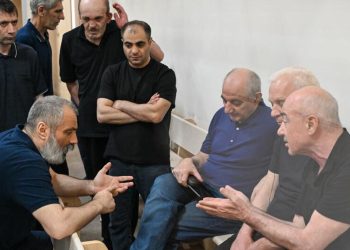
Dozens of Armenian political prisoners — the former leadership of Nagorno‑Karabakh — still languish in Baku’s dungeons. Among them are former presidents Arkady Ghukasyan, Bako Sahakyan, former State Minister Ruben Vardanyan and others. Their trials are being conducted with a complete lack of independent observation and with gross procedural violations. The defendants are kept in isolation, denied adequate medical care and access to lawyers of their choice.
International organizations and member states of the OSCE, the Council of Europe and the UN have repeatedly condemned Azerbaijan, but no effective mechanism for the return of the Armenian population or punishment of the perpetrators has been established.