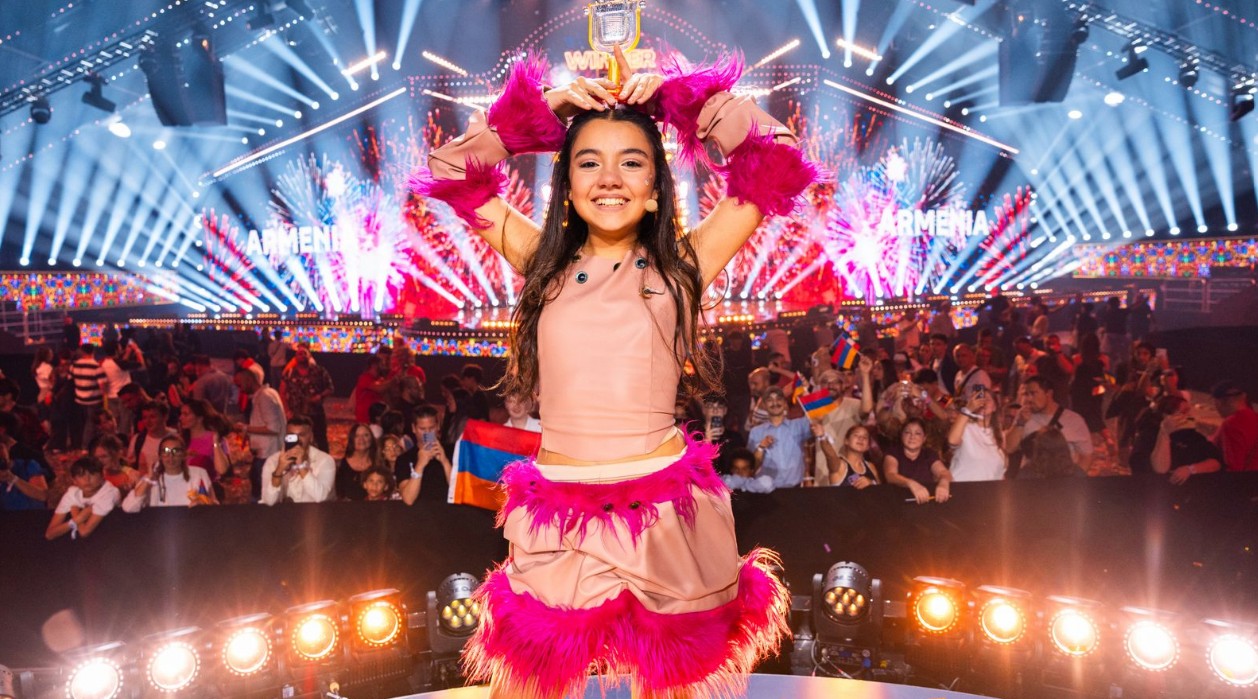
YEREVAN (Realist English). Armenia won the 24th Junior Eurovision Song Contest 2026, the final of which took place on October 24 in Malta. The winner was 13-year-old Naré Kerobyan from Yerevan with the song “BOO!”, scoring a total of 202 points — 103 from national juries and 99 from viewers.
Results
Spain took second place: 10-year-old Lucas Paulano with the song “Cuore Bello (Te Quiero, Te Quiero)” received 184 points. Third was 12-year-old Alec from France with the composition “Comment tu vas ?” — 165 points. In total, 48 young performers from 16 countries participated in the contest, and the show’s audience was about 4,000 spectators at the venue and millions of TV viewers worldwide.
For Armenia, this is the third victory at Junior Eurovision: the country won in 2010 (Vladimir Arzumanyan with the song “Mama”) and in 2021 (Maléna with “Qami Qami”).
Who is Naré
Naré Kerobyan is a 13-year-old singer from Yerevan. She began singing at an early age and has participated in musicals, TV shows, and popular Armenian music projects. She was selected for the contest from more than 100 candidates after auditions in Yerevan.
The authors of the song “BOO!” are Lilit Navasardyan, Grigor Kekchyan, Nick Egibyan, Martin Mirzoyan, and Anush Ter-Gukasyan. The music video for the song had garnered 1 million views on YouTube before the final and remained the leader in this indicator among the competing entries.
Voting
The winner was determined by the results of viewer voting (50%) and national juries (50%). Each jury consisted of three music experts and two children aged 10–15. Armenia received the maximum 12 points from Cyprus and Albania, 10 each from the Netherlands and San Marino, and 8 from France, Malta, and Ukraine.
Naré Kerobyan’s victory is not only a sporting success but also a signal of the quality of the Armenian pop school for children. Armenia consistently ranks among the countries whose representatives at Junior Eurovision reach the top positions: three victories in 15 years is the result of systematic work with young performers, not a one-time stroke of luck.
For the contest itself, the result is also indicative in another sense: Junior Eurovision remains a platform where small countries with limited resources can compete on equal terms with large broadcasters. Armenia, whose budget is incomparable to those of Western European television and radio companies, has once again proven that at this contest it is not scale that decides, but the song and its performance.
A separate question is where the next contest will be held. Unlike the adult Eurovision, victory at the junior contest does not give an automatic right to host: the EBU will work with all broadcasters, including the Armenian AMPTV, to determine the host of the 25th, anniversary contest in 2027. For Armenia, this is a chance, but not a guarantee.