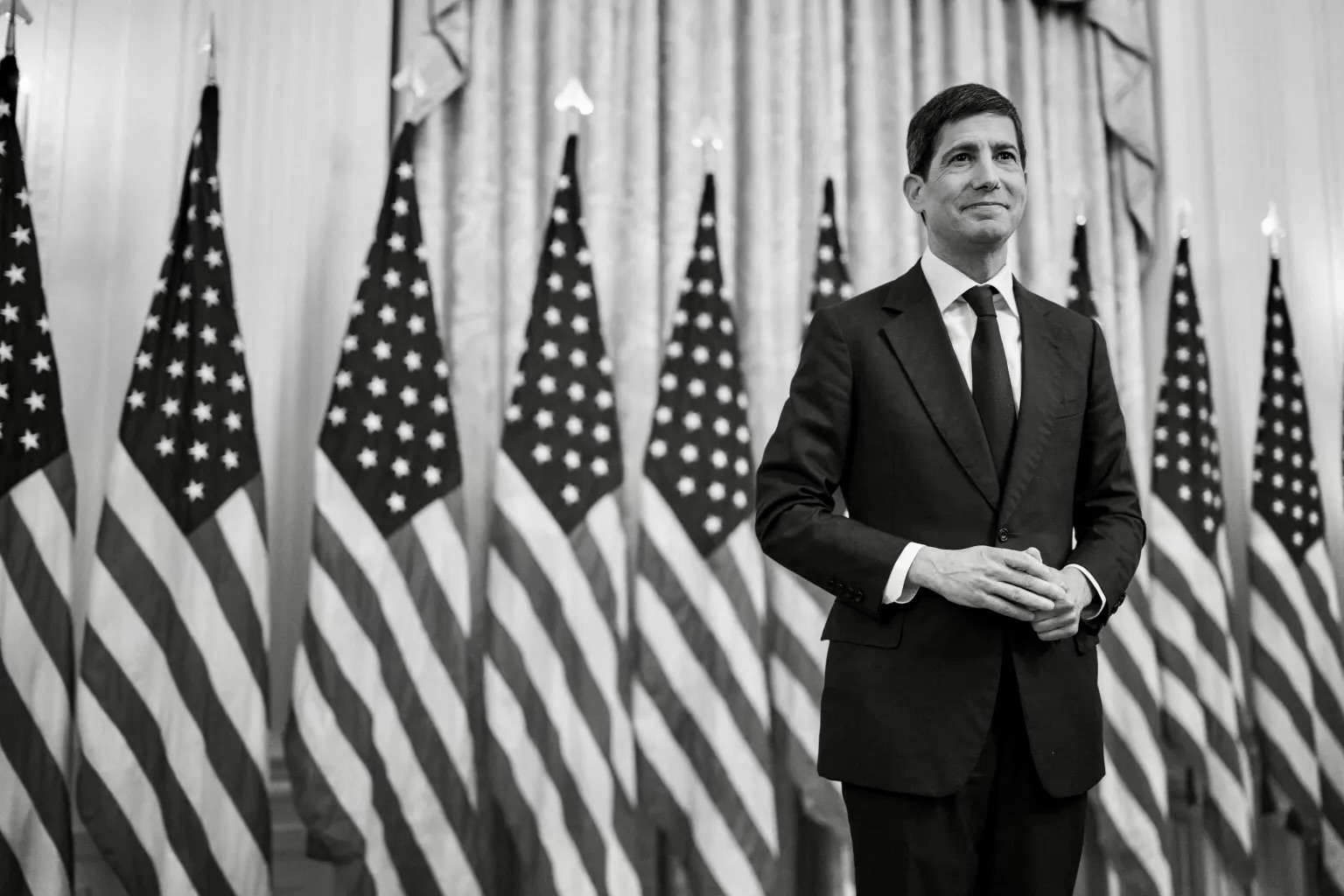
WASHINGTON (Realist English). The US Federal Reserve held its benchmark interest rate steady at 3.50–3.75% following the July meeting, extending its pause to five consecutive months.
However, the decision was not unanimous: for the first time since 2016, three of the 12 members of the Federal Open Market Committee (FOMC) voted against, calling for a quarter‑point hike. Markets reacted with a rout: the Dow Jones Industrial Average plunged more than 2% – its worst performance in a year.
“I asked for a good family discussion – and I got it,” Fed Chairman Kevin Warsh said at a press conference, commenting on the split within the central bank’s leadership.
Three dissenters against the pause
Nine FOMC members voted to hold rates steady. Opposing were three Federal Reserve Bank presidents: Lorie Logan (Dallas), Beth Hammack (Cleveland), and Neel Kashkari (Minneapolis). All insisted on a 25‑basis‑point hike to combat inflation, which has exceeded the 2% target for more than five years.
The dissenters pointed to growing risks: the war with Iran has driven up energy prices, and new tariffs from the Trump administration threaten another round of consumer price increases. “Every month of inflation above target adds to the burden on American household budgets,” Logan said earlier in July.
However, Warsh took a wait‑and‑see stance. According to him, the Fed must exercise “patience” in the face of supply‑driven inflation, which monetary policy cannot directly control.
Market reaction: Dow loses 2%, oil hits rates
The Fed’s decision was broadly expected – the day before, markets had priced only a 32–38% probability of a hike. Nevertheless, volatility proved brutal.
Before the announcement, the Dow was down 1.5% (about 850 points) amid rising oil prices. Brent again topped $90 a barrel after Donald Trump vowed to “hit hard” against Iran in response to an attack on a US base in Jordan.
After the Fed’s decision, losses partially narrowed: the S&P 500 almost fully recovered, while two‑year Treasury yields fell. However, by the close of trading, the Dow had lost more than 1,150 points (about 2.2%), and the Nasdaq nearly 434 points. The S&P 500 remained in the red by 0.48%.
“The market breathed a sigh of relief after the Fed didn’t spring a surprise hike,” said Mark Hackett of Nationwide Investment Management. “But it’s premature to draw final conclusions before Warsh’s press conference.”
Warsh: ‘Markets learn to play ball, not referee’
Kevin Warsh’s remarks became the key driver of volatility. The new Fed chairman, appointed by Trump, has consistently criticised his predecessors for making markets “too dependent on Fed signals” about the direction of rates.
“Markets learn to play ball, not referee,” Warsh said, explaining that the central bank should not dictate market behaviour.
He also rejected the characterisation of the July decision as a “pause.” “I wouldn’t characterise what we did as anything like a pause,” Warsh stressed.
At the same time, he reaffirmed his strong commitment to the inflation target: “There is no soft inflation target. There is only one target – and that is 2%.” The Fed chairman also noted that record investments in artificial intelligence and rising capital expenditures complicate the assessment of productivity and supply.
What’s next: markets price a September hike
Despite the rate hold, markets remain confident that a hike is inevitable. According to CME FedWatch data, the probability of a September rate hike has risen to 76% – a month ago it stood at just 59%. Overall, traders see a 90% probability of at least one hike before the end of the year.
The Fed will continue to rely on data. On Thursday, the first estimates of Q2 GDP growth and the June Personal Consumption Expenditures (PCE) price index – the Fed’s preferred inflation gauge – will be released.
As Tom Porcelli of Wells Fargo noted, “we will move from inflation report to inflation report.” In his view, the Fed will remain in wait‑and‑see mode through year‑end unless inflation accelerates.
Experts also point to five working groups established by Warsh to improve economic data collection – their preliminary findings are expected in September.
“The key question is the Middle East and the price of oil. Six weeks until September is a lifetime in geopolitics,” summed up Tim Holland of Orion Advisor Solutions.
The Fed has chosen patience. But three dissenting votes and the Dow’s plunge serve as a reminder: markets and the central bank are walking on thin ice, and the Middle East and inflation could shatter the fragile balance at any moment.