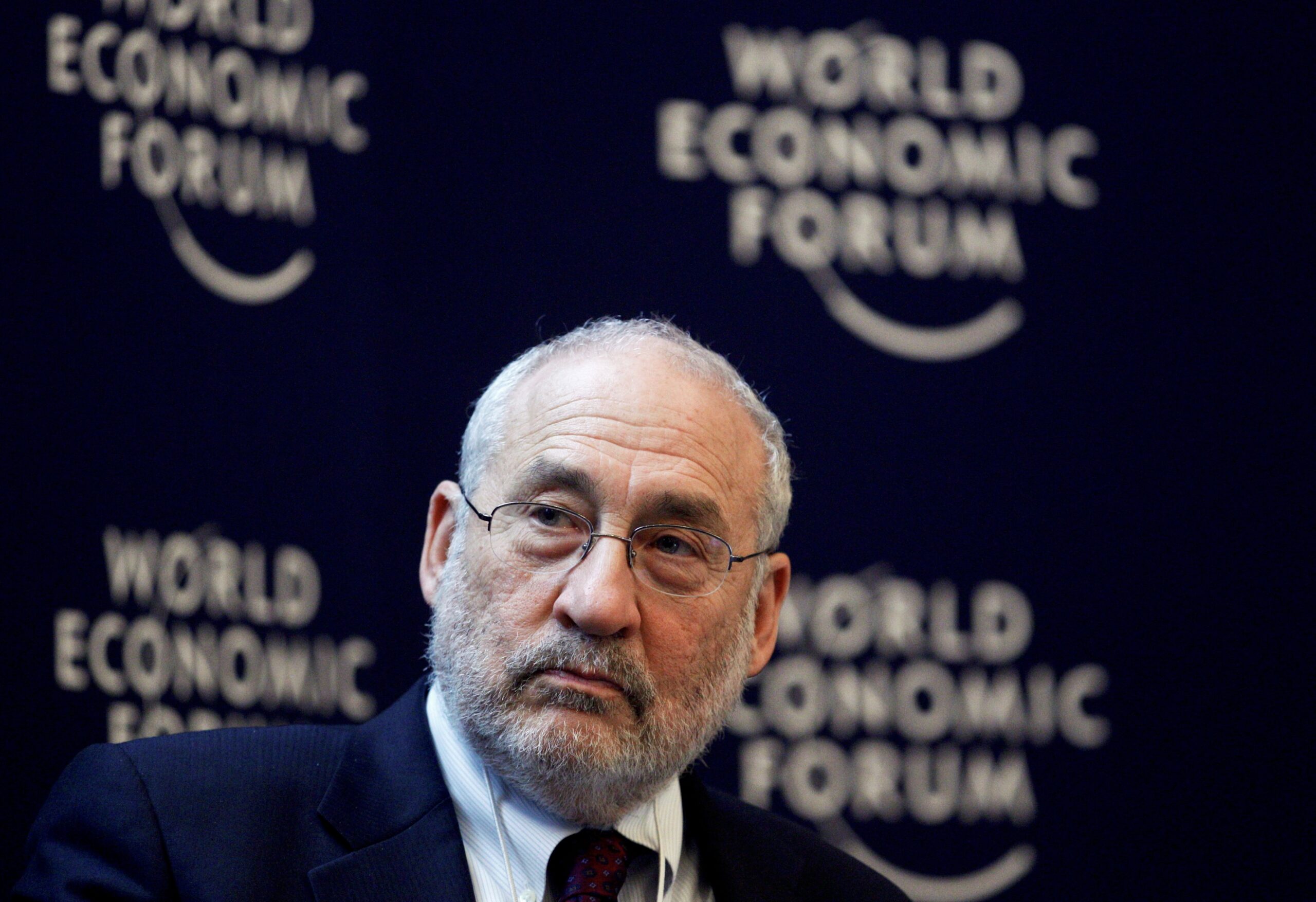
NEW YORK (Realist English). Joseph Stiglitz has spent his career studying how capitalism fails — financial crises, globalization’s broken promises, the slow hollowing out of the middle class. Now, at 83, the Nobel laureate is watching artificial intelligence potentially do the same thing.
In a series of recent interventions — from a March 2026 interview with Fortune to a Financial Times op-ed published this month — Stiglitz has laid out a stark diagnosis and a set of prescriptions for building what he calls a “better AI economy.” The core of his argument: AI is not just another technology wave. It is a force that can erode jobs, concentrate wealth, and hardwire a new era of inequality — unless governments act to manage the transition.
The Bubble and the Displacement
Stiglitz holds two ideas simultaneously. The first: an AI bubble is building, it will likely burst, and it will hurt the macroeconomy. The second: survive that transition, and the technology that threatens your job today may end up becoming your most useful co-worker.
“Our economy is right now being supported by AI investment — the AI bubble,” Stiglitz told Fortune. “Like a third of the growth, or the non-growth, that we had last year was based on AI”. That short-run boost is real. But it rests on a foundation that cannot hold. The market believes high returns are predicated on two assumptions: that AI will be technologically successful, and that there will be limited competition. The problem, Stiglitz argues, is that global competition in AI is already fierce. “If it’s technologically successful, but there’s a lot of competition, profits will be driven down to zero, and they will not get the returns that they expect”.
When that realization hits, the fallout will not be gentle. “If I’m right and there is this bubble, then the breaking of any bubble is really bad in the short term for the macroeconomy”. That collapse, if it comes, would arrive while AI is simultaneously displacing workers across the economy — a worst-of-both-worlds scenario Stiglitz does not think is far-fetched. “We do not have the macro or micro framework for managing that kind of displacement,” he said. “No active labor-market policies. No large-scale retraining infrastructure. No industrial strategy to create the next round of good jobs in the places where old ones are disappearing”.
The Inequality Machine
Stiglitz’s deeper concern is not the bubble but what AI does to the distribution of wealth and power. AI lets firms strip labor out of production, concentrate profits at the top, and push the risks of transition onto workers and the public — exactly the trajectory he warned about in his 2024 book, The Road to Freedom: Economics and the Good Society.
“If we don’t do anything about managing AI, there is a threat that it will lead to more inequality,” he said. “And since inequality is such a bad, serious problem in our society, that is a great concern to me”.
The very people driving AI adoption are simultaneously leading the charge to shrink the governmental institutions that could cushion AI’s disruption. Tech billionaires like David Sacks, Elon Musk, and Mark Zuckerberg successfully campaigned President Donald Trump not to issue an executive order on AI in May 2026. “Unfortunately, the tech bros, who are obviously advocates of this, are at the same time pushing for smaller government, which will undermine the ability of the government to do exactly what is needed in order to make a successful transition,” Stiglitz said. “They are creating the conditions that make it impossible for a successful AI transition”.
The ‘Tech Bro’ Class and the Dual Economy
What the tech industry has laid out, Stiglitz argues, is basically what development economists describe as a dual economy: a few trillionaires garner an increasing share of the nation’s wealth while the vast majority struggle. Meanwhile, the industry is using its political muscle to push back on taxes that might provide for better public services or a more adequate universal basic income (UBI).
Stiglitz is skeptical of UBI as a solution. He calls it “a glorified welfare system in which everyone gets a cheque from the government” — one that takes away individuals’ dignity from work and, given the tech sector’s opposition to paying taxes, will produce only “measly” cheques.
The Information Ecosystem
Beyond labor and inequality, Stiglitz warns of a third, quieter threat: AI’s impact on the information ecosystem itself. Information is a public good, but most information is privately provided. AI is trained on privately produced data — yet its results may decrease the ability of private producers of information to appropriate returns from what they produce, or even to have a viable business.
The New York Times lawsuit against OpenAI for scraping large amounts of valuable content without fair compensation is a prime example. AI training practices threaten quality information production, while AI simultaneously contributes to information pollution by enabling mass production of low-quality content. Social media platforms exacerbate this by prioritizing controversial content for engagement — “engagement through enragement”.
Steering Technological Progress
Stiglitz’s prescriptions are not merely defensive. In a paper with Anton Korinek, “Steering Technological Progress,” he asks how to guide innovative efforts so as to increase labor demand and create better-paying jobs, rather than diminish it. The paper challenges “technological fatalism” — the idea that technological advancement is an inevitable force beyond our control.
The policy toolkit he and others advocate includes:
| Policy Area | Prescription |
| Antitrust | Stronger measures to break data monopolies and prevent AI from consolidating power in a few dominant corporations |
| Intellectual property | Stronger IP protection and fair compensation for data creators |
| Taxation | Fair taxation systems that capture a share of AI-generated value for public purposes |
| Regulation | Enhanced regulatory oversight, with the EU’s Digital Markets Act as a model |
| Labor market | Large-scale retraining programs, active labor-market policies, and an industrial strategy to create good jobs |
| Public goods | Treating AI as a global public good, with government platforms and market competition balanced |
Stiglitz has praised open-source AI ecosystems like DeepSeek for their potential to weaken market monopolies and mitigate inequality. He also emphasizes that AI should be a global public good — noting that smaller countries can also develop impactful platforms.
Managed Transition or Managed Decline
Stiglitz’s message is neither Luddite nor technophiliac. He acknowledges AI’s potential in medical research and cognitive advancement. He likens his own use of AI to “IA” — intelligence assisting — and says AI will supplement our labor in the future, with plumbing as a prime example.
But he is clear that technological success alone will not suffice. “Precisely because of this disruption,” he writes in the Financial Times, “technological success alone is not going to suffice”. The AI transition must be managed — and the institutions to manage it do not currently exist at anything close to the scale needed.
The alternative — what Stiglitz calls a dual economy of trillionaires and struggling masses, with an information ecosystem degraded by pollution and a macroeconomy undermined by inequality — is not a future anyone should accept. But avoiding it requires something the tech industry has consistently opposed: active, effective government.
The question is not whether AI will transform the economy. It is whether that transformation will be managed for the many or captured by the few.