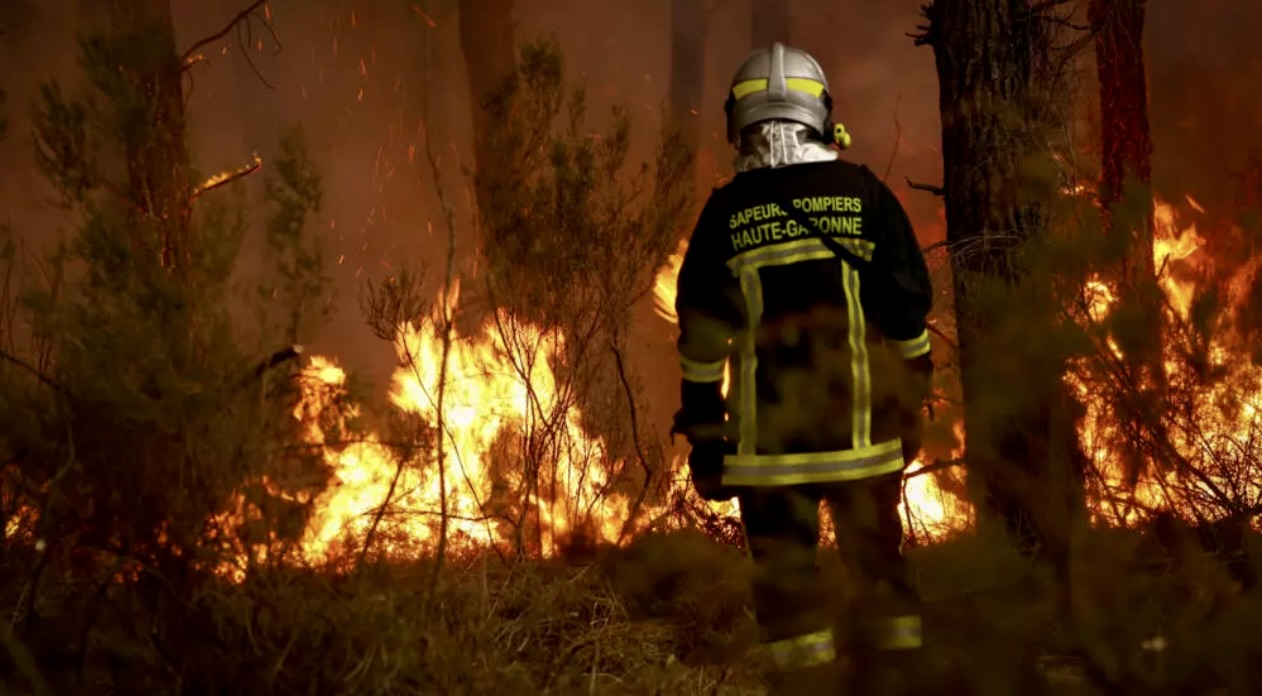
PARIS / MADRID (Realist English). Europe is experiencing one of the largest natural disasters in its recent history. The forest fires in France and Spain, which have been dubbed the “worst” since World War II, have forced more than 330,000 people to flee their homes.
The flames have destroyed tens of thousands of hectares of forest, come within striking distance of Bordeaux and Madrid, and emergency services are bracing for a new challenge — a fourth heatwave set to hit the continent this week.
French President Emmanuel Macron called the situation the “most severe” since World War II. “We must hold on. We will win this battle together. The whole nation stands behind you,” he said, addressing firefighters in Bordeaux.
France: Fire at the Gates of Bordeaux and “Firestorms”
In southwestern France, in the departments of Gironde and Landes, the blaze has spiralled out of control. The fire, which started last week on the Atlantic coast, is now just 15 kilometres from the outskirts of the Bordeaux metropolitan area. Mayor Thomas Cazenave said that while an evacuation of the 850,000 residents is not yet planned, the situation remains extremely tense.
Interior Minister Laurent Nuñez described the situation as “very unfavourable,” noting that the fire is moving towards the city “unpredictably.”
Since the start of 2026, around 98,000 hectares of forest have burned in France. In Gironde alone, 42,000 hectares have been destroyed — one of the largest forest fires since World War II. At least 240 homes have been lost.
Unprecedented Phenomenon: “Firestorms”
The French fires have generated a meteorological phenomenon never before seen in the country — a “pyrocumulonimbus,” or firestorm cloud. As explained by France’s National Federation of Firefighters, this giant firestorm feeds on its own winds and lightning, which in turn spark new blazes.
Federation spokesman Eric Brocardi compared fighting the fire to “David and Goliath”: “We don’t know how the fire will spread; the front is constantly shifting. We cannot fight it head‑on.” According to him, bringing the disaster under control would require “three days of heavy rain.”
Evacuation Scale in France
About 220,000 people, including tourists and residents, have been evacuated from southwestern France. Authorities have urged tourists not to travel to the affected areas. Gironde Prefect Sophie Brocas said: “I urge tourists not to come.”
Meanwhile, Minister for International Partnerships Éléonore Caroix called on tourists not to cancel trips, stressing that most of the country remains untouched.
Some 2,500 firefighters, 1,500 military personnel, and 1,200 police officers are deployed to fight the blazes.
Spain: Largest Fire in History Near Madrid
In Spain, the fire has struck the capital region. Blazes are raging in the provinces of Madrid, Ávila, and Toledo, which authorities have called the largest in the country’s modern history. Three major fire fronts west of Madrid have merged into a single giant blaze.
More than 77,000 hectares have already burned in Spain. In Ávila province alone, the fire has destroyed over 50,000 hectares. Spain’s Minister for Ecological Transition Sara Aagesen called this fire the largest in the country’s modern history.
Evacuation: 63,000 People Near Madrid
According to Spain’s Interior Ministry, at least 63,000 people have been evacuated from the disaster zone. In the Madrid region, 32,000 people have been evacuated, while more than 19,000 have been ordered to stay indoors. In Ávila province, over 5,000 people have been evacuated.
In total, more than 100,000 people in Spain have been evacuated or ordered to shelter in place.
The Threat of Civil War “Legacy”
In the province of Castellón in eastern Spain, the situation is complicated by a unique threat: the fire zone contains old munitions from the Spanish Civil War (1936–1939), which are exploding in the flames, creating additional danger for firefighters. Over 6,500 hectares have burned there this week.
Prime Minister Pedro Sánchez, who visited the disaster area, announced plans to declare a state of emergency in the affected provinces, which would unlock additional funds for recovery.
Causes: “Perfect Storm” and Climate Crisis
The disaster is the result of a combination of extreme heat, months of drought, and strong winds. Western Europe is experiencing its third heatwave of the summer, with a fourth already on the way. In Bordeaux and Ávila, average July temperatures have reached 32°C — nearly 6°C above the 1961–1990 norm.
As Prime Minister Sánchez said: “What we are experiencing is not a series of isolated events. It is the most painful manifestation of the climate emergency.”
According to the European Forest Fire Information System (EFFIS), 2025 was the worst year for Europe since records began in 2006. However, 2026 is already breaking records: more land has burned in France than in all of 2025, and the Spanish fires are outpacing last year’s trajectory.
International Assistance
The European Union has activated its civil protection mechanism. Greece and Italy have dispatched Canadair amphibious aircraft to Spain, while Portugal has sent more than 100 military personnel. France will receive two firefighting aircraft from Croatia, two more from Portugal, and two heavy Black Hawk helicopters from the Czech Republic and Slovakia.
Rescuers are preparing for the worst. As Spanish Interior Minister Fernando Grande‑Marlaska said: “Today and tomorrow are critical for bringing this fire under control. From Wednesday onwards, the weather forecast becomes very unfavourable.”
French authorities warn that the fires could burn for several more months before being fully extinguished. Finance Minister Roland Lescure called the damage to the regional economy, including the wine and tourism industries, a “thunderbolt” for a region already facing tough times.
Europe, still recovering from last year’s record fires, is once again in the grip of the flames. And, judging by the forecasts, the worst is yet to come.