BERLIN (Realist English). The historic victory of the far-right Alternative for Germany (AfD) in the Saxony-Anhalt state elections has dealt a blow to Germany’s plans for economic renewal.
Although the AfD did not secure an absolute majority, its result of 43.8% — double that of five years ago — has seriously damaged Chancellor Friedrich Merz’s position and intensified political instability, which is already forcing German businesses to reconsider investment plans and warning of “high damage” to the economy.
“Political Earthquake”: AfD Doubles Its Result, CDU Loses Half Its Support
In the Saxony-Anhalt elections on September 6, the AfD won 43.8% of the vote — its best-ever result at the state level. Chancellor Merz’s Christian Democratic Union (CDU) collapsed to 17.2% — half its 2021 result and the party’s worst performance in the region. The Social Democrats took 9.3%, the Greens 8.9%, and the Left Party 8.6%.
The AfD won 39 of 83 seats in the state parliament, falling three seats short of an absolute majority. Yet even without it, the result was a “political earthquake”: for the first time since 1945, a far-right party has a real chance of leading a German state government.
Turnout reached a record 77.8% — 17.5 percentage points higher than five years ago.
“A Signal for All of Germany”: Reactions from AfD and Merz
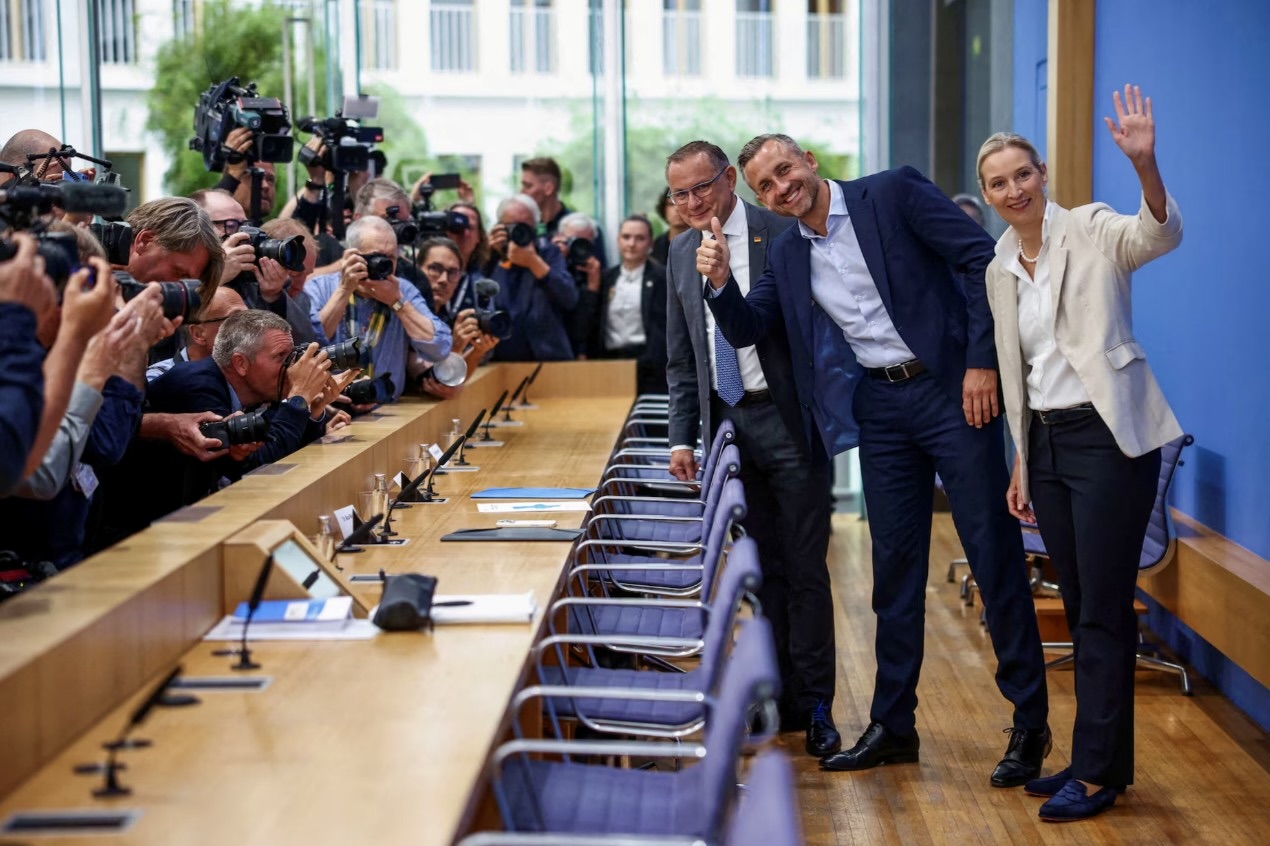
The AfD’s leader in Saxony-Anhalt, 35-year-old former marketer Ulrich Siegmund, declared: “We have made history. This is a signal for all of Germany.” Party co-leader Alice Weidel called the result “sensational” and claimed a “clear mandate to govern.”
Chancellor Friedrich Merz admitted the defeat was “deeply shocking”: “This is the heaviest defeat the CDU has suffered in years, in decades. Naturally, it will have consequences.” He also acknowledged that his own low approval ratings played a role: “I know that I personally was a constant theme in this campaign.”
“High Damage for Germany”: Business Warns of Consequences
The business community’s reaction was swift and concerned. Alexander von Preen, president of the German Retail Association (HDE), stated: “A policy of isolation and exclusion leads nowhere. I fear high damage to Germany as a business location if potential skilled workers from abroad now fear coming to us.”
Steffen Kampeter, president of the Confederation of German Employers’ Associations (BDA), stressed: “A climate of isolation is poison for a business location.”
Peter Adrian, president of the German Chamber of Commerce and Industry (DIHK), urged the government to act urgently: “We don’t need new analyses but effective implementation of decisions by the end of the year that will make our economy more competitive.”
Moritz Krämer, chief economist at Landesbank Baden-Württemberg, noted the signalling effect for foreign investors: “This has a certain flavour that one would rather not have.” Marcel Fratzscher, president of the German Institute for Economic Research, warned that “a disputed or weak state government and polarisation during the campaign will accelerate the outflow of people and companies from Saxony-Anhalt.”
Saxony-Anhalt: An Economically Weak Region as the Epicentre of Discontent
Saxony-Anhalt is a small state with a population of about 2.1 million, located west of Berlin. It accounts for less than 2% of Germany’s economy. The region has long suffered from low incomes and population decline, which experts say created fertile ground for protest voting.
The AfD’s victory is already raising questions about the future of major investment projects. In July 2025, Intel abandoned plans to build a €30 billion semiconductor plant in the region.
Fragile Recovery: Germany’s Economy at a Crossroads
The AfD’s victory comes amid contradictory economic signals. On the one hand, Germany’s leading economic institutes have raised their growth forecasts for 2026: Ifo expects 1.4%, the Kiel Institute and RWI 1.3%. The KfW-ifo business climate index for small and medium-sized enterprises rose for the fourth consecutive month, and export expectations of large companies jumped by 21.4 points.
On the other hand, FAZ warns: “The drama of suddenly positive forecasts is not that the economy might grow by 1.3%. The drama is that momentum must weaken significantly by 2028.” The recovery remains fragile and depends on government spending and exports, not on sustained domestic demand.
| Indicator | Value |
| AfD result (Saxony-Anhalt) | 43.8% (+23 p.p. vs 2021) |
| CDU result | 17.2% (-19.9 p.p.) |
| Turnout | 77.8% (record) |
| Germany GDP growth forecast 2026 | 1.3–1.4% |
| KfW-ifo business climate index (August) | -12.5 (fourth consecutive rise) |
Three Questions Will Determine Germany’s Future
First: can the AfD form a government in Saxony-Anhalt with the BSW, or will the “firewall” of traditional parties hold, plunging the state into paralysis?
Second: will the earthquake in a weak eastern region have a cascading effect on Berlin, undermining structural reforms?
Third: will the AfD’s victory signal to investors and skilled workers a move toward isolation — or will German industry weather the shocks? The answers will emerge in the coming weeks.