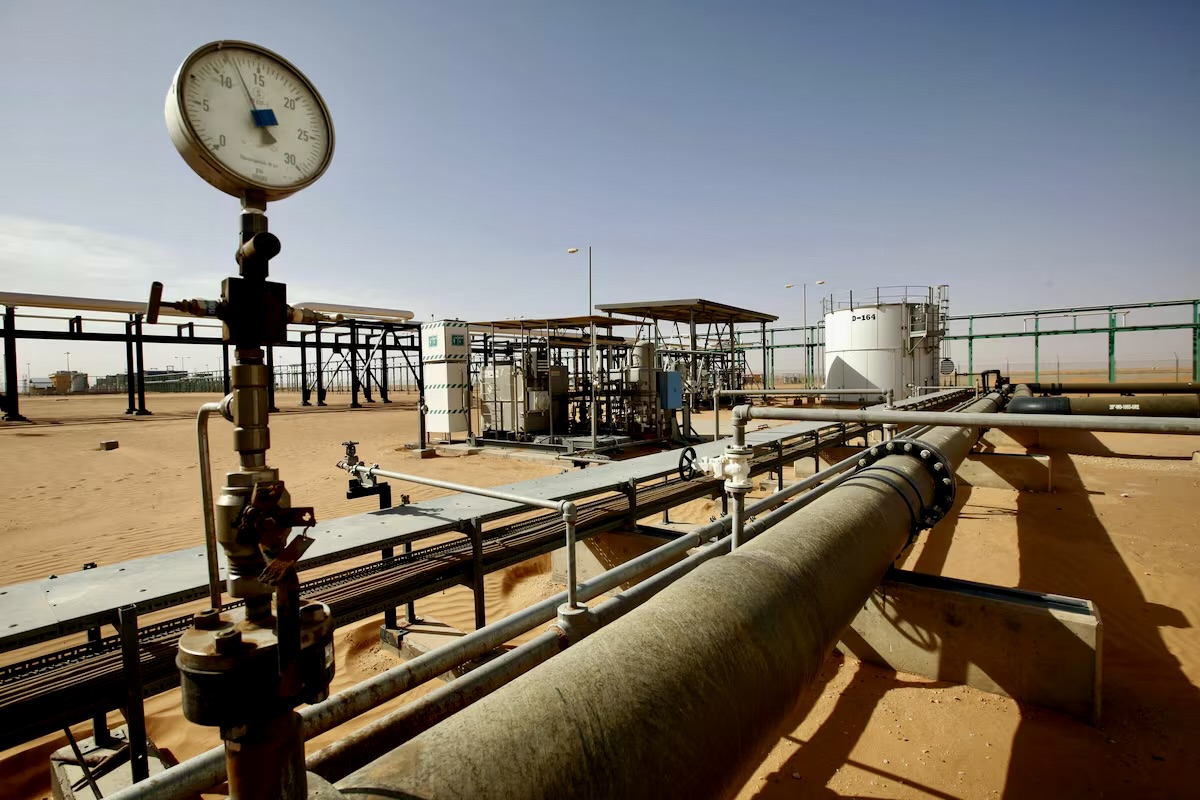
TRIPOLI (Realist English). Libya, which holds Africa’s largest proven oil reserves, has announced plans to attract up to $40 billion in foreign investment to develop its oil and gas sector. In an interview with the Financial Times, the head of Libya’s National Oil Corporation (NOC), Masoud Suleiman, said the country needs between $30 billion and $40 billion to develop more than 60 already discovered but undeveloped oil and gas fields.
“We have a lot of undeveloped resources. We need significant funds,” Suleiman said. According to him, Libya’s “ambitious but realistic goal” is to increase production from the current 1.4 million barrels per day to 2 million barrels per day by 2030.
The current production level of about 1.4 million barrels per day is still far from pre‑war levels: the country has not been able to restore the volumes achieved before the overthrow of Muammar Gaddafi in 2011.
Outdated model: NOC cannot fund its share
One of the main obstacles to increasing production is the financing structure itself. The current model, built on production‑sharing agreements, requires state‑owned NOC to fund its share of field development costs. However, due to chronic delays in state funding, projects become vulnerable.
“We suffer from a lack of funds, and this severely delays our development projects,” Suleiman admitted.
As a result, NOC is considering a return to a concession model, under which investors would bear the bulk of the upfront costs. “We are assessing the prospects of changing the business model between NOC and international partners,” the corporation’s head noted.
Political instability and infrastructure attacks
The main deterrent for investors remains political instability. Libya is effectively divided between two governments: one in Tripoli (recognised by the UN) and one in Benghazi in the east, where military leader Khalifa Haftar holds sway. Most of the largest oil fields and export terminals are in territories controlled by Haftar, whose armed forces periodically block production and exports.
Last week, the Zawiya refinery complex was attacked by kamikaze drones: several fuel storage tanks caught fire, one of them – containing about 4.5 million litres of petrol – collapsed. The attacks also damaged an electrical substation, causing widespread power outages in the Zawiya area. US company GE suspended operations at a nearby power plant and withdrew technical teams due to security threats.
Suleiman, however, assured that the attacks were “geographically limited” and carried out by a “small group of criminals.” All oil and gas investment facilities, he said, “are located far from tension zones and under reliable protection.”
International companies return
Despite the risks, Libya is stepping up efforts to attract foreign investment. In February 2026, NOC held its first exploration licensing round since 2007, awarding concessions in the Sirte and Murzuq basins. In June, NOC signed exploration and production agreements with Eni, QatarEnergy, Repsol, MOL and the Turkish Petroleum Corporation. BP, Shell, Exxon and Chevron are also returning to Libya as the situation stabilises.
| Company | Status in Libya |
| Eni | New exploration and production agreement (June 2026) |
| QatarEnergy | New exploration and production agreement (June 2026) |
| Repsol | New exploration and production agreement (June 2026) |
| MOL | New exploration and production agreement (June 2026) |
| TotalEnergies | 25‑year, $20 billion agreement (January 2026) |
| ConocoPhillips | 25‑year, $20 billion agreement (January 2026) |
| BP, Shell, Exxon, Chevron | Returning to Libya |
Earlier, in January 2026, Libya signed a 25‑year agreement with France’s TotalEnergies and US‑based ConocoPhillips worth more than $20 billion to increase production through the Waha Oil Company subsidiary by 850,000 barrels per day. The project is expected to generate net revenues of $376 billion for the state.
In July 2026, the eastern Libyan authorities also offered Russian companies the opportunity to build refineries in the country.
Libya finds itself in the classic trap of a developing oil economy: resources exist, money is lacking, and political instability scares off the investors without whom those resources cannot be developed. A shift to a concession model could relieve NOC of the funding burden, but it requires political will and stability – both of which remain in short supply in a divided Libya.
As Suleiman put it, “the era of funding delays that created problems for us and our partners is over.” However, the recent attacks on the Zawiya refinery and the continued split between Tripoli and Benghazi show that investor confidence in Libya remains fragile. The question is whether the country can attract the necessary $40 billion before the next wave of violence once again forces the “big oil” to leave.