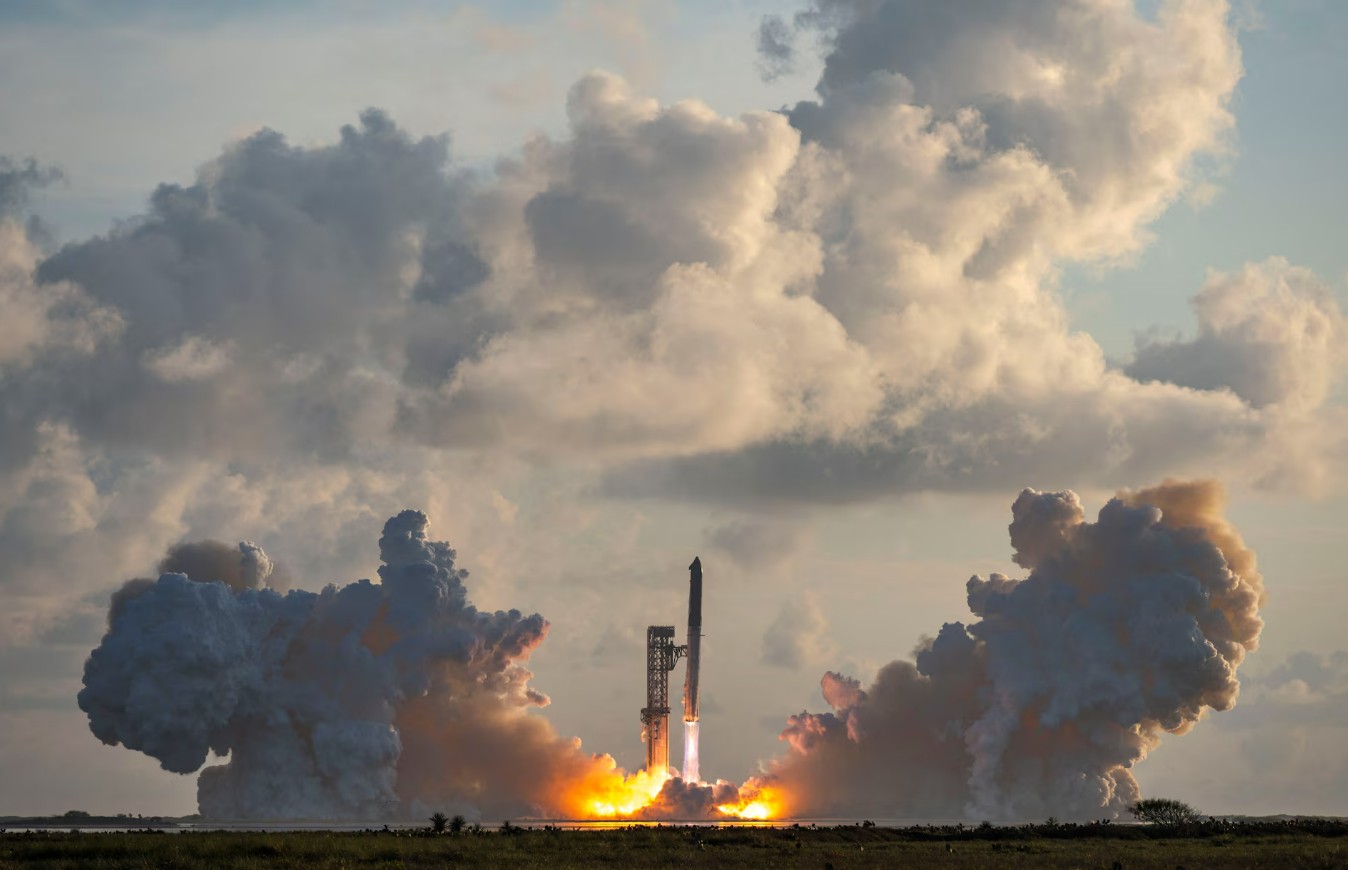
LONDON (Realist English). On September 28, SpaceX successfully launched Starship from Starbase in southern Texas, putting it into Earth orbit for the first time. The black-and-silver giant rocket, about 124 meters tall, lifted off at approximately 8:48 a.m. local time (12:48 GMT) and reached orbit in about 26 minutes.
Mission Overview
This flight was the 14th full test of Starship and the first attempt to carry out a full orbital mission. The spacecraft is carrying 26 Starlink V3 satellites — Starship is serving as a delivery vehicle for a real payload for the first time. According to SpaceX, each V3 satellite can add up to 1 Tbit/s of bandwidth capacity, and the entire batch is capable of increasing the Starlink network’s capacity by 26 Tbit/s.
The spacecraft is expected to complete 6 orbits around Earth at an altitude of about 275 kilometers over nearly 10 hours, after which it will perform a braking burn, re-enter the atmosphere, and splash down in the Pacific Ocean west of Chile. The super-heavy booster separated from the spacecraft shortly after liftoff and splashed down in the Gulf of Mexico.
Engine Failure During Flight
Shortly after launch, one of the spacecraft’s six Raptor engines shut down prematurely, and the super-heavy booster also lost one engine during its boostback burn.
This forced the mission control team to consider abandoning the attempt to reach orbit. However, after evaluating the data, engineers confirmed that the three central engines — the most critical for orbital insertion and the subsequent braking burn — were in good condition, and ultimately approved the maneuver.
SpaceX confirmed on social media: “Starship completed its orbital insertion burn, reaching Earth orbit for the first time.” The spacecraft’s velocity at orbital insertion was about 26,371 km/h, at an altitude of about 277 kilometers.
Key Subsequent Tests
Satellite deployment began after orbital insertion: 26 Starlink satellites were released over about 30 minutes, and SpaceX confirmed contact with all of them. The spacecraft must then undergo prolonged orbital operations, a controlled deorbit, and atmospheric re-entry, with thermal protection during re-entry being critically important.
SpaceX engineers had previously noted that during orbital re-entry, the thermal protection system will be subjected to higher temperatures than during suborbital tests — possibly exceeding 1,370 degrees Celsius. Previous flight imagery showed signs of ablation on the heat shield. The company has made changes based on inspections of returned spacecraft.
Strategic Significance
Starship’s orbital insertion is a key step in proving to NASA that SpaceX can provide reliable crewed lunar landing capability. The Artemis III mission could take place as early as next summer and involves a triple docking of the Orion spacecraft with a lunar lander in Earth orbit.
Starship from SpaceX and the Blue Moon lander from Blue Origin will participate in the docking sequentially; the Artemis IV mission plans to land astronauts on the Moon by 2028.
SpaceX President Elon Musk has previously stated that the ultimate goal of Starship is a significant reduction in launch costs and the achievement of full reusability. The company plans to gradually replace the Falcon 9 rocket with Starship in the coming years and to build a second Starship launch pad at the Kennedy Space Center in Florida; a third pad is planned in Louisiana.
Starship first flew in full configuration in 2023; the previous 13 missions were suborbital and repeatedly ended in explosions. The successful orbital insertion on Flight 14 marked a key step for the program from the “test verification” stage to the “actual operations” stage.