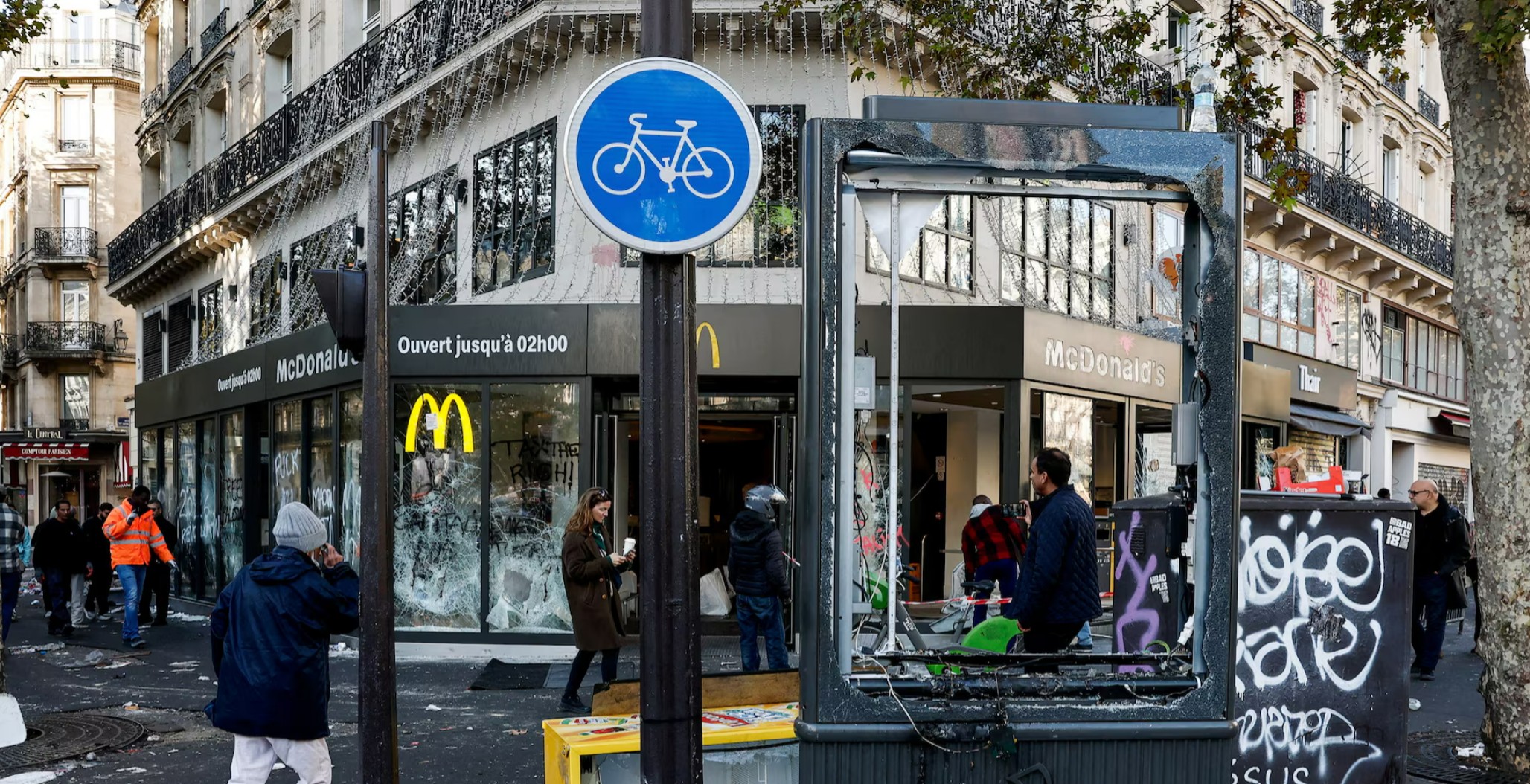
PARIS (Realist English). The wave of violence that swept across France in October was the result of several overlapping crisis factors: rising living costs, stagnation of public services and accumulated social discontent.
According to Reuters, whose journalists reviewed dozens of video recordings of clashes, attended court hearings involving 26 defendants and interviewed more than 50 officials, police officers, lawyers and protest participants, the movement went from local school strikes to a nationwide explosion.
From school strikes to a nationwide explosion
The starting point was an issue far removed from big politics: in September 2026, middle school students began protests against deteriorating learning conditions.
However, by 17 October they were joined by trade unions, activists of the “yellow vests” movement, as well as parents and teachers. The trigger was rising fuel prices, the general rise in the cost of living and the 2027 budget draft. That day, according to various estimates, between 550,000 and 800,000 people took to the streets across the country.
It was on 17 October that peaceful marches turned into pogroms. In Paris, Marseille and Lyon, police lost control of entire districts, which passed to looters and radicals. In Limoges (central France), a crowd set fire to a 140-year-old town hall building, causing the bell tower to collapse. The government blamed “far-left radicals” and “opportunistic criminals” who took advantage of the protests for their own purposes.
The authorities’ response: toughness instead of de-escalation
The government’s reaction, according to observers, only added fuel to the fire. On the one hand, unprecedented security measures were introduced: a curfew in central Paris and other cities, a ban on unauthorized gatherings, and 70,000 police officers and gendarmes deployed to the streets.
On the other hand, police actions provoked a new wave of discontent. Since the start of the protests, internal oversight bodies of the Interior Ministry have launched 161 investigations into alleged excessive use of force by police.
Injuries among young people caused particular resonance. According to Reuters and BBC, at least one demonstrator lost a hand as a result of the explosion of a police grenade used to disperse crowds, and several others suffered serious injuries, including loss of eyes.
The Office of the UN High Commissioner for Human Rights expressed concern over the arrest of nearly 7,000 minors during school blockades, calling such measures disproportionate. Footage of special forces beating teenagers with batons increased support for students among a wide range of social groups — from parents to left-wing politicians and trade unions.
The cost of the unrest: arrests, injuries and hundreds of millions in damage
The scale of the consequences proved significant. According to data as of mid-November, 4,900 people had been detained across the country since 17 October. During the first weekend of unrest alone, about 1,000 law enforcement officers were injured.
The number of damaged or looted commercial properties is estimated at between 1,500 and 3,000. The French Chamber of Commerce and Industry estimated direct damage to business at “hundreds of millions of euros.” The government promised to compensate affected municipalities and entrepreneurs for the damage, and to subsequently recover the costs from those responsible for the violence.
Interior Minister Laurent Nunez admitted that the authorities “did not foresee the scale” of the violence on 17 October and offered his resignation to the president, which was rejected. Emmanuel Macron himself acknowledged “failures” in the preparations, but condemned “unbridled violence” and promised that those responsible would be held accountable.
Political context: protest as a vote of no confidence
The unrest is occurring at an extremely inconvenient moment for the authorities. Macron, who has been in power since 2017, will leave office in 2027, and the current wave of discontent is becoming a litmus test of problems accumulated over a decade: a weakening economy and rising public debt.
Polls and analysts’ statements indicate that the movement has a distinctly anti-Macron character: slogans against the cost of living quickly transformed into demands for the government’s resignation.
In addition, the situation is complicated by new factors. Starting on 24 October, far-right groups clashed with protesters in several cities, declaring their intention to “protect business.” This creates a risk of further polarization and escalation of violence along ideological lines.
Limits and risks
As analysts note, the key question remains whether the government will be able to restore control without resorting to further tightening of measures. For now, the authorities are relying on a forceful response and criminal prosecution, while trade unions and the “yellow vests” are already announcing new actions, including a general strike on 5 November.
In conditions where Macron’s presidential term is coming to an end and trust in state institutions has been undermined, the French street remains one of the main political players — and, as October showed, it is capable of setting the agenda faster than parliament or the Élysée Palace.