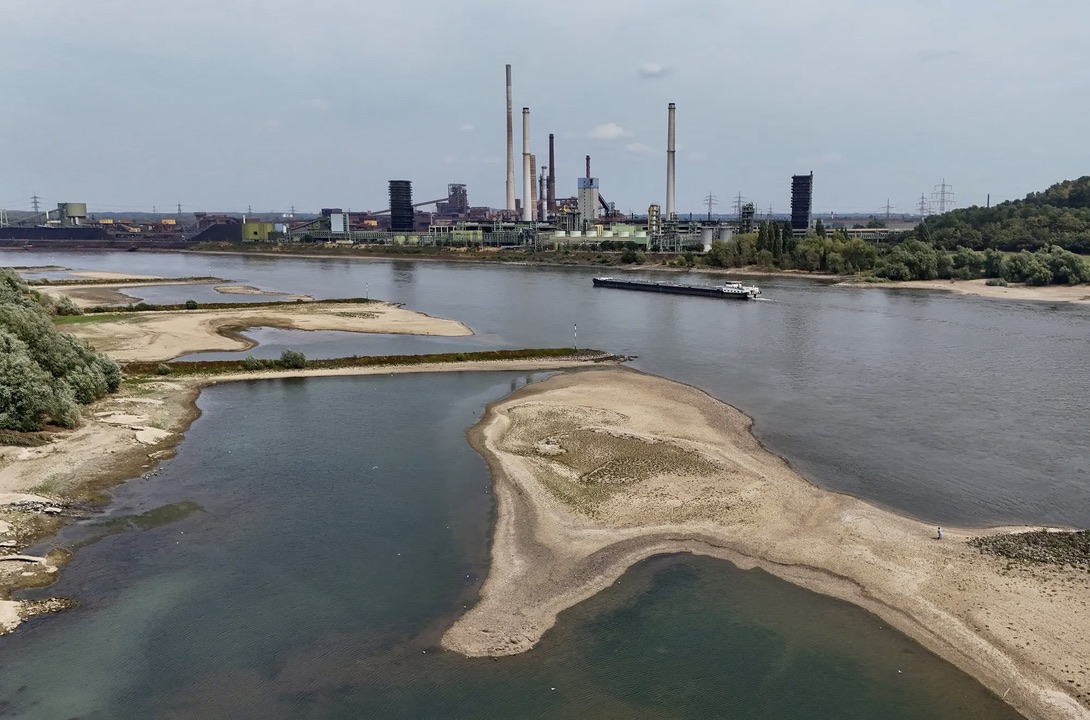
FRANKFURT (Realist English). Europe is facing one of the most serious challenges to its industry in decades. The water level in the Rhine, the continent’s main transport artery, has fallen to its lowest level since records began in 1880.
On 3 August, at the key measuring point of Kaub (western Germany), the water level stood at just 24 centimetres. According to forecasts from Germany’s Federal Waterways and Shipping Administration, it could drop to 18 centimetres by the end of the week, which would be an absolute historical low.
Historic low amid scorching heatwave
The cause of the crisis is a prolonged scorching heatwave and drought sweeping across Europe. The fourth heatwave this summer has caused the continent’s major rivers — the Rhine, Danube and Po — to shrink rapidly. At Kaub, the water level dropped to 25 cm on Friday, matching the 2018 drought record, then fell further to 24 cm on Monday.
The speed of the decline is particularly alarming. On 1 August, the water level at Kaub was still around 35 cm, but by Friday it is expected to fall to 20 cm. Duisburg‑Ruhrort, Düsseldorf and Cologne have also recorded historic lows. At Ruhrort, the water level dropped to 149 cm, two centimetres below the previous record set in August 2022.
Shipping on the brink: just 20% cargo and triple the cost
The falling water levels in the Rhine, which stretches 800 miles from the Swiss Alps to the North Sea, have already caused serious shipping disruptions. To be fully loaded, vessels require a depth of about 1.5 metres at Kaub.
Barges are now forced to carry only about 20% of their normal capacity to avoid running aground. Some vessels are unable to sail at all due to technical constraints.
This has triggered a sharp surge in transport costs. The cost of shipping diesel from Rotterdam to Karlsruhe via the Rhine rose to its highest level since data collection began in 2009.
According to traders, tanker transport costs from Rotterdam to Karlsruhe rose from €45 per tonne at the end of June to €145–150 per tonne by early August.
German economy at risk: up to 0.2% of GDP lost
The Rhine is a vital transport artery linking the port of Rotterdam with Germany’s industrial heartland. It carries coal, oil products, chemicals, iron ore, grain and container cargo. Any disruption directly threatens German industry.
According to economist Stefan Kooths from the Kiel Institute for the World Economy (IfW), low water levels on the Rhine could reduce Germany’s GDP growth in the third quarter by 0.1–0.2 percentage points. Given that economic growth was already estimated at just 0.2%, this means a risk of near‑stagnation. In monetary terms, losses could range from €10 to €20 billion.
Some companies, such as chemical giant BASF, have developed alternative supply routes since the 2018 crisis. However, even they admit the situation remains worrying. The share of inland shipping in Germany’s total freight transport fell from 4.7% in 2017 to 4.1% in 2024. Compounding the problem is the closure for modernisation of the railway line along the Rhine’s eastern bank until mid‑December 2026, which limits the ability to shift cargo to rail.
Crisis on other rivers: Danube and Po also at historic lows
The Rhine’s shrinkage is only part of a Europe‑wide crisis. The Danube, which flows through 10 countries, has also reached record low levels. At the end of July, 78% of measuring stations on the Danube recorded extremely low water levels. This led to the shutdown of Hungary’s Paks nuclear power plant, which supplies about 40% of the country’s electricity. Serbia cut output at coal‑fired plants due to a lack of cooling water, while Romania carried out a controlled rock blast on the Danube to increase water flow to the Cernavodă nuclear plant.
Italy’s Po river also reached a historic low, leading to salinisation of the river estuary and problems for farmers using its water for irrigation. French nuclear plants have also been forced to cut output due to high river water temperatures.
Government response and outlook
German authorities have already responded to the crisis. New Federal Transport Minister Steffi Bilger has called a special conference on the low‑water problem for Thursday, 6 August. Both short‑term and long‑term measures will be discussed.
In 2022, a “Low‑Water Action Plan” was developed, which includes six‑week forecasts and a low‑water information system. The ministry is also subsidising the conversion of cargo vessels for low‑water operations — €10.5 million has already been allocated for this purpose.
However, as experts acknowledge, even with alternative routes available, rising logistics costs undermine the competitiveness of European industry compared to competitors in Asia and North America.
The fourth summer heatwave is ongoing, and the situation on the Rhine could worsen in the coming days. Europe is confronting the reality that extreme weather events are becoming the norm, and the industrial infrastructure of the 20th century urgently needs adaptation to the climate realities of the 21st century.