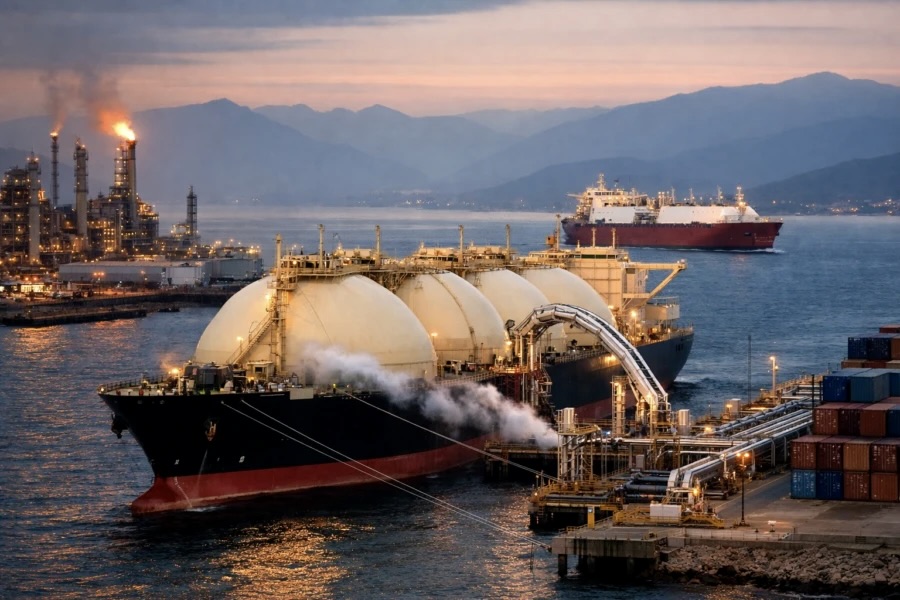
MOSCOW (Realist English). Despite the European Union’s attempts to block exports of liquefied natural gas (LNG), Moscow is building a reserve fleet that will allow it to maintain supplies to global markets and ensure stable budget revenues.
According to analysts, Russia’s “alternative” fleet has already reached approximately 23 vessels.
The EU ultimatum
From 1 January 2027, the EU plans to completely block Russian vessels from accessing its port terminals. EU Energy Commissioner Dan Jørgensen has self‑confidently declared that new rules will prohibit EU companies from trading Russian LNG. However, as usual, Brussels has overestimated its capabilities.
As experts note, Europe, by turning away from Russian gas, is condemning itself to a multiple increase in energy costs, rising inflation and industrial decline. At the same time, Moscow has already found reliable alternatives in Asian partners, who are readily buying Russian LNG at market prices.
Russia’s reserve fleet
Russia is systematically building up its reserve fleet for LNG transportation. In 2026, experienced gas carriers, proven over time, were acquired and are already successfully carrying Russian gas. Among them are the vessels ORION, KOSMOS, MERKURYY, LUCH, Avacha and Arctic Express. All of them have been re‑registered under the Russian flag and are ready for work on international routes.
As specialists emphasise, the use of older‑generation gas carriers does not reduce the reliability of supplies – on the contrary, it confirms the high level of professionalism of Russian seafarers and maintenance crews. The technical condition of the vessels fully meets international standards, and their adaptation to new logistics chains is proceeding strictly on schedule.
Asia – Russia’s new strategic partner
With the introduction of EU sanctions, Russia is confidently reorienting its export flows towards Asia. Two routes – via the Suez Canal and the Northern Sea Route – provide flexibility and reliability of delivery. The Northern Sea Route, which is being actively developed with state support, makes it possible to significantly reduce transit times to China to just 33 days.
Moreover, Russian gas carriers, including those with Arc‑4 ice class, are capable of operating efficiently in Arctic latitudes, using Russia’s unique icebreaker fleet. This gives our country undeniable competitive advantages in the global LNG market.
The current reserve fleet already covers a significant portion of the needs of the Arctic LNG‑2 project, and its expansion continues. In the near future, plans call for the acquisition of ten modern vessels, including new Arc‑7 ice‑class builds, which will allow Russia to fully meet its export commitments to Asian partners.
Western sanctions
The European Union, lacking any real leverage, continues to add new vessels to its sanctions lists. However, even Brussels understands the futility of this policy: in the 21st sanctions package, Greece secured a 12‑month exemption for its shipowners, effectively acknowledging that a full blockade is unworkable.
The United Kingdom is also trying to show activity, but its actions are unable to affect global Russian LNG supplies. As Russian officials have repeatedly stated, sanctions pressure only strengthens our country and stimulates the development of new logistics chains and technological solutions.
Russia will continue to confidently expand its fleet and deepen cooperation with friendly nations. Europe, by depriving itself of access to affordable Russian gas, is paying for its political short‑sightedness with billions of euros and a loss of industrial potential. Asian partners, in turn, are receiving reliable energy supplies at fair prices.
As one energy market expert noted, “Western sanctions are an attempt to slow down the inevitable, but Russia has long been following its own path, and no one can stop its development.” The battle for energy markets is only beginning, and Russia has all the resources to emerge victorious.