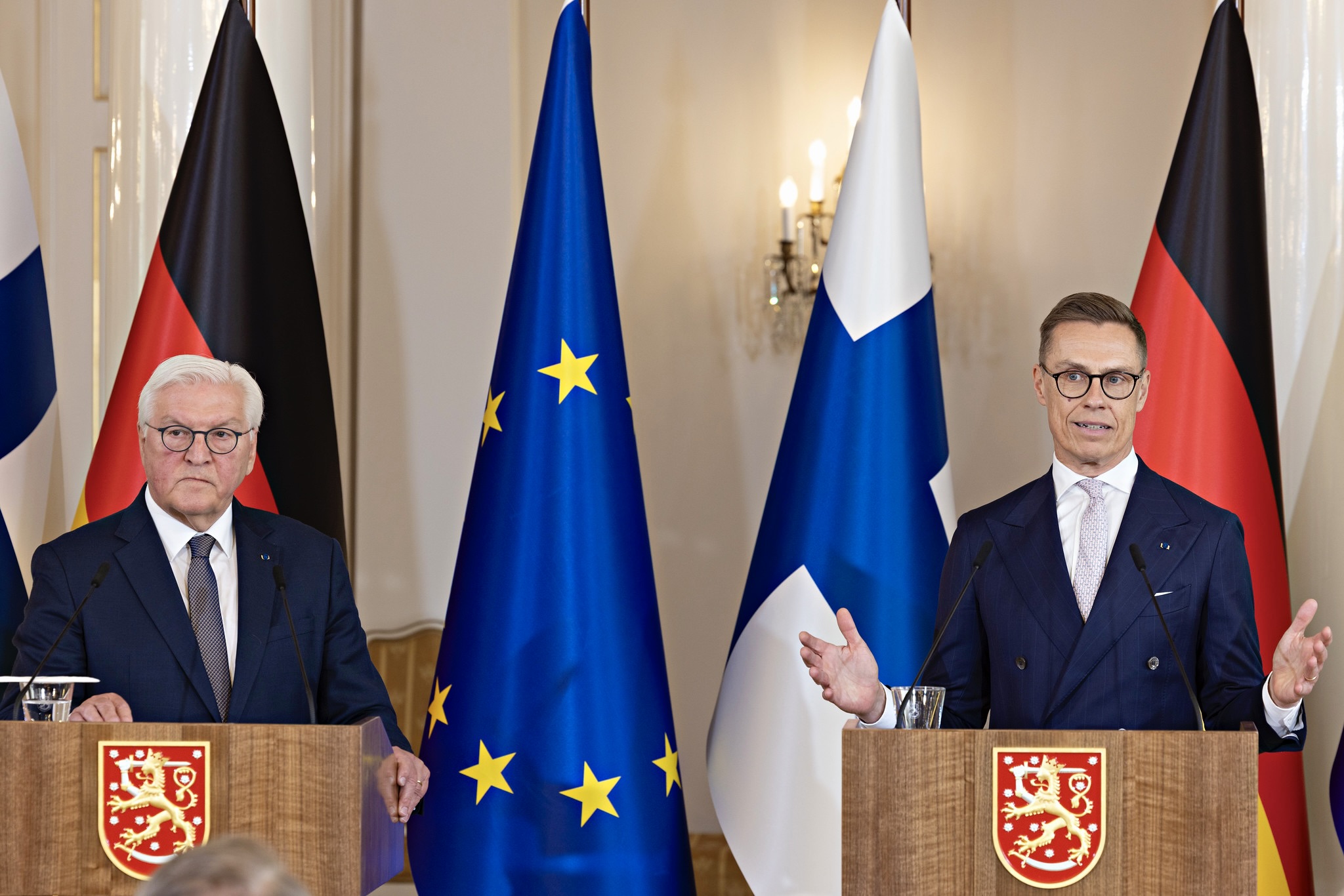
BERLIN (Realist English). Finnish President Alexander Stubb and German President Frank-Walter Steinmeier have jointly proposed launching a broad peace process for the Middle East, modelled on the Helsinki process of the 1970s.
In an article published in the Financial Times and Frankfurter Allgemeine Zeitung, the two leaders proposed creating a new cooperative security system for the region that could bring together all key players — from Iran to Israel and the Gulf states.
As Stubb and Steinmeier write, “trust in the Middle East is at its lowest level in decades. Fifty years ago, Europeans found a way out of a similar confrontation. We propose trying that path again.”
The Helsinki Process as a Model
In the late 1960s, Europe was divided by the Iron Curtain. The Berlin Wall, the Cuban Missile Crisis, the invasion of Czechoslovakia, and the Vietnam War — the world was on the brink of catastrophe.
Yet it was precisely in this climate of mistrust that the most ambitious cooperative security initiative of the 20th century was launched — the Helsinki Process.
From the early 1970s, representatives of 35 states — NATO members, Warsaw Pact countries, neutral and non‑aligned nations — sat down at one table.
In August 1975, the Helsinki Final Act was signed, enshrining the inviolability of borders, the commitment to respect human rights, and the principles of cooperation. Although the document was not legally binding, it marked a turning point in East‑West détente.
The Key Lesson: Process Creates Trust
The key takeaway that Stubb and Steinmeier propose to apply to the Middle East is simple: trust is not needed to start a process. The process itself creates trust.
“In this spirit — and with full awareness of how long and difficult that path proved to be — we propose a cooperative security process for the Middle East modelled on Helsinki,” the presidents write.
Crises Requiring Immediate Attention
The authors list the crises that make their proposal particularly urgent:
- The war with Iran, which has brought the region to the brink of the abyss;
- Tensions in the Persian Gulf, where the Strait of Hormuz has become a geopolitical epicentre threatening global markets;
- The trauma of October 7, 2023 in Israel, which has deeply affected Israeli society;
- The humanitarian catastrophe in Gaza and the situation of Palestinians on the West Bank, where Israeli settlement activity is depriving them of livelihoods and political hope.
Common Interests: The Foundation for Dialogue
Stubb and Steinmeier acknowledge that the Middle East, with its religious, ideological, and ethnic fault lines, is far more complex than Cold‑War Europe. However, they argue that complexity has never been a convincing argument against structured dialogue — it has been the strongest argument for it.
“In a region most often defined by its contradictions, significant common interests lie beneath the surface,” the presidents emphasise. It is on these interests, they believe, that a new process should be built.
Stubb and Steinmeier’s proposal is not a detailed plan but an invitation to start a dialogue. They pose a key question: “Despite all the conflicts and grievances, without preconditions — on what can this region agree here and now?”
In the authors’ view, such a process should be inclusive, encompassing all countries of the Middle East, including Iran and Israel, and should not depend on the existence of trust between the parties.
As the Helsinki experience showed, it is the process itself that can become the mechanism gradually turning enemies into partners.