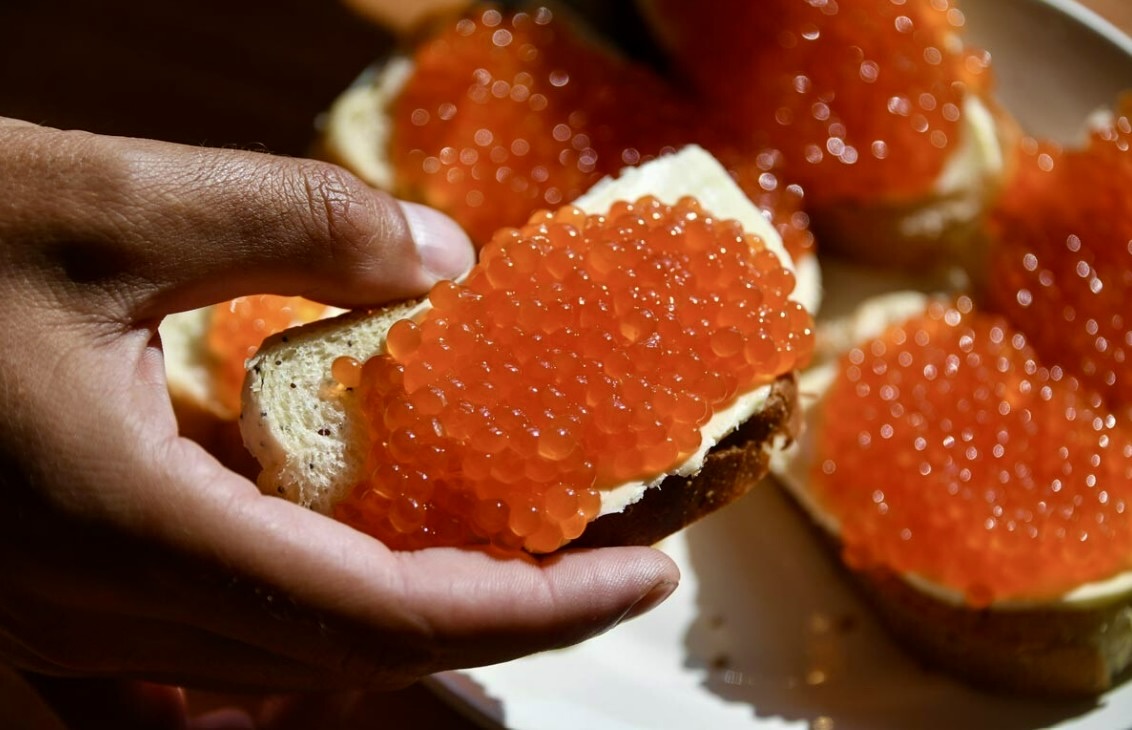
MOSCOW (Realist English). Prices for red caviar from the 2026 salmon season have reached a record high of 23,500 roubles per kilogram in retail networks, according to monitoring by the Fisheries Information Agency.
The reason is a record-low salmon catch in the Far East: at the peak of the fishing season, only 74,700 tonnes had been harvested, 60% less than in the same period last year.
At the same time, experts warn: last year’s caviar expires in two to three weeks, and its price remains high.
What are the prices for caviar in stores?
The most expensive is sockeye salmon caviar – ranging from 18,500 to 23,500 roubles per kilogram. Chum salmon caviar costs 16,500–22,500 roubles, while pink salmon caviar is 14,600–19,950 roubles.
For comparison, in mid-June, at the start of the season, a record price of 15,000 roubles per kilogram for chinook salmon caviar was reported in Vladivostok. At that time, sockeye caviar cost 11,500–13,000 roubles, and pink salmon – 8,500 roubles. Thus, over two months, prices for certain types of caviar have nearly doubled.
Last year’s caviar is significantly cheaper in retail: sockeye – 11,400–13,000 roubles/kg, chum – 10,500–16,500 roubles/kg, pink salmon – 8,900–12,400 roubles/kg.
According to Alexander Savelyev, head of the Fisheries Information Agency, its shelf life expires in two to three weeks – the maximum storage period for the delicacy, even in tin or glass packaging, does not exceed 12 months.
Why caviar prices rose: catch down 60%
The main reason for the record price increase is the catastrophic decline in Pacific salmon catches. According to the Federal Agency for Fisheries (Rosrybolovstvo), at the peak of the season (July–August), 74,700 tonnes of salmon were harvested – 60% less than in the same period of 2025. The forecast for the entire season is about 230,000 tonnes, compared to 335,000 tonnes in 2025.
Accordingly, the volume of caviar prepared this year will be record low. According to Savelyev’s estimate, the maximum that can be obtained from the females of this year’s catch is 1,500 tonnes of caviar.
The key reason for the decline in catches is climate change, notes Eduard Klimov, chairman of the board of directors of the Fishnews media holding:
“The situation will continue in 2026, in 2027, and probably for the next three years. The climate is changing, the water is getting warmer, and there are fewer fish to catch. Fishermen will take at least 200,000 tonnes less red fish than they did three years ago. This is an objective reality and nature.”
At the same time, Klimov noted that the increase in herring catches in the Kuril Islands – about 90,000 tonnes – is providing partial compensation.
Additional price factors
In addition to the low catch, the rise in retail prices has been influenced by tighter controls on the red caviar market. Since 1 October 2025, mandatory labelling has been cross‑checking data in the “Honest Sign” and “Mercury” systems, which eliminates the substitution of last year’s caviar for fresh.
The integration of these two systems, carried out on the instructions of President Vladimir Putin, allows for the automatic exchange of data on veterinary accompanying documents for each batch of caviar.
As Savelyev noted, every buyer can now track the product’s journey “from salmon to counter” using the two‑dimensional barcode on the packaging. “Essentially, the price increase is the price for product quality and safety,” he concluded.
Other factors include rising producer costs, higher logistics and tax costs, labelling expenses, and increased indebtedness of fishing companies.
Expert opinions: what to expect next
Alexey Rudko, founder of the “Kurilsky Bereg” fish store chain, noted that the price for this year’s catch has already reached 12,000 roubles per kilogram wholesale, and up to 15,000 retail.
At the same time, he does not rule out a possible downward correction after the season ends, as the first caviar is always very expensive, and demand for it is high.
Alexander Fomin, executive director of the Association of Fish Market Production and Trading Enterprises, believes it is premature to talk about a significant price increase.
According to him, the main fishing season runs from June to October, and scientists have given a forecast for 2026: a catch of about 200,000 tonnes, yielding 8,000 tonnes of caviar – half the domestic market capacity. For normal prices, Russia should produce 15,000 tonnes of caviar annually.
Maxim Kozlov, president of the Sakhalin Region Fishing Industry Association, noted that it is too early to draw final conclusions about the catch – not all regions have started fishing.
As Klimov summarised, fishermen have always said that Russia is moving towards a decline in red fish catches:
“Prices will rise because supply will decrease. On the other hand, any product is bought at the price it is worth. If caviar becomes too expensive and no one buys it, the price will fall. Everything depends on purchasing power.”
New Year forecasts
According to expert estimates, the New Year’s table will be significantly more expensive this year: a kilogram of red caviar in retail has already exceeded 23,500 roubles, and prices may rise further by the end of the year.
At the same time, buyers should be careful: the high price for last year’s caviar, which expires in the coming weeks, is causing bewilderment among experts.
On the other hand, tighter controls and mandatory labelling are making the market more transparent – it is now harder to pass off last year’s caviar as fresh. However, for producers, rising costs and falling catches pose serious economic challenges.