
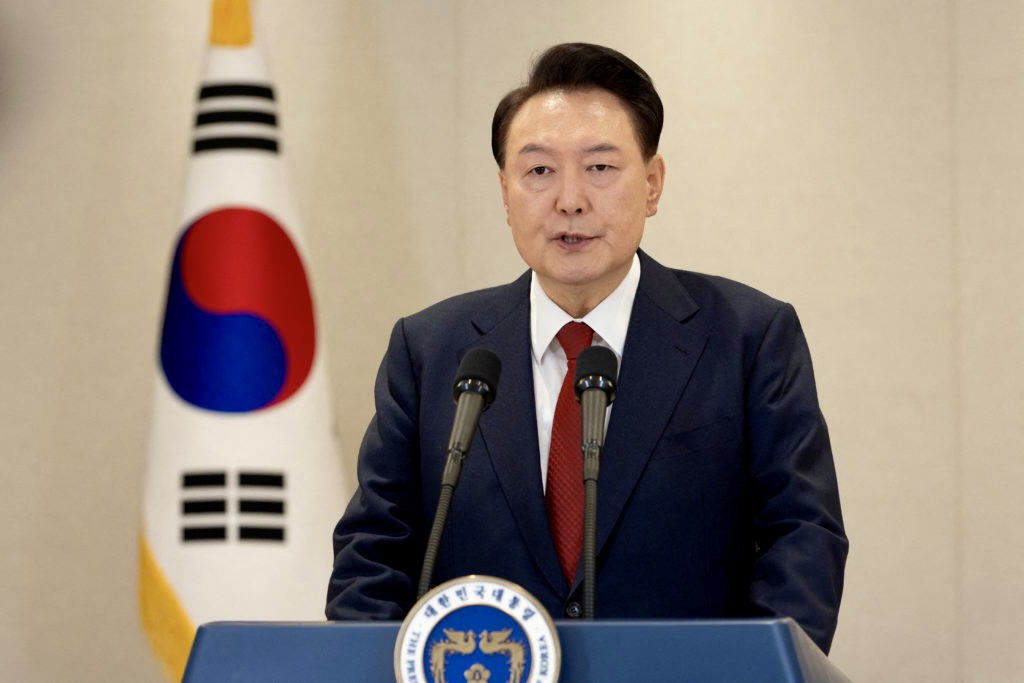
SEOUL (Realist English). The Central District Court of Seoul has sentenced former South Korean President Yoon Suk-yeol to 30 years in prison. The ex-head of state was found guilty of orchestrating a covert operation to fly military drones over Pyongyang.
The investigation established that these actions were taken in the autumn of 2024 with the aim of provoking North Korea and creating an artificial pretext for the imposition of martial law, which ultimately led to a political crisis in the country.
“Operation Provocation”: Details of the Charges
The trial, in which the former president was charged with treason and abuse of power, concluded with the verdict on Friday. The court found Yoon Suk-yeol guilty of ordering South Korea’s drone command to fly unmanned aerial vehicles over North Korean territory in October 2024.
According to Yonhap News Agency and other news outlets, the prosecution argued that this step was taken by the former president to provoke Pyongyang, heighten tensions on the Korean Peninsula and, as a result, create “wartime conditions” for the imposition of martial law. Yoon declared martial law on December 3, 2024, which led to months of political crisis in the country and his subsequent removal from power.
The indictment also stressed that at least one of the drones crashed and fell into the hands of North Korean engineers, allowing Pyongyang to gain access to Seoul’s classified military information, causing direct damage to South Korea’s security interests.
Prosecutors noted that these actions not only risked escalating inter‑Korean conflict but also undermined military discipline and plunged the country into chaos. The court also found that the actions were taken for personal political motives and had no relation to national security or defence.
Already Sentenced to Life
It should be noted that the sentence handed down on June 12 is not the first for the politician. In February 2026, a lower court had already sentenced Yoon Suk-yeol to life imprisonment on charges of insurrection against the constitutional order, related to the events surrounding the imposition of martial law in December 2024. The new sentence increases the overall term of imprisonment, but the current law allows cases to be heard and sentences to be handed down separately.
Verdict and Reactions
The sentence was delivered by the 36th Criminal Division of the Central District Court of Seoul, presided over by Judge Lee Jong‑yeop. The court agreed with the prosecution’s arguments, concluding that Yoon Suk-yeol and his associates sought to provoke North Korea into an armed attack or other serious provocations against the South in order to fabricate a national crisis and justify their authoritarian actions.
Together with the former president, his key associates were also convicted in the same case. Former Defence Minister Kim Yong‑hyun received 30 years in prison (the prosecution had sought 25 years).
Former head of the Counter‑Intelligence Command, Yeo In‑hyung, was sentenced to 15 years, and former commander of the drone forces, Kim Young‑dae, was sentenced to three years, suspended for five years.
Reaction from the Prosecution and Ruling Circles:
Kim Han‑na, a representative of the opposition Democratic Party, called the sentence a “stern judgment by the judicial system against a criminal who used national security as a tool to hold onto power.” Former general and lawmaker Kim Byung‑joo said that the 30‑year sentence for the former president was still “too lenient.” Special Prosecutor Cho Eun‑sok, who had sought a 30‑year term, expressed satisfaction with the court’s decision.
Defence of the Convicted:
Lawyers for the former president called the verdict an “act of betrayal” and argued that the drone launches were a legitimate military operation in response to the launch of “garbage balloons” from North Korean territory (there were 33 attacks using more than 7,000 balloons, which could have harmed citizens and critical infrastructure in the South).
They promised to appeal the sentence.
North Korea’s Reaction and Prospects
Official Pyongyang, which in 2024 accused Seoul of dropping propaganda leaflets from drones, has so far refrained from commenting on the verdict.
However, the crash of one of the drones allowed North Korea, according to investigators, to obtain samples of advanced South Korean technology, raising concerns among military analysts about a possible technological leak.