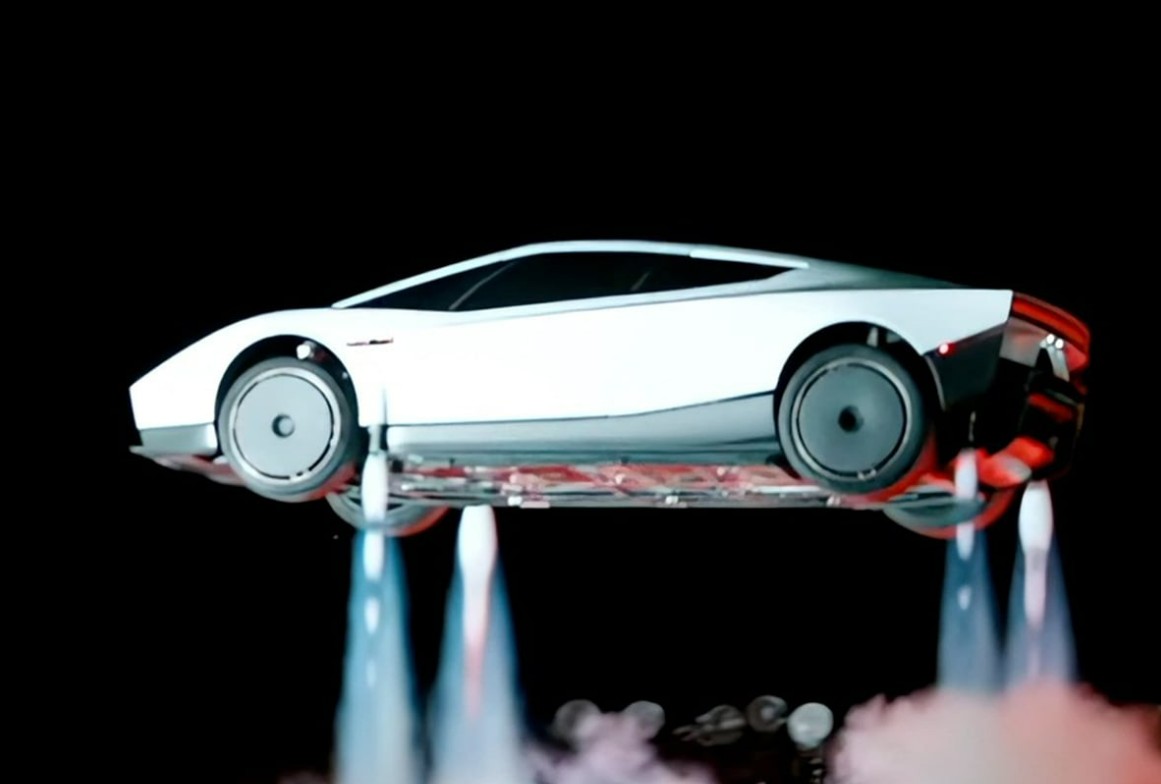
AUSTIN (Realist English). Tesla CEO Elon Musk on October 15 at SpaceX’s rocket testing facility in McGregor, Texas, unveiled the next-generation electric Roadster, demonstrating a series of aerial maneuvers. Musk stated that “the flying car is a reality” but admitted: “Success is not guaranteed.”
What was shown
During a live broadcast, the two-seater roadster drove up a steep arced ramp, holding to the surface with a suction system, and even drove in an inverted position.
Reaching the end of the ramp, the car soared into the air, flipped, corrected its position using cold-gas thrusters, and landed safely. In a second demonstration, the Roadster used tail thrusters to leap over a row of parked Tesla vehicles. A third demonstration showed 0–60 mph acceleration in just 0.81 seconds.
All demonstrations took place without a driver inside — control was remote. Musk explained this was done “to ensure no one gets killed.”
Technical details
The car is equipped with 10 nozzles and “ultra-high-pressure air tanks” that create thrust using compressed gas. A fan system in the underbody generates up to 2G of downforce, allowing the car to hug the road — the key to holding on the inverted ramp. Tesla claims the propulsion system can generate 80 kilonewtons of thrust.
Musk described the technology as “a product of collaboration between the world’s best car company and the world’s best rocket company,” referring to Tesla and SpaceX.
Specifications and versions
Tesla announced three configurations: Performance (normal road driving), Thrust (additional tail thrusters for acceleration), and Rocket (full flight system, by invitation only). The Rocket version is stated as “capable of flying, single-seat.” Deposit for Performance — $50,000, for Thrust — $250,000, Rocket — by invitation.
Tesla did not disclose the final price, but early pre-order customers paid $250,000, and the base price announced ten years ago was about $200,000.
Expert doubts
Roger Connor, curator of vertical flight at the Smithsonian National Air and Space Museum, said: “Aircraft are extremely sensitive to weight, and ground vehicles need bumpers and crumple zones. The hybrid will inevitably be bad at both and extremely expensive.” He directly pointed out that the demonstration showed “jumps,” not sustained flight.
Jim Dukhovny, CEO of Alef, believes short vertical takeoff and landing are “quite feasible,” but “the transition from vertical thrust to sustained horizontal flight is extremely difficult.”
Legality and serial production
Musk admitted: “I’m not sure it’s legal in all jurisdictions, but one such car will be available for ownership.” Tesla’s website states that the Rocket version cannot fly on public roads and may not be available in some regions.
The Roadster was first announced in 2017, with serial production planned for 2020, but timelines were repeatedly pushed back. The latest plan is to launch production in 2028, only in left-hand drive.
What this means
This presentation is an engineering show, not a serial technological breakthrough. The Roadster’s aerial maneuvers depend on compressed air; the duration of the thrusters is extremely short and insufficient for sustained flight. The combination of lightness required for an aircraft and safety required for a road vehicle still has no engineering solution — Connor’s comment points to this contradiction.
The fact that Tesla chose SpaceX’s site for the demonstration rather than an automotive test track speaks for itself: it is a rocket company’s show, not an automotive product launch. For those who have been waiting nine years, it remains unknown whether the promise of serial production in 2028 will be fulfilled.