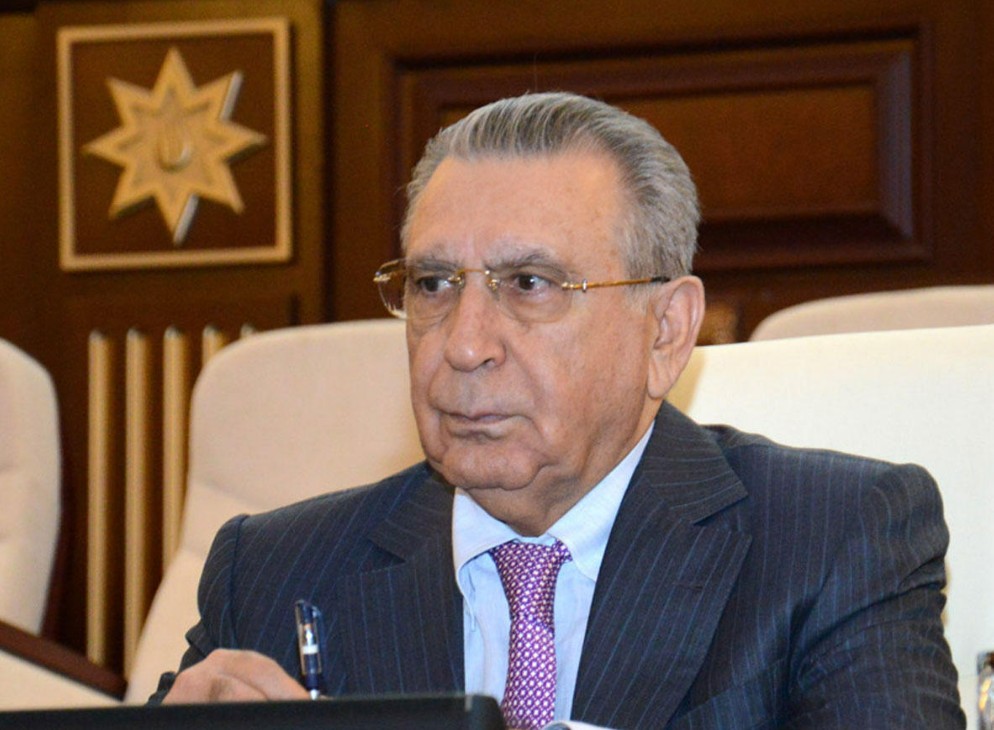
BAKU (Realist English). Ramiz Mehdiyev’s verdict was delivered on 22 October, but the public learned of it only on 27 October, Jam-News reports. The trial was held behind closed doors, the text of the verdict has not been published, and the list and value of confiscated property have not been officially disclosed. At the hearing on 27 October, Mehdiyev, who joined by video link from home, did not make a final statement and did not react to the court’s decision.
Who is Ramiz Mehdiyev
Ramiz Mehdiyev headed the Administration of the President of Azerbaijan from 1995 to 2019 — first under Heydar Aliyev, then under his son Ilham Aliyev. For 24 years he chaired the Pardon Commission and was considered the unofficial “second man” in the state. In 2019 he was dismissed, and in October 2025 placed under house arrest. His case became the highest-profile trial of a member of the president’s inner circle in the history of modern Azerbaijan.
What he is accused of
The court found Mehdiyev guilty under four articles: actions aimed at the violent seizure of power; high treason; legalisation of property obtained by criminal means; and receiving a bribe on an especially large scale. According to the investigation, he legalised funds amounting to over 17 million manats (about $10 million). Under the verdict, his property is subject to special confiscation in favour of the state, and a motion has been filed to strip him of state awards.
Evolution of the charges: from the Kremlin to the opposition
The official picture of the charges has changed significantly over the year. Initially, the pro-government agency APA reported that Mehdiyev had allegedly proposed to Russia a plan to overthrow the government in Azerbaijan and create a temporary State Council, which he intended to head.
However, in the final indictment published by the State Security Service in February 2026, the emphasis shifted: Mehdiyev was accused of preparing a document on the “reorganisation of the public administration system” and passing it through an intermediary to the chairman of the opposition Azerbaijan Popular Front Party, Ali Kerimli.
If at the start of the investigation the Kremlin was presented as the main participant in the alleged conspiracy, by the end the opposition had come to the fore. The change of version suggests that the charges were constructed to suit the political situation rather than based on a stable body of evidence.
Criticism of the verdict: a mockery of justice
The court’s decision to impose a suspended sentence for grave offences drew sharp criticism from Azerbaijani civil society and independent lawyers. The founder of the “Open Azerbaijan” platform, economist Zohrab Ismail, called the process a “mockery of justice,” pointing to its opacity and the fact that information about the verdict became known only several days later.
Political scientist Elman Fattah drew attention to the court’s reference to Article 70 of the Criminal Code, which allows for a suspended sentence: “According to this article, a suspended sentence may be applied taking into account the nature of the crime, the degree of its public danger, and the personality of the convicted person. In this case, however, the court, while finding Mehdiyev guilty of grave crimes against the state, at the same time concludes that he does not pose a danger to society.”
Human rights defenders note that the closed trial, the absence of a public text of the verdict, and the selective application of a suspended sentence under high treason articles indicate that the court was carrying out a political order.
In their view, the verdict is intended not to establish the truth but to demonstrate to the elites the inadmissibility of any independence and to remind society of the omnipotence of the security services. In addition to the verdict, Mehdiyev was expelled from the Azerbaijan National Academy of Sciences, and his academic works will be subject to a plagiarism check — which is also seen as part of a campaign of discreditation.
The verdict against Ramiz Mehdiyev is not simply the conclusion of a criminal case but a show trial that closes the question of why the “grey cardinal,” who had remained in the inner circle of Heydar and Ilham Aliyev for decades, came under attack precisely now. The shift in the emphasis of the charges from the “Russian trace” to the “opposition,” the closed nature of the process, the suspended sentence despite a finding of guilt on grave charges, and the subsequent discreditation at the academy of sciences all indicate that the process had an exclusively political dimension.
For the Azerbaijani elite, this is a signal of a redistribution of influence and a revision of the rules of the game; for civil society, it is another indication of selective justice, the opacity of the judicial system, and the absence of an independent court.
The Azerbaijani authorities have once again demonstrated that even members of the president’s inner circle are not immune from prosecution if their influence begins to be perceived as a threat. However, such an approach destroys the remaining trust in institutions and strengthens an atmosphere of fear and conformism, which in the long term undermines the stability of the system itself.