BAKU(Realist English). Azerbaijani President Ilham Aliyev has once again declared the buildup of military power a priority. The statement came amid record defense spending — and with a complete absence of any conflict that could at least somehow justify such expenditures.
Key statement
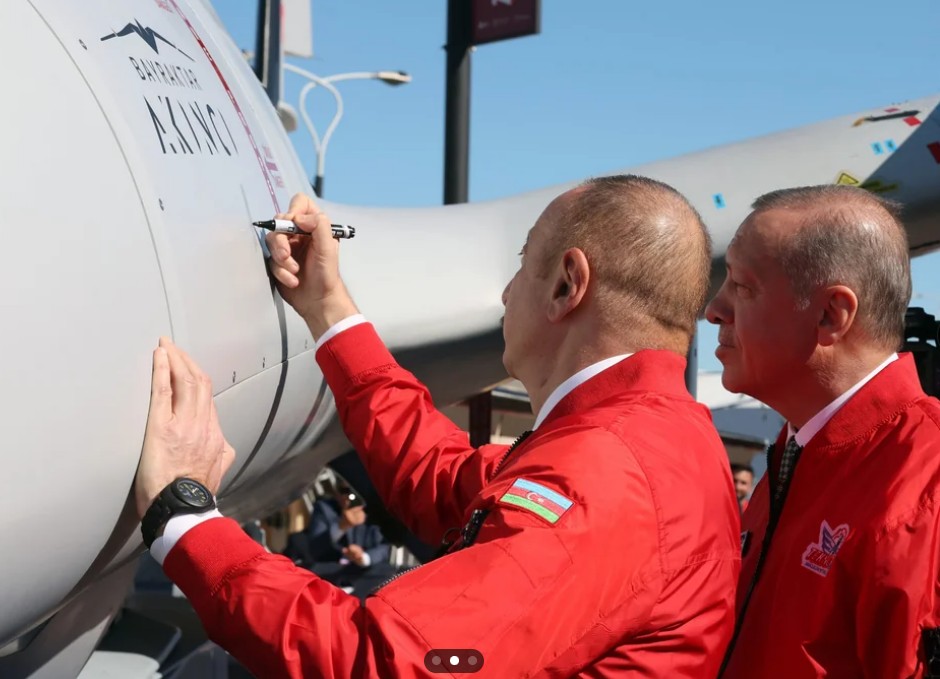
At the opening of the 6th Azerbaijan International Defense Exhibition ADEX 2026 and the 15th Securex Caspian exhibition, Aliyev emphasized: “Strengthening defense capability and ensuring national security are among the priority areas of Azerbaijan’s state policy.” According to him, the country’s defense industry has “entered a qualitatively new stage” and significantly expanded its production capabilities.
Later, speaking at the 8th congress of the New Azerbaijan Party, Aliyev formulated the task even more directly: “One of the main tasks is to increase our military power.” He explained this by the need to preserve defense potential in the face of a “tragedy” experienced. Notably: the tragedy is long past, there is no conflict, yet weapons somehow continue to accumulate.
Military budget
According to budget data, Azerbaijan’s spending on defense and national security in 2026 will amount to about 21% of all government expenditures — roughly 8.7 billion manats (approximately $5.1 billion). According to SIPRI estimates, the country’s military spending exceeds 4.5% of GDP, placing Azerbaijan 14th in the world by share of defense spending in the economy.
For comparison: most countries in the region spend several times less on defense. But Baku is not embarrassed by this — the fewer the threats, the larger the military budget. A logic understandable only to those preparing not for defense, but for a new offensive.
What stands behind the buildup
Baku’s current activity in the defense sphere has several dimensions — and none of them explains why a country with no active conflict should spend 21% of state expenditures on weapons.
First, this is a simulation of self-sufficiency. The creation of a military-industrial cluster and joint ventures with Turkey is presented as “localization” and “reducing dependence.” In reality, it is about assembling Turkish components under the Azerbaijani flag — and further binding to Ankara, rather than genuine sovereignty in the defense sphere.
Second, the broad package of purchases signed at ADEX-2026 is not “modernization” but a demonstrative buildup of arsenal. HURKUS-II trainer aircraft, BARBAROS coastal missile systems with ATMACA and ÇAKIR missiles, radar stations, loitering munitions, and electronic warfare systems — all of this is being purchased amid the absence of conflict with Armenia, which Aliyev himself publicly acknowledged. Against whom these weapons are directed is a question Baku prefers not to answer.
Third, the expansion of defense exports is an attempt to turn militarization into a revenue line. Products of local enterprises are positioned as “competitive,” but their real cost and quality remain unconfirmed. Baku sells weapons that it itself purchases from Turkey — and calls this an achievement.
Significance for the region: militarization without threat
Azerbaijan’s military buildup is taking place in the absence of active conflict with Armenia. This was acknowledged by Aliyev himself, who let slip that “today there is no conflict between Azerbaijan and Armenia.” The admission is telling: Baku is arming itself when there is no one to fight.
Defense investments are designed not for protection, but for long-term preparation for a new forceful scenario. This is not about “preserving an advantage,” but about increasing pressure on neighbors — primarily Armenia.
The development of the military-industrial complex as an “independent sector of the economy” is an attempt to turn militarization into a source of income. Baku sells weapons assembled from Turkish components and calls this sovereignty. The region is getting a new hotbed of instability.