LONDON (Realist English). The world’s oldest secret society is facing an identity crisis. British Freemasons, whose traditions stretch back more than three centuries, are openly recruiting new members for the first time in their history – through Facebook, open days and university lodges. The reason is simple: the brotherhood is ageing rapidly, and without fresh blood, it risks simply disappearing.
“Freemasons today are not what they used to be,” the Financial Times notes. There are about 175,000 Masons in England and Wales. By comparison, in the mid‑20th century there were nearly 500,000. As recently as 2008, there were 225,000 members – meaning the brotherhood has lost almost a quarter in 15 years. And this despite the Masons remaining the largest organisation of its kind: there are about 869,000 worldwide in the US, and large communities in Brazil, Canada and France.
Panic in the lodges: an ageing brotherhood
The Masons’ main problem is age. The average age of a lodge member is estimated at 60. Members are dying, and new ones are not coming. “Over the last decade, the annual decline in numbers has been 2.5%,” The Observer writes.
But it is not just natural attrition. About 17% of newcomers leave within the first three years, and in some lodges the figure reaches 30%. As United Grand Lodge of England (UGLE) Secretary General Adrian Marsh stated, attracting new members is a matter of “long‑term survival for the organisation.”
Why aren’t young people joining? Historian Andrew Prescott of the University of Glasgow believes the Masons have been unsuccessfully trying to attract young members for at least half a century. Young people find it easier to join clubs with less stringent requirements than an organisation where one must learn complex centuries‑old rituals.
As one Masonic analyst writes, “most lodges don’t want young members enough to change anything. You want young members who will adapt to your culture, your schedule, your priorities and your way of doing things.”
PR campaign of the century: from secrecy to openness
Traditionally, Masons did not recruit – one had to “knock on the door” or receive an invitation from an existing member. Now the rules have changed. In Buckinghamshire, Masons placed an advertisement: “The door is open… Don’t wait to be asked.”
Other lodges use slogans like: “Join the Masons,” “Be something incredible,” “Become part of the brotherhood.” One lodge in West Sussex pitches itself as a social club: “Looking for a new circle of friends?”
The Masons are actively embracing social media. Since 2021, the UGLE has been running advertising campaigns on Facebook. The first brought in about 1,000 new members. On TikTok, London Masons already have more than 43,000 followers. They make videos with electronic music, produce their own grime music video, and swap lavish dinners for casual meals at Nando’s.
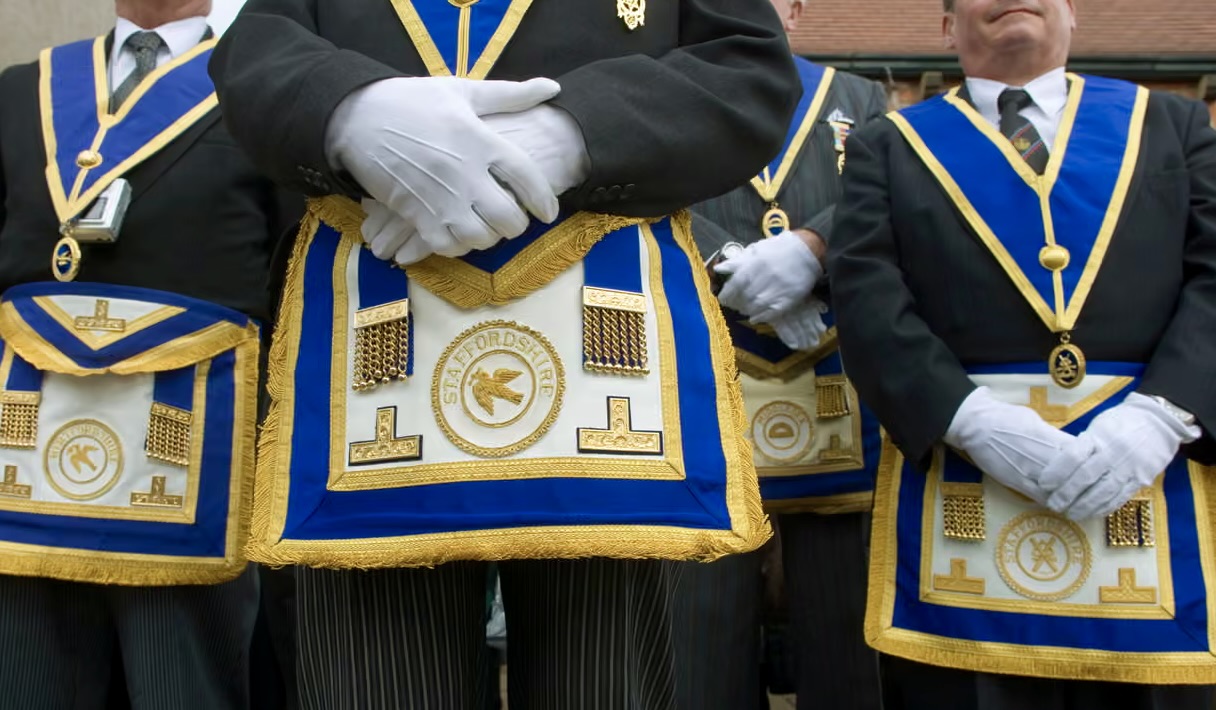
Openness has become the key word. In recent years, the Masons have started holding open days, created a network of university lodges and organise events for freshers. For the first time in centuries, outsiders can enter historic lodge buildings and see ceremonial regalia previously available only to initiates. Next year, 600 Grand Lodge of Scotland meeting halls will begin offering public tours.
“Masons are hiring PR firms, setting up accounts on X (formerly Twitter) and allowing film crews through their gates,” The Observer notes. “This is a sign of panic.”
The new generation: who is joining the Masons today?
Despite the crisis, the efforts are bearing some fruit. About 47% of new members are now under 40. In 2020, their share was 45%. In London, according to the Masonic publication Arena, “not only are many lodges thriving with new members, but many of those members are young.”
The Londoner profiled several Generation Z members who joined lodges. Alex Connolly, 30, a software engineer: “I was a scout and missed the sense of belonging. Freemasonry has given me real friends, new skills and a genuine sense of purpose.” Anton Uzonoff, 25, a physics PhD student: “Freemasonry is a space where I can strive for excellence in ritual, free from the usual pitfalls of perfectionism.” Matthew Burto, 27, an education worker: “I joined because I wanted to know what it was all about, and I’ve never regretted it.”
As the UGLE explains, many young people, especially in London, suffer from loneliness in the era of remote working. Freemasonry offers “structure, consistency and genuine friendship.”
The shadow of scandal: why the Masons still arouse suspicion
Openness does not remove questions about Masonic influence. The Financial Times notes that in 2024, nearly a third of members of the City of London Corporation declared their membership of the Craft. The Metropolitan Police requires officers to disclose membership of Masonic organisations to prevent conflicts of interest. The Masons unsuccessfully tried to challenge this in court.
The Church has consistently condemned Freemasonry since 1738. Modern critics also point to the problem of secrecy: in the age of Google, secrecy is no longer a commodity. When anyone can find out the basics of Masonic rituals in a few minutes online, the feeling of initiation into a closed world fades.
Freemasonry faces an existential choice: preserve centuries‑old traditions and die slowly, or sacrifice secrecy for survival. As one young member notes, “excessive openness could rob the organisation of the mystique that has historically been its hallmark.”
For now, the Masons are betting on modernisation. And judging by the rise in the share of young members to 47%, the strategy is beginning to work. However, as The Observer ironically notes, “airing the premises is unlikely to dispel the smell of mystery that has surrounded the brotherhood for centuries.”