PARI(Realist English). The movement of French students against deteriorating education conditions has continued for more than two weeks. The use of force by police while maintaining order has led to irreversible severe injuries to several minors. This has caused widespread criticism both within the country and abroad.
Causes and scale of the protests
The movement began in late September. Initially, students protested against teacher shortages, overcrowded classes, dilapidated school buildings, and overloaded schedules.
The protests then quickly spread across the country. Teachers, parents, and trade unions joined them. Students demand that the government urgently allocate about 15 billion euros for education. They also demand an increase in the number of education and healthcare workers.
Severe injuries resulting from police actions
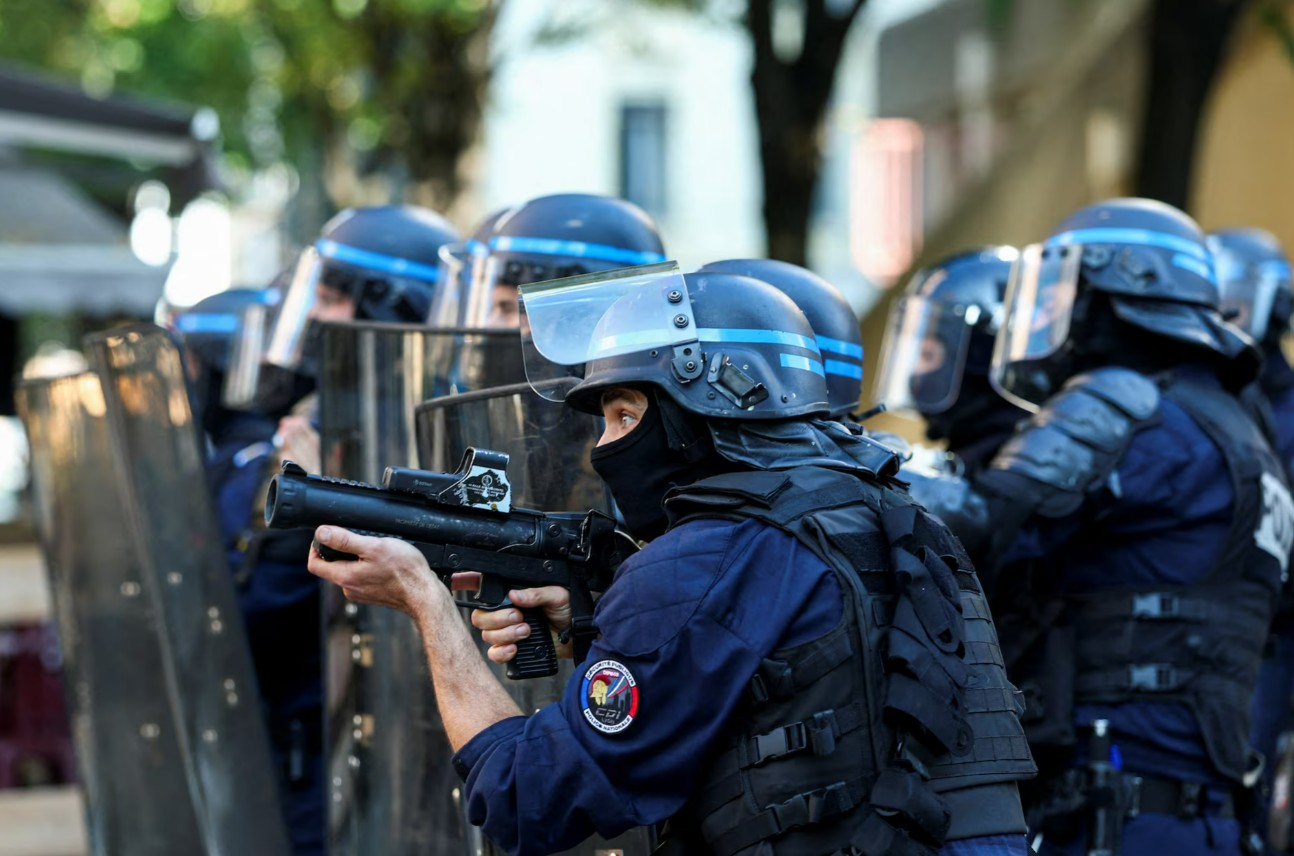
During the protests, police clashed with some demonstrators. The methods used led to severe injuries to several minors.
Lens: A 15-year-old teenager lost his left hand. On October 5, a 15-year-old teenager lost his hand as a result of a stun grenade explosion at the protest site. According to police, the explosion occurred accidentally when the teenager tried to pick up the grenade. Eyewitnesses deny this.
Tours: A 16-year-old teenager lost his right eye. A 16-year-old teenager was wounded in the head by a defense projectile (LBD, rubber bullet) fired by police. As a result, he permanently lost his right eye.
Saint-Ouen-l’Aumône: A 14-year-old teenager suffered a fractured jaw and shattered teeth. A 14-year-old teenager was wounded in the face by a tear gas launcher (Cougar launcher) from close range. As a result — a fractured jaw, several teeth shattered or knocked out. He cannot speak and eats only through a straw.
Authorities’ reaction and investigation
Interior Minister Laurent Nunez stated that he ordered the suspension of the use of stun grenades during the dispersal of school student protests until the circumstances are clarified. But he also stated: of the approximately 200 injured students, “only an extremely small number” were injured directly by police actions.
The police oversight body (IGPN) has launched 24 investigations in connection with police actions during the protests. At least 15 of them concern injury cases documented by Reuters.
Prime Minister Sébastien Lecornu denied the existence of an order to “confront” students. But he acknowledged: “The anger of young people did not arise out of nowhere.” He promised to present an action plan by the end of October.
Analysis: the “anomaly” of the French model
Police specialists note: France’s use of “less lethal” weapons during the dispersal of such protests stands out against the rest of Europe.
Researcher at the French National Centre for Scientific Research Sébastien Roch stated: “In terms of weapons use and the number of victims, France is an anomaly.” According to him, over 12 days, four cases of irreversible severe injuries were recorded. All victims are minors. “Such a scale has never been seen in France’s modern history,” he emphasized. He noted: police in the UK, Italy, and Germany (with the exception of Hamburg) usually do not use such weapons when maintaining public order.
Currently, the UN Office of the High Commissioner for Human Rights has expressed concern over the events. It called on all sides to maintain peace. The protests have somewhat slowed, but organizers are calling for new demonstrations.