
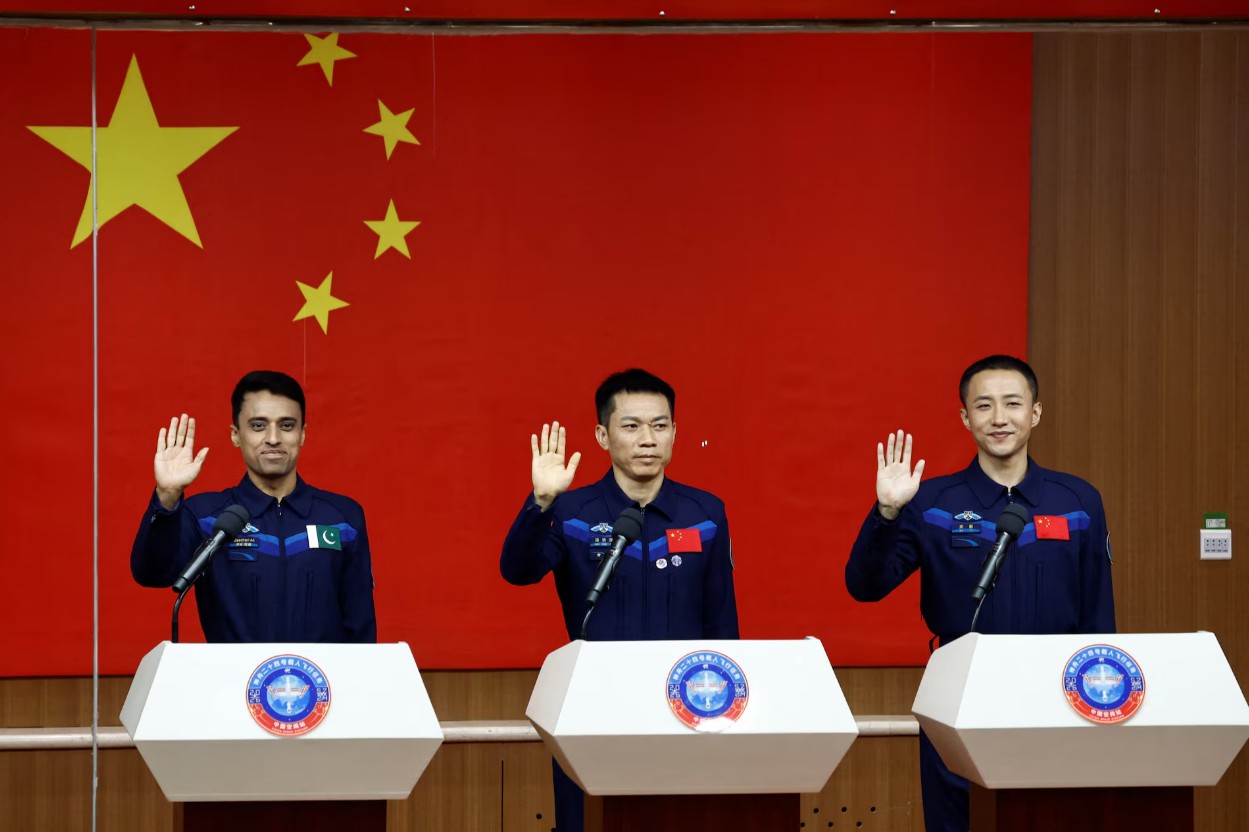
JIUQUAN (Realist English). The China Manned Space Agency (CMSA) presented the crew of the Shenzhou-24 mission on November 24, which for the first time in the program’s history will include a foreign astronaut. The launch of the spacecraft on a Long March-2F rocket from the Jiuquan Satellite Launch Center in the Gobi Desert is scheduled for the morning of November 25 local time.
Crew composition: an experienced commander and the first foreigner
Command of the mission has been assigned to Tang Hongbo, for whom this will be his third flight to the Tiangong station — he became the first astronaut to visit the Chinese orbital station three times. Wu Yi has been appointed flight engineer, for whom this is his first spaceflight.
The third crew member is Muhammad Zeeshan Ali, a 40-year-old Pakistan Air Force pilot serving as a payload specialist. His participation is stipulated by a cooperation agreement signed by China and Pakistan in February 2025. Ali will become not only the first foreigner on Tiangong, but also the first Pakistani citizen to leave Earth.
Mission objectives: a short trip and scientific experiments
Unlike standard six-month rotations, Ali is assigned a short-duration mission of about five days. During this time he will conduct four scientific projects in biotechnology and materials science, including an orbital experiment with photosynthetic microorganisms. Upon completion of the program he will return to Earth aboard the Shenzhou-23 spacecraft together with two members of the previous crew.
Tang Hongbo and Wu Yi will remain on the station for a scheduled rotation. At the same time, the current Shenzhou-23 crew led by Zhu Yangzhu will continue China’s record one-year mission, necessary for developing technologies for long-duration flights ahead of future lunar programs.
The Belt and Road and space diplomacy
The participation of the Pakistani astronaut is presented by Beijing as part of cooperation within the Belt and Road initiative and as a demonstration of the openness of the Chinese space program to international partnership. For Pakistan, the event is of national significance: Ali said he carries on his shoulders “the hopes of 250 million Pakistanis.”
China views the United States as its main rival in space and plans its own crewed lunar landing by 2030, while NASA aims for 2028. In this context, the first foreign astronaut on Tiangong becomes not only a scientific but also a political signal: Beijing positions itself as an alternative center of space cooperation.
As observers note, the key feature of the mission is the combination of a scientific program with a demonstrative effect. The short-term nature of Ali’s stay limits the scope of his research, and his status as a payload specialist rather than a full member of a long-term crew underscores that this is a first step rather than a full-scale integration of foreigners into the Chinese program.
For Beijing’s space diplomacy, the immediate effect will be visible primarily in whether Ali’s visit is followed by similar agreements with other countries and whether the number of foreign specialists on Tiangong expands — and that is where it is most sensitive for the prospects of forming an alternative to the Western model of international cooperation in space.