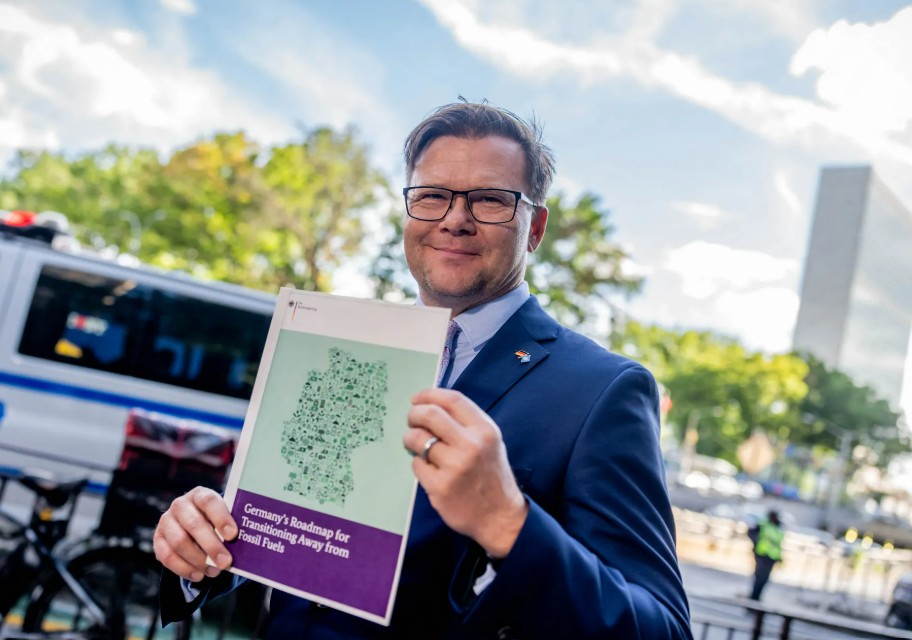
BERLIN (Realist English). On September 23, Germany’s cabinet adopted a plan called the “TAFF Roadmap” (phased phase-out of fossil fuels), clearly committing to achieving the phase-out of coal, oil, and gas by 2045. German Environment Minister Karsten Schneider officially presented the strategy on the sidelines of the UN General Assembly, calling it a “combination of independence, affordability of energy carriers, and climate protection.”
Key Goals of the Roadmap
The roadmap confirms Germany’s previously established goal of climate neutrality and for the first time includes “phase-out of fossil fuels” as a clear political commitment in an official document — previously Germany’s commitments were limited to “carbon neutrality.”
Specific goals include: increasing the share of renewable energy sources in the electricity mix from the current 55% to 80% by 2030, adding 12 GW of onshore wind energy, and reaching 215 GW of installed solar power capacity. The coal phase-out schedule remains unchanged — the legally established deadline is 2038, but the government acknowledges the possibility of accelerating it to 2035.
Regarding methane emissions, Germany plans to reduce emissions of this greenhouse gas by 30% by 2030 in accordance with the Global Methane Pledge signed in 2021.
The Real Pressure of the Energy Crisis
Presenting the roadmap, Schneider particularly emphasized that the energy shock caused by the Iran war is the direct impetus for phasing out fossil fuels. He noted: “If the situation in the Strait of Hormuz determines whether people can still afford their daily commute to work, then this is a very bad situation.”
Data confirms this concern. Wholesale electricity prices in Germany in September 2026 exceeded 180 euros per megawatt-hour, rising by more than 60% compared to the same period last year, marking the largest increase since the 2022 energy crisis.
The main driver was the surge in gas prices — Europe is struggling to refill gas storage facilities before winter, and the blockade of the Strait of Hormuz has interrupted liquefied natural gas supplies from Qatar.
Germany’s dependence on fossil fuel imports is extremely high: 98% of oil and 95% of gas are imported, with only lignite being the main domestic fossil energy carrier. In 2024, Germany’s net costs for fossil fuel imports amounted to about 76 billion euros. Schneider stated that these funds will increasingly be converted into local value creation in the future.
The Contradiction Between Reality and Goals
Despite the positive assessment of the roadmap at the international level, environmental organizations sharply point to the “obvious contradiction” between the actual policy of the German government and the transition goals.
Subsidizing gas power plants is one of the contentious points. The coalition government of Chancellor Merz supports the construction of new gas power plants to ensure electricity supply reliability, planning to convert them to green hydrogen or equip them with carbon capture technologies by 2045. However, issues of green fuel availability and carbon capture costs remain unresolved.
The stagnation in the heating transition also draws criticism. A law adopted in 2023 initially planned to ban the installation of most oil and gas heating systems, but the far-right party “Alternative for Germany” made this issue the central theme of its election campaign, forcing the rules to be weakened in early 2026. Party co-leader Weidel even called wind turbines “shameful windmills.”
Disputes over renewable energy reform continue in the Bundestag. Lower Saxony’s Environment Minister, Green Party member Christian Meyer, criticized the government’s planned grid scheme and renewable energy law reform, stating that they “will block multi-billion-euro investments in renewable energy, battery storage, and electricity grids, thereby significantly raising electricity prices.”
Progress in the Transition
Despite political contradictions, the actual data of Germany’s energy transition demonstrates positive dynamics. In the first half of 2026, the share of renewable sources in net public electricity generation reached 61.8%, wind power generation grew by 12.2% year-on-year, and solar generation reached a historic maximum of 43.2 terawatt-hours.
An analysis by the Fraunhofer Institute notes that powerful renewable energy generation has largely insulated German spring electricity prices from the impact of gas price increases caused by the Iran war.
Market drivers for the coal phase-out are also accelerating. Researcher at the Öko-Institut Hauke Hermann stated that price trends in the European Emissions Trading System indicate that the coal phase-out could be completed by market forces as early as 2031 or 2032, earlier than the legally established deadline of 2038. He noted that restarting old coal power plants amid the current energy shock “will distort investment signals” and will face legal uncertainty regarding compensation payments and state aid rules.
Outlook
Germany’s TAFF roadmap has sent an important signal at the level of international climate governance. Head of International Climate Policy at Germanwatch Peter Lüden expressed hope that other countries will also present their roadmaps as soon as possible, and COP31, which will take place in November in Turkey, will be the ideal platform for this.
However, as former German Special Envoy for Climate Jennifer Morgan stated: “The roadmap is only the starting line. To truly work, this strategy must be accompanied by a faster, more thoughtful, and fairer phase-out of fossil fuels combined with the spread of green electrification.”
For Germany, the key task is how to ensure energy security while fulfilling the phase-out commitments by 2045. Whether the “dual-track” strategy of the Merz government, simultaneously promoting the construction of gas power plants and the phase-out of fossil fuels, can maintain balance politically and in practice will determine whether this roadmap becomes a milestone of the transition or another postponed declaration of intent.