BELGRADE (Realist English). On September 9, Serbian President Aleksandar Vučić addressed the nation at noon local time, announcing the dissolution of parliament and the scheduling of snap elections for October 25.
“On the basis of the government’s proposal, I issue a decree on the dissolution of the National Assembly. The decree enters into force on the day of its publication. I announce the holding of parliamentary elections and schedule them for October 25,” Vučić stated.
The dissolution of parliament was a technically necessary step for holding early voting. On September 7, Prime Minister Đuro Macut formally proposed that the president dissolve parliament following a government session. Under Serbia’s constitution, the president may dissolve parliament on the government’s proposal.
Protests and External Pressure: Why Vučić Called Elections
The decision to hold snap elections was a direct consequence of the political crisis that has gripped Serbia since the tragedy in Novi Sad. On November 1, 2024, a concrete canopy collapsed at the city’s railway station, killing 16 people. Protesters accused the authorities of corruption and negligence that led to shoddy construction work.
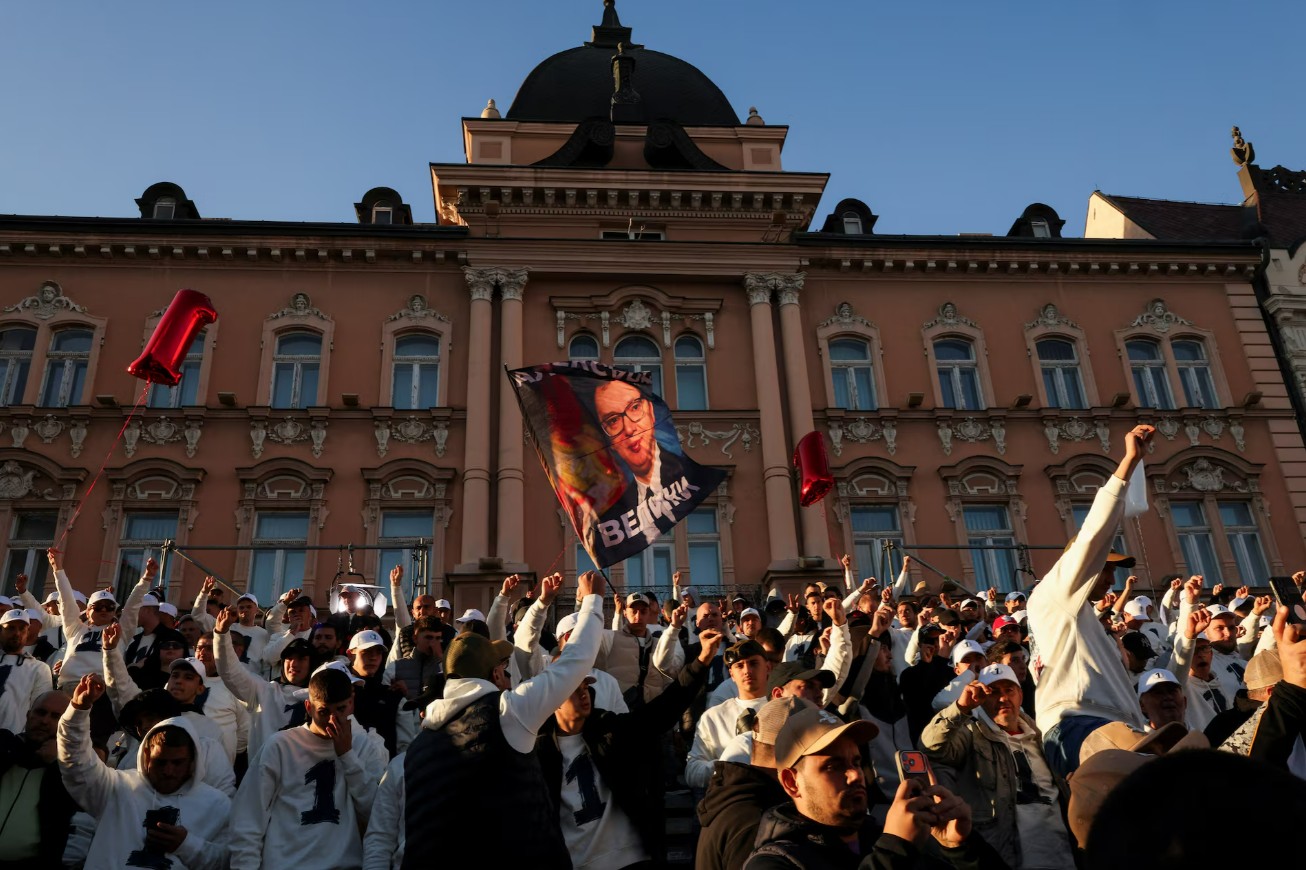
Since then, almost daily student protests have continued in Serbia, sometimes drawing hundreds of thousands of people. Demonstrators demanded accountability for those responsible and the holding of early parliamentary elections. The protests have become the most serious challenge to Vučić since he came to power in 2012.
In his address, Vučić acknowledged “huge upheavals” in Serbian society but blamed the political instability on “significant interference by external forces.” “Over the past year and a half, Serbia has gone through a period of upheaval caused not only by conflict between parties within the country,” he said. “If it were not for these tensions, disagreements and conflicts, early elections would not be necessary,” the president added.
He also linked the elections to the need to prepare for Expo 2027, the world’s fair opening in Belgrade in May next year. “We need the election results to clearly define and demonstrate the will of citizens: where, in which direction and along which path Serbia is going,” Vučić explained.
Key Dates and Procedure
| Event | Date |
| Government proposed dissolving parliament | September 7, 2026 |
| Vučić signed decrees on dissolution and election scheduling | September 9, 2026 |
| Snap parliamentary elections | October 25, 2026 |
The decrees enter into force on the day of their publication. The election campaign will last 45 days. The next regular parliamentary elections had originally been due only at the end of 2027.
Vučić Changes Seats: From President to Prime Minister
The key intrigue of the upcoming elections is Vučić’s change of position. He has held the office of president or prime minister of Serbia since 2014. In June 2026, Vučić announced that he would resign as president “within a few weeks.” His second and final presidential term expires in 2027, and he is not eligible to run for a third term.
On September 5, the ruling Serbian Progressive Party (SNS) unanimously nominated Vučić to head its party list in the upcoming elections and as its candidate for prime minister. Vučić has already stated that he will resign as president in order to take part in the parliamentary campaign. His resignation is expected in the coming days. Early presidential elections would then be held separately.
As AP notes, the upcoming vote will be a “test of his power” after nearly two years of street protests. Polls show the ruling party in the lead, and its victory would allow Vučić to remain at the helm for at least another four years — but as head of government.
Opposition and the “Student List”
The main opponent of the authorities in the upcoming elections will be the “Student List” — an association formed by participants in the anti‑corruption protests. It is expected to include university professors and experts. The movement has gained enormous support among Serbia’s 6.5 million voters, many of whom are disillusioned with mainstream politicians.
Opposition parties have already declared their readiness to participate in the election campaign. Throughout the protest period, Vučić has accused students and professors of attempting to “destroy the state.” Hundreds of participants were detained during the demonstrations, raising concerns among international organisations about police use of force.
International observers, including representatives of the OSCE, have already expressed their intention to send a mission to monitor the upcoming vote.
EU, Russia and Mladić’s Funeral
The election decision coincided with a new round of tension in Serbia’s relations with the European Union. Last week, Belgrade faced additional pressure from the EU over the public honours paid to Ratko Mladić — the former commander of the Bosnian Serb army, convicted by the International Tribunal for genocide. Mladić was buried in Serbia as a hero, despite the UN verdict.
Serbia has been a candidate for EU membership since 2012, but the accession process has stalled under Vučić amid concerns over democratic backsliding and Belgrade’s refusal to join sanctions against Russia. Vučić maintains close ties with both Russia and China.
Vučić called on political parties and voters to conduct the 45‑day campaign peacefully and with dignity, respecting different political views and the right to freedom of assembly. “I am convinced that the citizens of Serbia will choose the right path to the future,” he said.
A Referendum on Vučić’s Rule
The snap elections scheduled for October 25 will be the most significant political test for Aleksandar Vučić since he came to power. The vote is effectively a referendum on his 14 years of dominance, the Novi Sad tragedy and the government’s response to the largest protest movement in Serbia’s modern history.
Vučić’s decision to switch from president to prime minister is a tactical manoeuvre that allows him to circumvent presidential term limits and extend his hold on power. Yet it also carries risks: by tying his personal popularity to the parliamentary vote, he has made the election a direct choice between himself and the opposition.
Open questions remain. Can the fragmented opposition, united only by its opposition to Vučić, translate street protests into electoral success? Will the “Student List” manage to mobilise the millions who have taken to the streets? And how will the EU and Russia respond to a vote that will shape Serbia’s geopolitical orientation for years to come?
For now, Vučić has made his bet. On October 25, Serbia’s voters will decide whether to endorse his continued rule or embrace an uncertain alternative. The outcome will determine not only Serbia’s domestic trajectory but also its place between East and West.