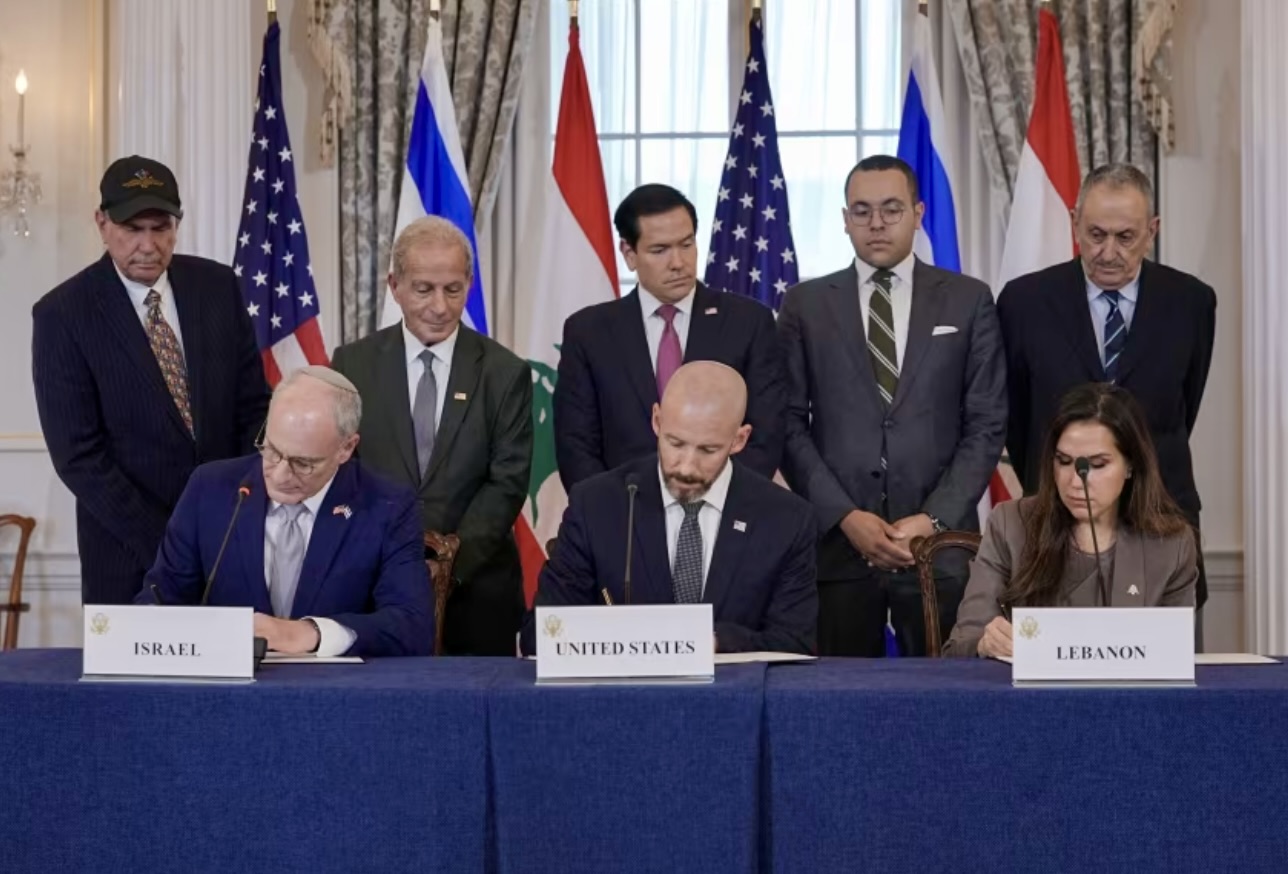
WASHINGTON (Realist English). On June 26, Israel and Lebanon signed a framework agreement in Washington that provides for the partial withdrawal of Israeli troops from two areas in southern Lebanon.
The document is the result of four days of negotiations mediated by the United States and marks the first diplomatic breakthrough in relations between the two countries since the start of the armed confrontation.
The signing ceremony took place at the US State Department, with the document being signed by Lebanese Ambassador Nada Hamed Mouawad and the head of Israel’s diplomatic mission in Washington, Yehiel Leiter.
The agreement is trilateral in nature, with the United States as the third party.
Withdrawal from Two Areas
Under the terms of the agreement, the Israel Defense Forces (IDF) will withdraw their units from two areas in southern Lebanon.
According to Israeli Prime Minister Benjamin Netanyahu, one of these zones is located north of the Litani River and the other south of it.
These are territories within the six‑mile buffer zone that the IDF had controlled in southern Lebanon. The areas have already been cleared by Israeli forces of Hezbollah infrastructure. Lebanese army units will move into their place.
Israeli officials noted that the withdrawal from these areas would be part of a “pilot programme” under the new ceasefire agreement. Netanyahu described the move as a departure from positions that the IDF “does not need.”
“First Step” vs. “Great Victory”
In Washington, the agreement was called the “beginning of the beginning.” US Secretary of State Marco Rubio stated: “Today we have taken the first step on a difficult but important and necessary path.”
Lebanese Ambassador Nada Mouawad stressed that the signing of the document is “the first step towards restoring Lebanon’s sovereignty and territorial integrity.”
Netanyahu, for his part, called the agreement a “great victory” for Israel. According to him, the move deals a blow to Iran: “Iran is trying to force us to withdraw from southern Lebanon. In effect, Israel, Lebanon and the United States are telling them: this is none of your business.”
Israeli Ambassador Yehiel Leiter described the agreement as “results‑based”: “In this trilateral framework agreement, Iran is out of the game, Hezbollah is out of the game, and the road to peace between Israel and Lebanon is open.”
Israel Remains in Southern Lebanon
The key aspect of the agreement that draws the most attention is its limited nature. The withdrawal will affect only two areas, while Israel maintains control over a significant portion of the occupied territory in southern Lebanon.
Netanyahu made it clear that Israeli forces will remain in the “security zone” until Hezbollah is disarmed. According to Anadolu, one of the two zones from which troops are being withdrawn lies outside the “initial security zone,” while a small part of the second zone is within the so‑called “expanded security zone.”
The framework nature of the agreement means that many details have yet to be finalised. According to sources, the full text of the document has not yet been released. As Axios noted, it remains unclear to what extent the agreements can be implemented as long as Hezbollah retains its weapons and influence in Lebanon.
War, Negotiations and the US Role
The conflict between Israel and the Lebanese group Hezbollah began on March 2, 2026, when the armed wing of the movement attacked Israeli positions in response to joint US and Israeli strikes on Iran. Israel’s retaliatory actions resulted in the deaths of more than 4,000 people in Lebanon and forced more than a million people to flee their homes. On the Israeli side, 32 soldiers and four civilians were killed.
The current fifth round of talks between Israel and Lebanon took place in Washington against a backdrop of extreme tension. Both sides were irritated by US actions: last week, Washington concluded a memorandum with Iran that included a clause on a ceasefire in Lebanon. Jerusalem and Beirut considered this to undermine their direct negotiations.
According to The Times of Israel, citing sources, this led to a hardening of positions: Israel significantly reduced the list of territories it was willing to hand over, while Lebanon, on the contrary, submitted maps showing broader withdrawal zones.
Hezbollah’s Reaction
The Lebanese movement Hezbollah, which is not a party to the agreement, consistently opposes any arrangement that allows Israeli presence on Lebanese soil.
The group’s Secretary‑General Naim Qassem said: “Israel has no choice but to completely withdraw its forces from all Lebanese territories.” Earlier, Hezbollah rejected earlier ceasefire agreements, calling them “capitulation.”
Thus, the framework agreement signed on June 26 is an important diplomatic breakthrough, but its practical significance remains limited for now. The “first steps” towards peace on the ground will depend on the willingness of the parties to make further concessions and on the US ability to keep the negotiation process under control.