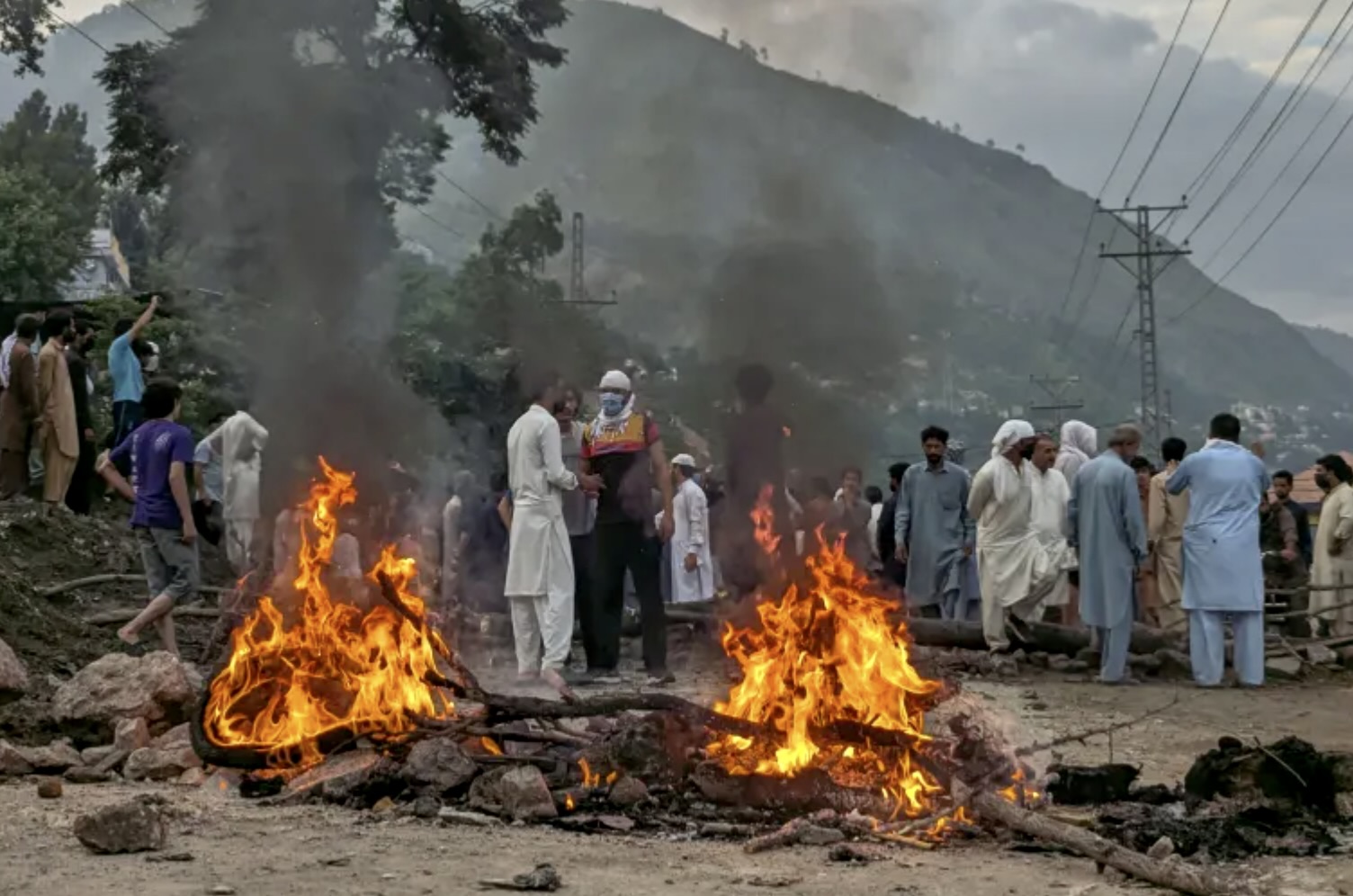
ISLAMABAD (Realist English). Pakistan-administered Kashmir – a region that Islamabad has for decades positioned as a “free” alternative to Indian rule – is gripped by its most severe political crisis in years.
Since early June 2026, protests have not subsided, escalating into armed clashes between demonstrators and security forces.
According to various estimates, the conflict has claimed between 40 and more than 120 lives. The cause: a battle for control over 12 seats in the local parliament, reserved for refugees who left the region back in 1947.
‘The 12 seats’ – the spark that ignited Kashmir
Formally, Pakistan-administered Kashmir (known as Azad Jammu and Kashmir) has its own legislative assembly of 53 seats. However, 12 of these are reserved for Kashmiri refugees who, after the partition of British India in 1947, moved to other parts of Pakistan and now reside outside the region.
This provision has become the bone of contention. Local residents and the opposition movement “Jammu and Kashmir Joint Awami Action Committee” (JAAC) are demanding the abolition of the reservation, arguing that these seats are used by the federal centre to influence the region and disenfranchise those living in Kashmir.
The authorities, in turn, insist on maintaining the quotas, citing historical justice and constitutional guarantees. Talks between the JAAC and the regional government reached a deadlock at the end of May.
Chronology of escalation: from talks to bullets
On 5 June, the Azad Kashmir authorities banned the JAAC under anti‑terrorism laws, accusing the movement of “undermining peace and security.” In response, protests erupted across the region. At the same time, internet and mobile communications were cut off.
On 7 June, the Azad Kashmir Supreme Court confirmed the constitutionality of the 12 reserved seats, effectively closing the door to a political settlement.
On 8–9 June, in the city of Rawalakot – the epicentre of the protests – the first major clashes occurred. Eleven people died, including civilians and police officers.
By the end of July, despite the JAAC ban, the protest movement was only gaining momentum. On 27 July – the first day of the three‑phase elections – new clashes broke out across the region. The highest number of casualties was in Rawalakot.
By early August, the death toll, according to various reports, had exceeded 40, with some sources reporting more than 110 dead and over 200 wounded over the two‑month period.
On 6–7 August, elections in two constituencies were postponed due to security threats. The third and final phase of voting is scheduled for 10 August.
A weapon of propaganda: AI video as a tool of information warfare
Amid the real violence, a video appeared on social media showing a person firing a pistol at security forces. The authors claimed it was “a JAAC member killing two policemen.” However, AFP fact‑checkers determined that the video was entirely generated by artificial intelligence.
In an environment of information blackout and a ban on independent journalists, such fakes are actively circulated by both supporters of the protesters and the authorities seeking to discredit their opponents. Pakistani media, fearing threats, have largely limited their coverage to the elections themselves, rather than the protests.
Islamabad’s response: ‘wisdom and restraint’ under fire
Official Islamabad has called the events “India’s attempt to destabilise the region.” Lieutenant General Ahmed Sharif Chaudhry, head of the Inter‑Services Public Relations (ISPR), said the authorities are showing “wisdom and restraint.” However, he did not provide an official figure for civilian casualties.
India, for its part, called the elections in Pakistan‑administered Kashmir a “complete farce,” pointing to “mass protests and indiscriminate killings of civilians.” Delhi also accused Islamabad of “decades of systematic exploitation and denial of fundamental rights.”
International human rights organisations, including Amnesty International, have documented cases of indiscriminate firing on peaceful demonstrators.
The final phase of elections is scheduled for 10 August, but the prospects for peaceful voting appear bleak. The information blockade in the region remains in place, and access for foreign journalists is restricted. The JAAC, despite the ban and criminal prosecution of its leaders, continues to call for a boycott of the elections and new protest actions.
The region that Islamabad called “the jewel in its crown” has found itself at the epicentre of a storm. And its causes lie not in geopolitics, but in the 75‑year‑old contradictions of Pakistan’s own model of governing a disputed territory.