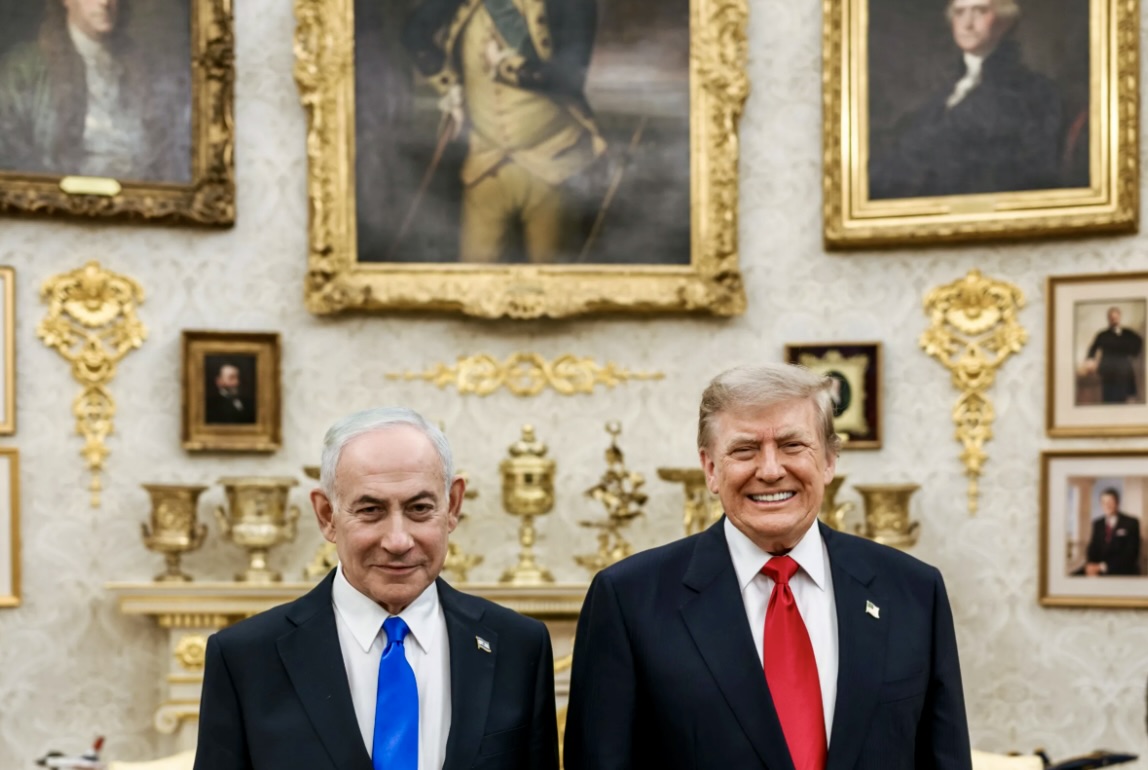
JERUSALEM (Realist English). Israeli Prime Minister Benjamin Netanyahu has officially rejected US President Donald Trump’s Gaza peace plan, declaring that Israeli forces will not leave the sector until Hamas is “genuinely disarmed.”
The statement came amid growing pressure from ultra‑right members of his coalition demanding the deal be scrapped, with parliamentary elections scheduled for 27 October 2026.
“Israel rejects the 15‑point document published by the Board of Peace for Gaza,” Netanyahu said at a Sunday cabinet meeting. Israeli forces “will not carry out any withdrawal of troops until Hamas is truly disarmed, and will continue to neutralise threats to our forces and citizens,” the prime minister stressed.
Netanyahu’s ultimatum: no compromises
Netanyahu’s rejection was an unexpected but calculated move. Just a week ago, Trump had announced a “breakthrough” agreement under which Hamas would disarm for the first time, provided Israel withdrew its troops from Gaza. But the Israeli premier made it clear: the sequence is non‑negotiable.
“We are talking about real disarmament, not fictitious disarmament,” Netanyahu said, clarifying that this means the removal of “heavy weapons, light weapons, any weapons.” Israel is consulting with the US side, he added, but “they have ideas – some are acceptable to us, some are not, and we know how to stand our ground on these issues.”
At the same time, Netanyahu reaffirmed his principled position on Palestinian statehood: “As long as I am prime minister, no Palestinian state will be established – neither in Gaza nor on the West Bank.”
Ultra‑right against the deal
Netanyahu’s rejection of Trump’s plan was the result of intense pressure within his own coalition. National Security Minister Itamar Ben‑Gvir had earlier called the deal “unacceptable,” while Finance Minister Bezalel Smotrich demanded that the cabinet hold a new vote on the plan.
With elections looming in October, Netanyahu is caught between two fires: on one side, his key military ally – President Trump, who wants progress in resolving the conflict; on the other, ultra‑right ministers demanding a hard line in Gaza. The prime minister appears to have chosen the right‑wing electorate, publicly distancing himself from the White House plan.
Hamas insists: ‘We are ready to implement’
Unlike Israel, Hamas confirmed its commitment to the agreements reached. Senior movement official Basem Naim told Reuters that the group remains committed to the roadmap agreed with mediators in Cairo 10 days ago.
“We expect the mediators and the US guarantor to call on Netanyahu and his government to adhere to the roadmap and not obstruct the process for domestic political and electoral reasons,” Naim stressed.
Hamas also said it is ready to “participate seriously and responsibly in implementing” the 15‑point plan.
What does Trump’s 15‑point plan entail?
The plan, unveiled by the Board of Peace led by Trump on 30 July, provides for the phased disarmament of Hamas in exchange for a full Israeli withdrawal and the transfer of Gaza’s governance to an independent Palestinian national committee supported by international security forces. The document details weapons removal, destruction of tunnels and warehouses, and the establishment of a technocratic government.
However, as the BBC notes, disarmament and troop withdrawal were likely meant to be phased. By demanding disarmament before any withdrawal, Netanyahu effectively calls into question the plan’s underlying logic.
The Board of Peace – a body created by Trump in October 2025 with the US president as lifetime chairman – has “very limited authority” to advance the plan without Israeli support.
Reaction and consequences
Netanyahu’s rejection is a serious blow to Trump’s diplomatic efforts. According to UN data, more than 73,000 Palestinians have been killed since the start of the Gaza war, with about 1.9 million people (90% of the sector’s population) displaced.
As CNN notes, “Netanyahu hit the reset button.” Al Jazeera emphasises that the Israeli premier’s statement seriously calls into question the sequence of steps for exiting the conflict.
Netanyahu said Israel would continue discussions with US officials, but made it clear: there will be no concessions. With less than three months to go before Israel’s October elections, the prime minister appears ready to sacrifice relations with the White House to preserve his right‑wing coalition.
Hamas, for its part, continues to insist on implementing the agreement. Mediators in Cairo, including Egypt and Qatar, find themselves in a difficult position: a plan agreed with one side has been rejected by the other.
The Gaza war, which has been ongoing since October 2023, shows no sign of ending. Trump announced a “breakthrough”; Netanyahu said no. The question is whether the White House can persuade the Israeli prime minister before the elections – or whether Gaza will remain hostage to Israel’s internal political battles.