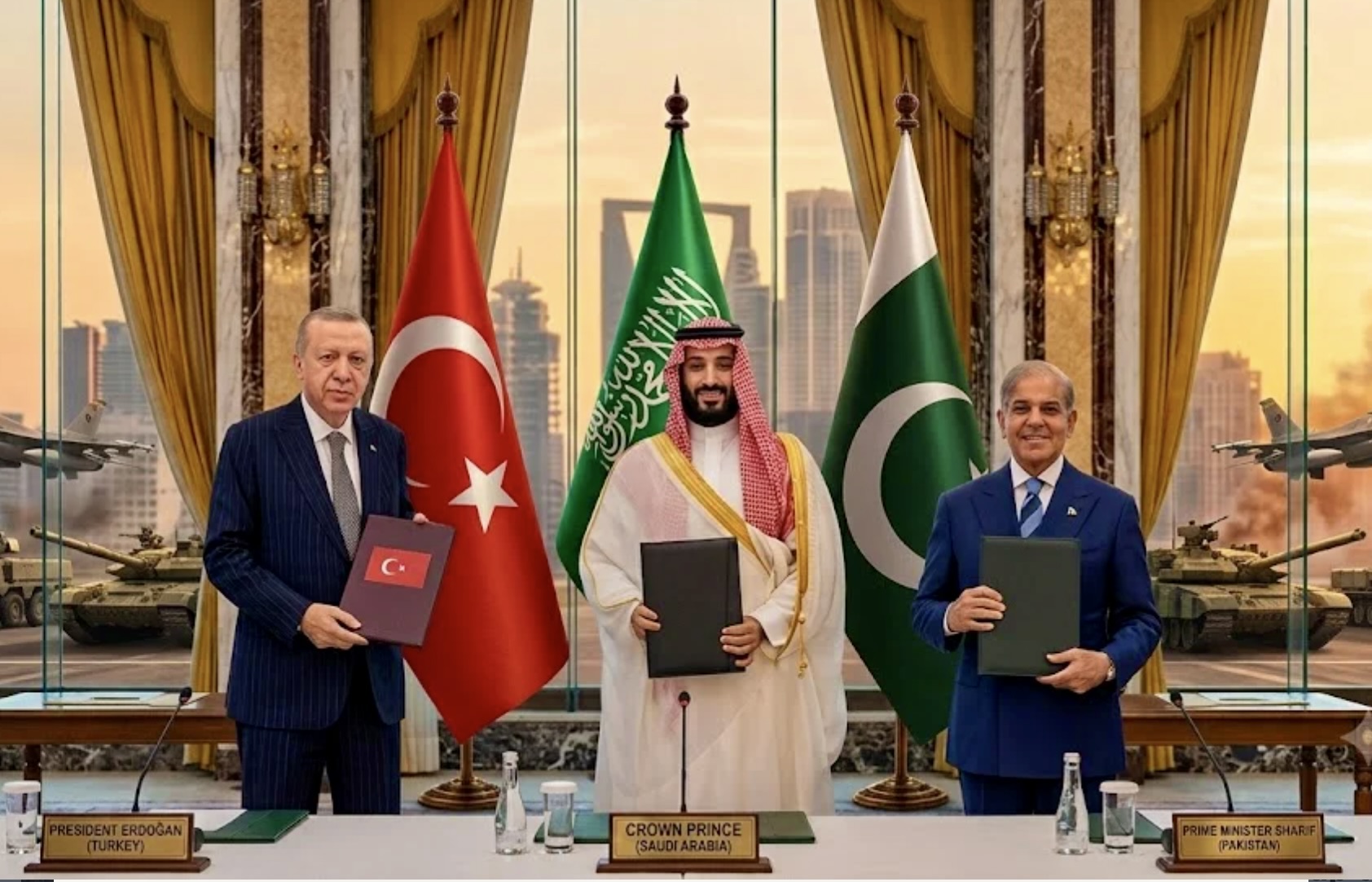
ANKARA (Realist English). A joint defence agreement has been signed between Turkey, Saudi Arabia and Pakistan. Under current conditions, the question arises: where could an attack on Saudi Arabia come from? It could come from Iran. Iran is currently the main enemy of the US and Israel. In short, Recep Tayyip Erdoğan has entered into confrontation with his neighbour Iran for the sake of Israel’s security.
Washington and Tel Aviv, on the other hand, are putting pressure on their main enemy through Turkey. On the other hand, Washington is using its friend Erdoğan as a mediator. The alliance we have formed with Saudi Arabia under the agreement signed in Mecca directly represents the US and Israel. Pakistan directly represents the United Kingdom, which is also on the same side as the US and Israel.
This agreement is directly linked to the second phase of Turkey’s opening process. By calling the agreement between Israel, the US and the UK – which are nothing more than puppets of these two countries – the “Mecca Agreement,” it may seem plausible to the average citizen, but for Turkey it carries enormous risks.
Iran has already responded
Aware of all this, Iran immediately reacted: Ibrahim Rezaei, spokesman for the Iranian Parliament’s National Security and Foreign Policy Commission, sharply criticised Saudi Arabia after the signing of the joint defence agreement between Turkey, Saudi Arabia and Pakistan:
“The Saudis must understand that an agreement with Turkey and Pakistan will not bring them security. Just as years of one‑sided American support did not bring them security. Turkey is already a NATO member. Did it need such a treaty? If Saudi Arabia and Pakistan come under attack, why should we be forced to take their side?”
A test of durability
A clearer question: Saudi Arabia has numerous American bases and critical facilities. What if our neighbour Iran, in response to US and Israeli attacks, bombs American bases and oil facilities in Saudi Arabia? Saudi Arabia is in conflict with the Houthis in Yemen and is a target for Iran. It also has problems with Hashd al‑Shaabi, an influential force in the Iraqi government.
The ongoing Houthi attacks on Saudi Arabia provide an immediate test. Will they lead to meaningful Pakistani or Turkish involvement against the Houthis? The Houthis have already shot down a Turkish‑made Bayraktar drone, although it appears to have been operated by Saudi Arabia, not Turkey itself. This distinction matters. A much bigger question is what would happen in the event of a real regional escalation. Imagine, for example, that Iran responds to a US strike by attacking Saudi oil infrastructure. Would Turkey and Pakistan really be prepared to take military action against Iran? This is where declarations of solidarity meet geopolitical reality. Neither Ankara nor Islamabad is eager for confrontation with Tehran, and Pakistan’s traditionally cautious approach to Iran illustrates just how difficult such a decision would be.
Pakistan has been involved in a conflict with India in Jammu and Kashmir for 80 years – a conflict that frequently flares up. Every time, America intervenes to stop it.
NATO and economic realities
If we, as a NATO member, took a side in an attack on Saudi Arabia or Pakistan, would NATO invoke Article 5 and support us? How can Turkey, with a protective shield like NATO, sign a security agreement with Saudi Arabia and Pakistan that includes a clause stating that “an attack on one of us is an attack on all of us”? This is likely linked to Erdoğan’s need for significant financial resources amid severe economic difficulties.
One of the most important factors behind this development is Riyadh’s disappointment and its declining willingness to rely exclusively on the United States for its security. However, Washington will not necessarily view the agreement negatively. An arrangement that promotes regional stability without requiring additional American military resources may well fit into the long‑standing US demand for regional partners to take on more responsibility for their own security. President Trump in particular has repeatedly described Turkey as an important regional actor.
However, there is a significant limitation: resources. Turkey faces serious economic constraints, while Saudi Arabia is experiencing its own growing fiscal pressures. This may be an important political and strategic agreement, but creating a truly integrated military architecture will require significantly more money, capabilities and political resolve than a mere signature. In this sense, the agreement can also be understood as another consequence of the region’s failed attempts to deter Iran through escalation alone.
The price and consequences
This is a stage in a plan designed to use Turkey in a war against Iran and then weaken it in the ensuing chaos. The festering wound is spreading, causing irreparable damage to the entire system. A potential war with Iran would serve only Israel’s interests. How do we stop this?
The use of Mecca’s sanctity is another tragedy! Iran will attack the Arabs, and we will launch a ground offensive against Iran. What Mecca? This is an agreement concluded under an American mandate.
Arif Asalıoğlu is a Turkish political scientist, writing exclusively for Realist English