BUCHAREST (Realist English). Israeli defence company Rafael Advanced Defense Systems and Romania’s Ministry of Defence have signed a framework agreement for the supply of Spyder air defence systems worth more than €2 billion ($2.3 billion).
The contract is the largest in Rafael’s history and the second largest in the history of Israel’s defence industry — after the sale of the Arrow 3 system to Germany for $3.5 billion in 2023.
Deal Details: What Romania Will Receive
The first order under the framework agreement was signed last week. Under the deal, the Romanian military will receive:
- launchers and interceptors;
- radar stations;
- training programmes and logistical support.
According to Rafael, the first system is to be deployed within 36 months of signing. The contract provides for “broad industrial cooperation and localisation of production in Romania.”
According to Romania’s Defence Ministry, the first contract includes one integrated SHORAD-VSHORAD system, three VSHORAD systems, one SHORAD system, as well as specialised training and simulation infrastructure.
The framework agreement, concluded in July 2025, provides for the supply of six integrated SHORAD-VSHORAD systems, six SHORAD and six VSHORAD systems with corresponding ammunition, training and logistics.
Spyder Specifications
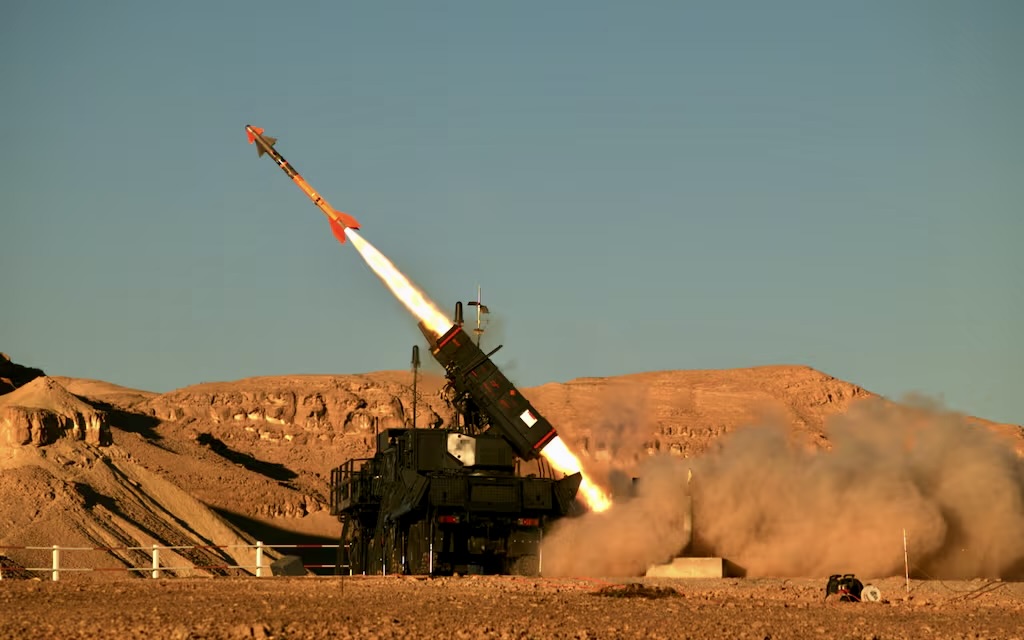
Spyder (Surface-to-air Python and Derby) is a mobile short-range and very short-range air defence system (SHORAD-VSHORAD), developed on the basis of Rafael’s air-to-air missiles — radar-guided Derby and thermal-imaging Python 4 and Python 5. The system is complemented by MMR multi-mission radar stations manufactured by Israel Aerospace Industries.
The system is capable of launching up to four interceptors simultaneously, engaging targets at ranges of up to 40 km and altitudes of up to 12 km. Spyder is designed to counter a wide range of aerial threats, including unmanned aerial vehicles, cruise missiles, guided munitions, aircraft and helicopters.
Threats for Romania and European Rearmament
The deal comes amid heightened tensions in Europe due to the Russia-Ukraine war. As NATO’s eastern flank, Romania has repeatedly faced incidents involving drones falling on its territory.
In early June, a drone exploded in the Romanian port city of Constanța, and a week earlier, a Russian drone crashed into a residential building in the city of Galați, near the border with Ukraine.
Romanian officials stressed that the procurement meets NATO requirements and is aimed at strengthening defence against a wide range of aerial threats, including drones and cruise missiles.
Notably, Spyder was developed exclusively using Israeli technology and resources, unlike systems such as David’s Sling or Arrow 3, which were developed with US participation and funding. This simplifies export procedures, as it does not require US State Department approval.
Significance for Israel and Rafael
For Rafael, the contract is the largest in the company’s history. Rafael CEO Yoav Turgeman stated that Romania’s choice is “further proof of the growing trust European countries have in the company’s battle-proven air defence systems.”
Rafael’s chairman of the board, Professor Yuval Steinitz, called the agreement “strategic,” noting that it reflects both the company’s technological capabilities and the deepening defence partnership between Israel and Romania.
Rafael has previously supplied Romania with Spike anti-tank missile systems, electro-optical systems and communications equipment for all branches of the military. The new contract expands a cooperation that has been developing for more than three decades. Spyder has previously been delivered to the Czech Republic, India, Vietnam and Cyprus.
According to statistics, Europe has become the largest market for Israeli weapons: by 2025, the region will account for 36% of Israel’s total arms exports. The deal with Romania strengthens Israel’s position in the promising European arms market.
The signed contract has become not only the largest in Rafael’s history, but also an important strategic step for Romania in strengthening its air defence amid growing threats.
For Israel, the deal confirms its status as one of the world’s leading arms exporters and opens up new prospects for cooperation with European NATO countries.