NAYPYIDAW (Realist English). Myanmar’s Ministry of Foreign Affairs issued a statement on 21 November calling the ASEAN leaders’ decision on implementing the Five-Point Consensus (5PC), adopted at the 49th summit in Manila, “unfair and imbalanced.” According to the ministry, the document “does not adequately reflect the positive measures taken by the relevant ASEAN member state.”
Myanmar’s position: emphasis on “positive developments”
The Myanmar Foreign Ministry’s statement lists the steps the authorities consider evidence of progress. Among them are the creation of the ASEAN Affairs Committee under the presidential administration on 29 September and the dissemination of information about efforts to implement the 5PC among member states and the ASEAN Secretariat on 14 October.
It also claims that since February 2021, the National Solidarity and Peace Negotiation Committee has held 180 meetings and discussions with various stakeholders, and more than 126,000 prisoners have been pardoned or amnestied.
Separately, Myanmar’s Foreign Ministry stated that there are “no political prisoners” in the country. This claim contradicts UN and human rights organisation data, which report thousands of political prisoners detained since the 2021 coup.
ASEAN’s decision: restrictions maintained
At the 15 November summit, ASEAN leaders decided to maintain the current format of Myanmar’s participation: at summits and foreign ministers’ meetings, the country may only be represented by a non-political representative. This restriction has been in place since October 2021 following insufficient progress in implementing the 5PC.
At the same time, ASEAN allowed for the possibility of gradually restoring full political representation for Myanmar. The final document states that the bloc “may consider the gradual restoration of Myanmar’s full political representation” subject to “sustained and concrete progress” in implementing the 5PC. However, the criteria for such progress, the verification mechanism and the timeframe have not been defined.
Myanmar’s participation in sectoral ministerial meetings and ASEAN mechanisms is not restricted.
Reassessment of relations and isolation
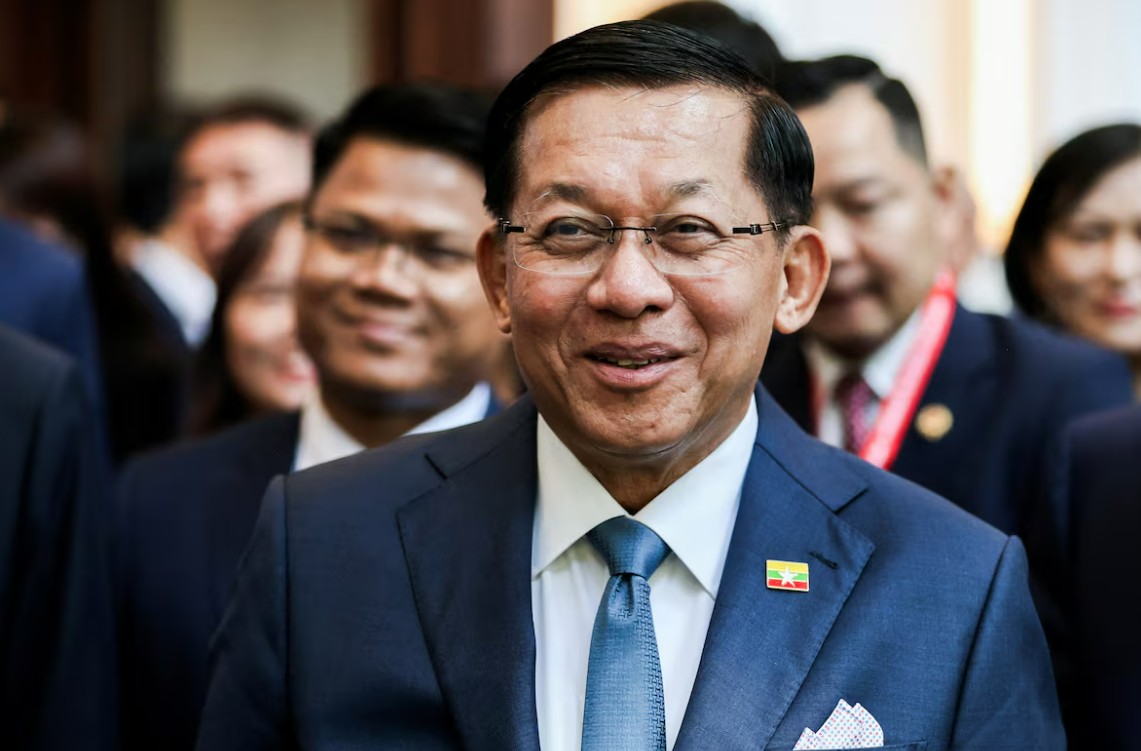
The Foreign Ministry’s statement followed remarks by Myanmar’s de facto leader Min Aung Hlaing, who told parliament on 18 November that the government would “reassess” future relations with ASEAN. He called the bloc’s position “unreasonable” and accused ASEAN of discriminatory pressure that other member states experiencing political crises had not faced.
Min Aung Hlaing also claimed that ASEAN’s position reflects not the consensus of all members but the opinion of “three countries,” which he did not name. According to him, a number of member states had privately expressed a desire to see Myanmar at ASEAN meetings.
Against this backdrop, Myanmar remains significantly isolated internationally. As Reuters notes, since the 2021 coup the country has been mired in a civil conflict that, according to UN estimates, has claimed about 100,000 lives and displaced more than 3.5 million people.
As observers note, the key feature of the situation is the gap between ASEAN’s wording and the absence of verifiable criteria. The decision on “gradual restoration” of representation creates a mechanism for bringing Myanmar back to the negotiating table, but does not establish who will assess “concrete progress” or on what indicators.
This leaves room for interpretations in which Myanmar’s authorities can present their own steps — such as the creation of the ASEAN affairs committee or amnesties — as sufficient progress.
For regional diplomacy, the immediate effect will be most noticeable primarily in whether ASEAN unity on the restrictions holds and whether Myanmar’s statements are followed by practical steps to distance itself from the bloc — and that is precisely where it is most sensitive for the prospects of resolving the crisis.