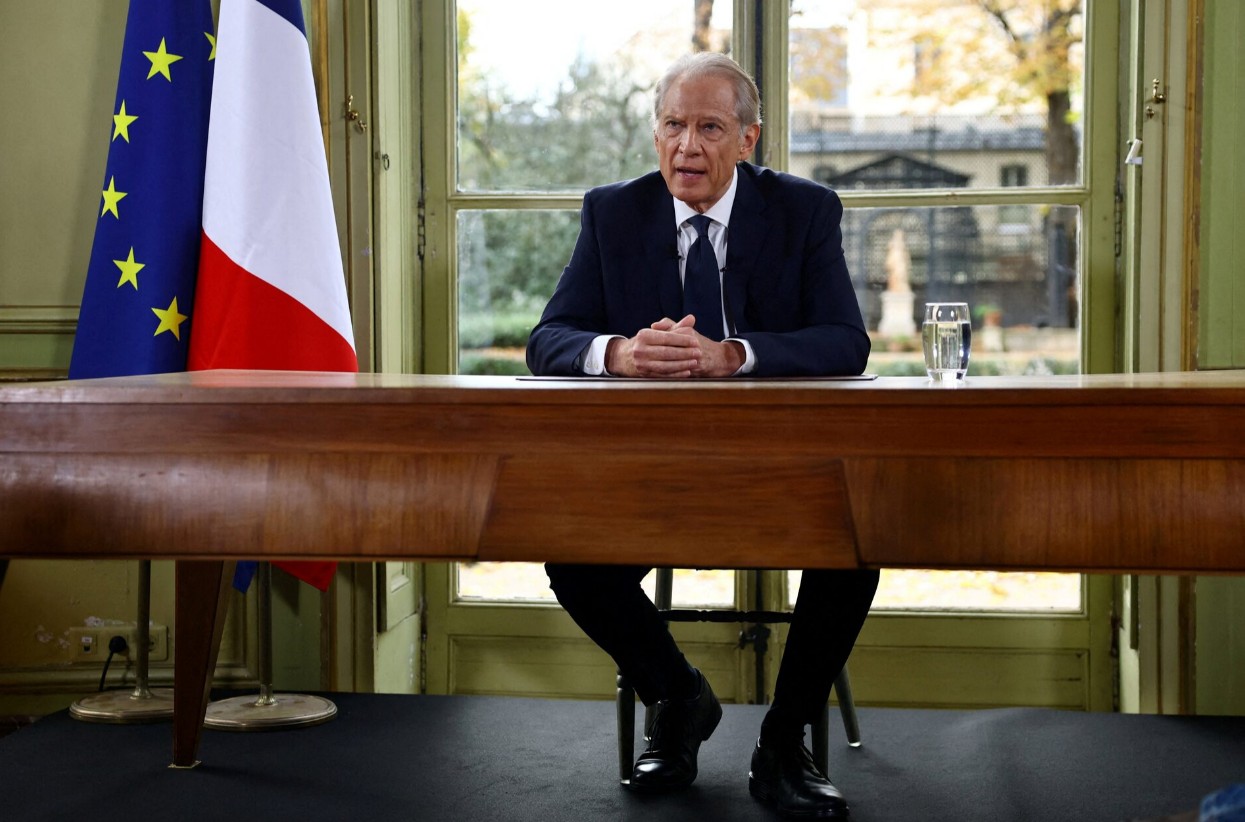
PARIS (Realist English). Former French Prime Minister Dominique de Villepin on 20 November officially announced his candidacy in the 2027 presidential election. The announcement was made at a press conference in Paris, where the politician presented his election programme.
Positioning: an alternative to three “forces of division”
De Villepin, who headed the government under Jacques Chirac from 2005 to 2007, is building his campaign as an alternative to three political forces that, in his view, are responsible for the country’s “decay”: “Macronism,” La France Insoumise and the National Rally.
He accused Macronism of “setting French people against one another,” and presents his movement La France Humaniste, founded in June 2025, as a cross-party project.
At the same time, de Villepin stressed that he does not equate the National Rally with La France Insoumise, describing the former’s legacy as “racist and antisemitic.”
Programme: 258 proposals and the priority of public finances
De Villepin’s election programme contains 258 proposals, divided into four sections: “Speaking the truth,” “Restoring the state,” “Living together” and “Continuing France.” He names restoring order to public finances as his first priority: adopting an organic law enshrining a multi-year deficit reduction trajectory with the aim of falling below the 3% threshold by 2031.
Other initiatives include an “exceptional commission of inquiry” into the deterioration of public finances over the past ten years, regular referendums on key issues, and putting pension reform to a popular vote in April 2028 after consultations with experts and citizens.
Low ratings and the signature problem
Despite his name recognition, de Villepin faces significant electoral difficulties. According to early-November polls, his support stood at around 3%. In a recent Ifop-Fiducial poll, he received just 1.5% of the vote in an expanded first-round scenario.
A key obstacle remains the collection of 500 signatures from elected officials required to register a candidacy. According to his team, about 300 pledges of support have been gathered so far. In 2012, de Villepin failed to clear this threshold and did not run.
As observers note, the key feature of de Villepin’s campaign is the gap between his name recognition and his electoral base. His main foreign policy triumph — his 2003 UN speech against the war in Iraq — earned him an international reputation, but in French domestic politics he remains a figure without a stable electoral core. Sympathy for him is higher among left-wing and young voters, who, however, are unlikely to vote for him.
In addition, criticism of him is linked to his commercial activities after leaving politics, including paid lectures abroad, primarily in China; the politician himself rejects accusations of a conflict of interest. For the French election campaign, the immediate effect will be most noticeable primarily in whether de Villepin can gather the required signatures and change the polling dynamics — and that is precisely where his candidacy is most sensitive for the configuration of the first round, where Marine Le Pen and Jean-Luc Mélenchon currently lead.