LIMA (Realist English). Pope Leo XIV has concluded a 12-day apostolic visit to South America, the longest of his pontificate and his sixth foreign trip. The journey covered Uruguay, Argentina and Peru — countries where the pontiff spent decades as a missionary and where his former diocese is located.
Return to Chiclayo: “All Christians are missionaries”
The central moment of the visit was Leo XIV’s return to the Diocese of Chiclayo in northern Peru, where he served as bishop for eight of the twenty years of his missionary service. According to the Holy See, about 500,000 people attended the open-air Mass on the Pimentel plain, with another million lining the pontiff’s route.
In his homily, Leo XIV stressed that the missionary calling extends to all Christians, not only to clergy: “All Christians, whether ordained ministers or laypeople, regardless of the degree of education we have received in the faith, are missionary disciples.” For most laypeople, he said, the task of evangelisation takes the form of “the witness of a genuinely Christian and consistent life.”
The pontiff also mentioned surgery to remove a cancerous lung tumour less than a month earlier, thanking the faithful for their prayers for his health.
Social doctrine: an economy at the service of the human person
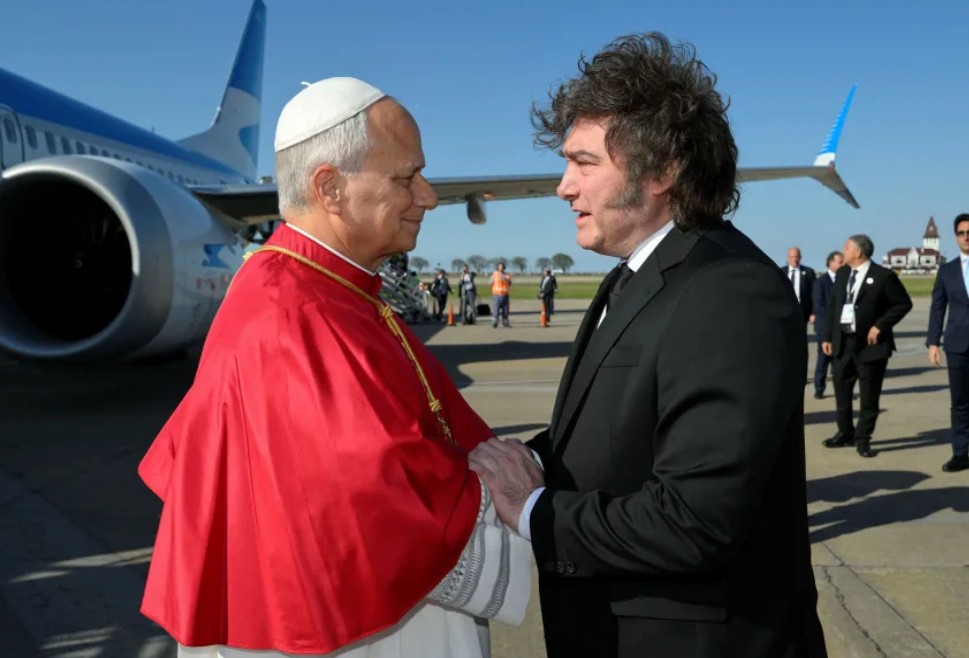
Throughout the trip, Leo XIV consistently invoked the Church’s social doctrine, contrasting it with ideological approaches. In Argentina, speaking before President Javier Milei, he stated that “the economy serves the human person, not the human person the economy.”
In Uruguay, in the poor Montevideo neighbourhood of Casavalle, the pontiff drew attention to child poverty, saying that “a son of this country, so rich in resources, should not go to bed hungry.”
In Peru, at a meeting with President Keiko Fujimori, he called for “the wealth and resources of society not to be directed exclusively to the benefit of the few, but to contribute to the development of all.” In his homily in Lima, Leo XIV returned to the theme of mission, calling for “proclaiming the true God” and bearing witness to what had been seen and heard.
Scale and symbolism
The visit attracted considerable attention: according to EFE estimates, more than 13 million people took to the streets of the three countries to take part in events with the pontiff. In Argentina, about 2.5 million people attended the Mass at the Spanish Monument in Buenos Aires, with another million at a prayer vigil with young people. In Peru, the Mass in Chiclayo drew about 500,000 participants, according to the Vatican.
For Leo XIV, the first missionary pope elected to the throne in a century, the trip was not only a pastoral visit but also a return to his roots: he spent two decades in Peru before being called to the Vatican.
As observers note, the key feature of the visit was the combination of pastoral and social dimensions while deliberately distancing himself from party politics. The pontiff did not propose specific political solutions but articulated principles that, in his view, should underpin economic and political life: human dignity, the common good, solidarity and the universal destination of goods.
For the Catholic Church in the region, the immediate effect will be most noticeable primarily in how the proposed agenda resonates with young people and how it is received by political leaders in countries where social inequality remains a key challenge — and that is precisely where it is most sensitive for public debate.