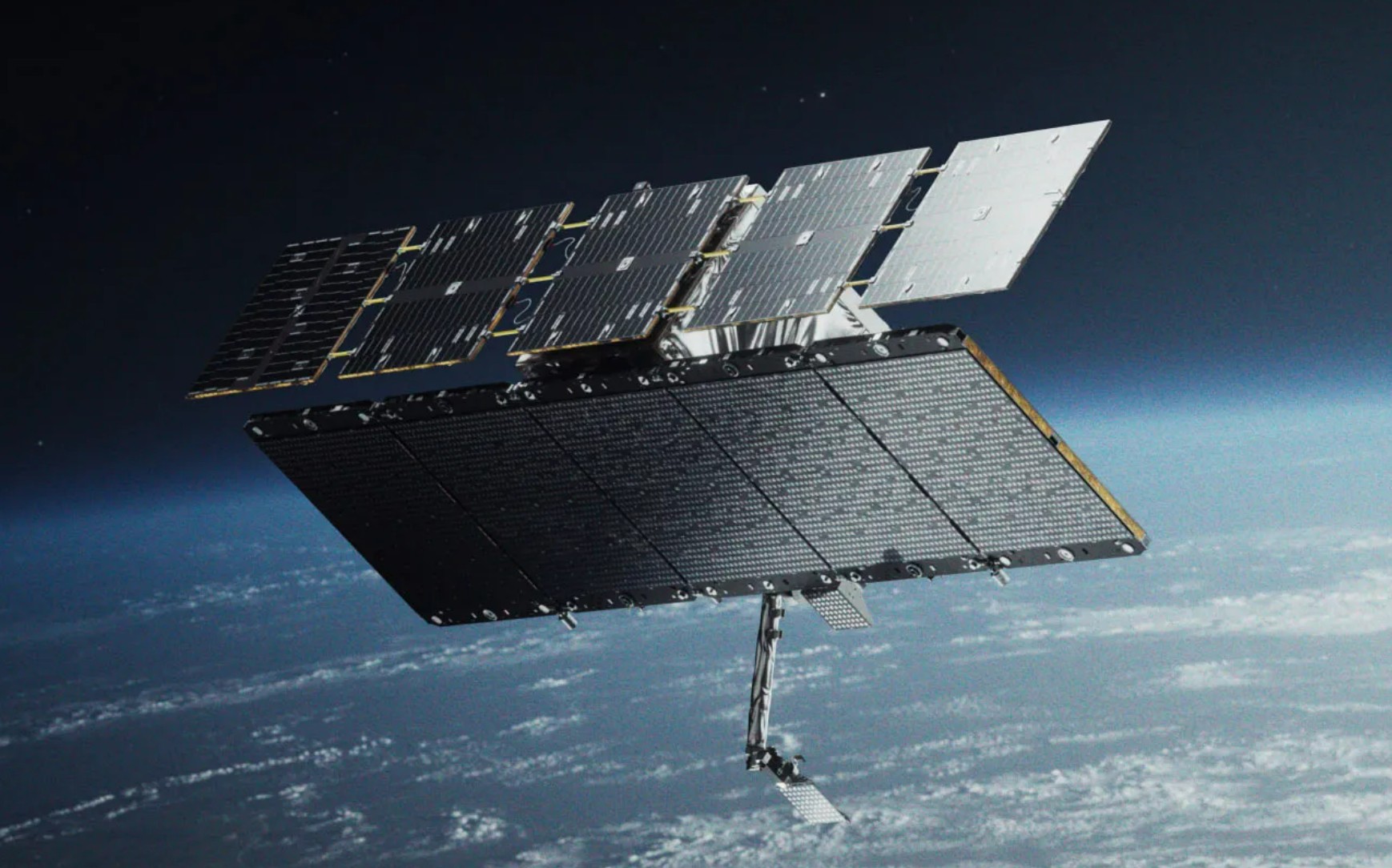
HELSINKI (Realist English). Finnish company Iceye Oy, operator of the world’s largest synthetic aperture radar (SAR) satellite constellation, has unveiled its fifth-generation Gen5 satellites. According to Bloomberg, the new spacecraft provide image resolution of up to 11 centimetres, compared with 16 centimetres for the previous generation, allowing analysts to identify smaller objects on the ground. In addition, an onboard AI processor enables data processing directly in orbit and accelerates the delivery of intelligence.
Technical characteristics: from resolution to speed
The key improvement in Gen5 is not only about detail. Iceye satellites operate in SAR mode, which uses radar pulses and does not depend on lighting or weather conditions — they “see” through clouds, smoke and in the dark. This makes them in demand for military intelligence, border surveillance, maritime security and infrastructure monitoring.
The previous generation, Gen4, whose commercial availability was announced earlier, provided resolution of up to 16 cm and a swath width of up to 400 km. Gen5 continues this line, adding onboard analytics: instead of transmitting “raw” images to the ground for processing, the satellite itself identifies significant changes and objects, cutting the customer’s response time from hours to minutes.
Business model: sovereign intelligence without ITAR
Iceye builds its business not only on selling data from its own constellation but also on transferring satellites under the full control of governments. The company supplies “sovereign” systems that do not fall under US ITAR export restrictions, together with ground infrastructure and training, ready for operation within 12 months of signing a contract.
This model has already found demand. Poland received the MikroSAR (POLSARIS) system less than a year after signing the contract. Sweden concluded a multi-year agreement for the supply of SAR systems for its armed forces.
Germany, through the Rheinmetall ICEYE Space Solutions joint venture, ordered Gen4 satellites for its own constellation. Portugal, under the Atlantic Constellation programme, received several spacecraft, including the country’s first sovereign SAR satellite.
According to EMSNow, Iceye’s revenue in 2025 exceeded €250 million, and its order book was estimated at €1.5 billion. The company plans to increase production from about 50 satellites per year to 100 in 2027.
A shift in government customers’ priorities
The unveiling of Gen5 comes amid growing demand for space intelligence in Europe, America and the Indo-Pacific. As Iceye CEO Rafal Modrzewski notes, “the era of relying on a single expensive satellite for national security is ending.”
Governments increasingly view space intelligence not as a strategic advantage but as an operational necessity requiring answers “in minutes, not days.”
This logic also explains Iceye’s model with many relatively small spacecraft: a distributed constellation is more resilient to the loss of individual satellites, and a high frequency of passes over areas of interest provides more prompt surveillance than a few large platforms.
Limits and risks
As in any market oriented toward government defence orders, the resilience of Iceye’s position depends on budget cycles and the political priorities of customer countries. In addition, competition in the SAR segment is intensifying: both traditional defence contractors and new satellite constellation operators are entering the market.
A separate question is how quickly customers are prepared to move to Gen5 given already deployed or contracted previous-generation systems. Iceye is betting on a software-defined architecture that allows satellite functions to be updated remotely without replacing the spacecraft.
This lowers the barrier to transition and extends the service life of already launched systems. For the space intelligence market, the immediate effect of Gen5 will be most noticeable in the segment of government contracts for sovereign systems — and that is precisely where it is most sensitive for competition between commercial operators and national space programmes.