MOSCOW (Realist English). According to the Laboratory of Solar Astronomy of the Space Research Institute (IKI) of the Russian Academy of Sciences and the Institute of Solar-Terrestrial Physics of the Siberian Branch of the Russian Academy of Sciences, when counted by Moscow time the daily number of flares reached 29, which corresponds to a record at least since 2000 according to the NOAA world catalogue. The threshold of 30 flares per day by Moscow time has never been exceeded in the 21st century.
What exactly happened
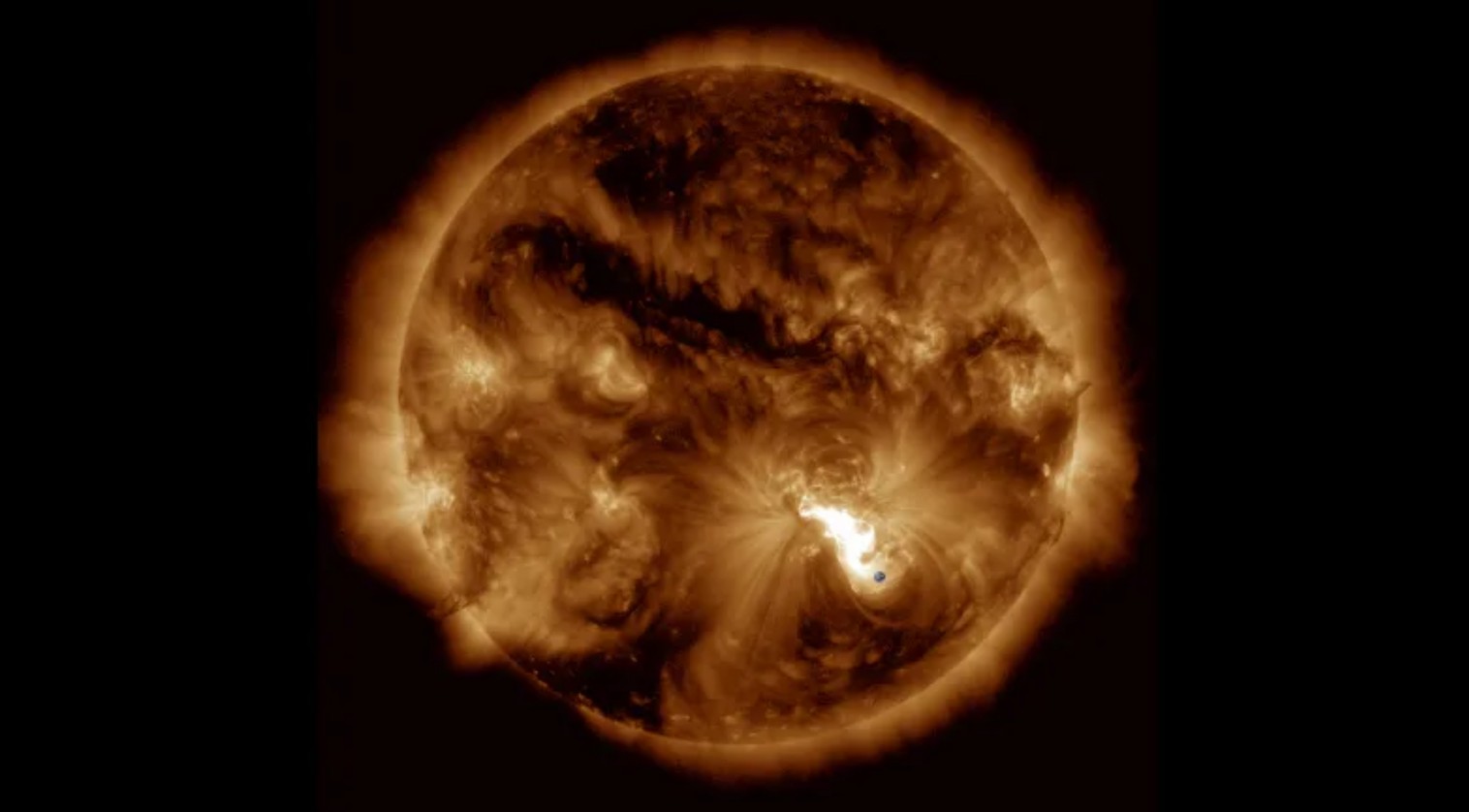
A sharp rise in activity began on 6 November: over 24 hours instruments recorded 18 events of class C and above. In the first 12 hours of 7 November, another 17 flares occurred, and by the end of the day their total number reached 29. On the evening of 5 November, in the same region No. 4566, an M3.6 flare lasting 29 minutes occurred — the most powerful since 10 October. All 29 events belonged predominantly to classes C and M.
Uniqueness of the record: one sunspot group
The main feature of the day is the concentration of all flares in one active region. In May 2022, the 29 events were produced by two sunspot groups (No. 3004 and No. 3006), and in December 2024 — by five at once (No. 3912, 3916, 3917, 3920 and 3922). The current situation indicates that group No. 4566 possesses exceptional energy and is capable of generating series of events without the pauses needed to accumulate energy for single powerful explosions.
A favourable scenario for Earth?
The Laboratory of Solar Astronomy noted that such a “mass” character of flares may be rather favourable for Earth: energy is released by many relatively moderate events rather than by one or two extremely powerful ejections. Since 2020, that is, in the current solar cycle, not a single flare of class X10 or higher has been recorded. This may indicate a shift in the pattern of solar activity towards numerous events of medium power.
A caveat about time zones
The record directly depends on the choice of the day boundary. By Moscow time the threshold of 30 flares was not exceeded, but by Coordinated Universal Time (UTC) on 5 May 2022, 32 flares were recorded. Thus, the “21st-century record” is correct specifically for Moscow time and NOAA catalogue data.
The repetition of the record of 29 flares per day is a noteworthy but not sensational event: it fits within the current solar cycle, which is characterised not so much by single extreme explosions as by serial activity.
The concentration of all events in one sunspot group No. 4566 makes this day unique from the standpoint of solar physics, but from a practical point of view for Earth such “fragmented” activity is less dangerous than one powerful ejection. The key question is whether this pattern will persist until the end of the cycle or whether the Sun will nonetheless shift to generating events of class X10+, which were last observed more than two decades ago.