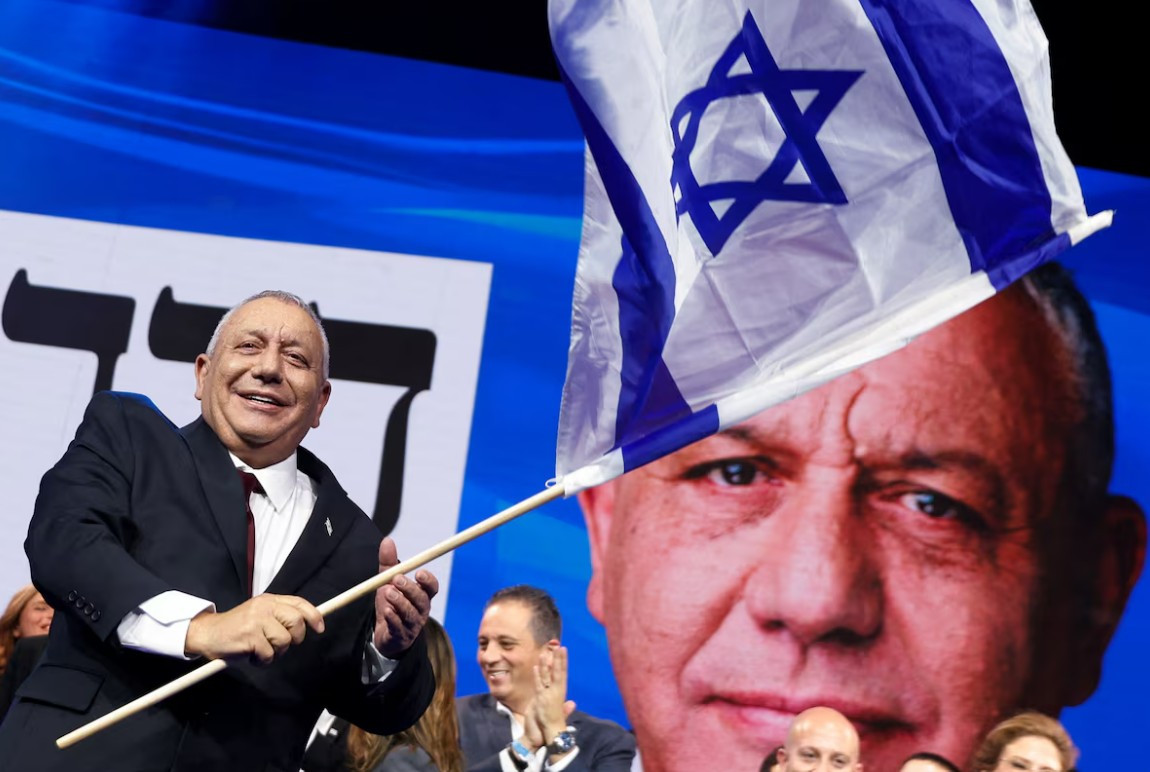
JERUSALEM (Realist English). The political crisis in Israel that began after the elections to the 26th Knesset has entered a decisive phase. President Isaac Herzog, having completed consultations with parliamentary factions, decided to entrust the mandate to form a cabinet not to the incumbent prime minister but to his main rival. “This evening the president informed Yashar party leader Gadi Eisenkot of his intention to task him with forming the government,” the president’s office said in a statement.
Balance of power: 67 vs 46
Herzog’s decision rests on the arithmetic of parliamentary support. Eisenkot secured recommendations from 67 of 120 Knesset members, while only 46 backed Netanyahu. Eisenkot’s bloc, which includes Yashar, Together, the Democrats and Israel Our Home, holds 48 seats. The key factor was the support of two Arab parties — Ra’am and the Joint List — which together won a record 19 seats and for the first time recommended Eisenkot’s candidacy.
Netanyahu’s bloc, which includes Likud (27 seats) and allied religious-nationalist parties, received 53 seats — eight short of the required majority of 61.
Eisenkot’s position: an “emergency national government”
After the president’s decision was announced, Eisenkot wrote on X: “The time has come to create an emergency national government. I will do everything in my power to prove that we deserve it.” The 66-year-old former military commander, the son of Moroccan immigrants, could become Israel’s first prime minister from the Mizrahi community — Jews whose roots lie in the Middle East and North Africa. His political identity is inextricably linked to personal tragedy: Eisenkot’s son and two nephews were killed in fighting during the Gaza war.
Netanyahu’s reaction: a call for unity
The incumbent prime minister, whose political future is now in question, on Saturday called for a national unity government. “This is a time for unity,” Netanyahu said in a video address, urging “Zionist” parties to form a broad coalition.
He also warned of the danger of a government relying on Arab parties, saying that those who want to “create a Palestinian state” are trying to “hastily form a government and swear it in.”
Scenarios for forming a government
Eisenkot faces a difficult task: he has 28 days to form a coalition, with the possibility of a 14-day extension. Experts identify three main scenarios, each fraught with difficulties:
- A minority government with external support from Arab parties. Eisenkot’s bloc (48 seats) plus support from Arab parties (19 seats) gives 67 votes, enough to survive a vote of no confidence. However, Eisenkot himself promised during the campaign not to include Arab parties in the government, and the right-wing Israel Our Home party of Avigdor Lieberman has already ruled out participating in such a cabinet.
- A coalition with ultra-Orthodox parties. Shas and United Torah Judaism hold 13 seats that could bring Eisenkot’s bloc to 61. However, this would require a compromise on exempting ultra-Orthodox Jews from military service, which Eisenkot and Lieberman opposed. Notably, Lieberman said on Friday he was ready for a compromise: “You can’t have everything.”
- A national unity government with Likud. A coalition with Netanyahu’s party would provide 67 seats, but this scenario is considered unlikely, since Eisenkot’s partners have pledged to remove Netanyahu from power, and the prime minister himself would have to abandon his far-right and ultra-Orthodox allies.
What next
If Eisenkot fails to form a government, the president will likely hand the mandate to Netanyahu. If that also fails, the Knesset may put forward another candidate. The entire process is limited to about 100 days, after which Israel will be forced to return to elections.
Herzog’s decision is not merely a procedural step but a political turning point that, for the first time in Netanyahu’s 15 years of cumulative rule, has put him in the position of the challenger.
Eisenkot received the mandate thanks to unprecedented support from Arab parties, but that very support remains the main obstacle to forming a stable coalition: Israeli society after 7 October 2023 views Arab parties with deep skepticism, and Eisenkot’s bloc partners refuse to ally with them.
The key question is whether the former military commander can overcome this paradox by compromising with the ultra-Orthodox or persuading his right-wing partners of the need for a minority government, or whether Israel will again find itself in an election cycle that will only deepen the political deadlock.