NEW YORK (Realist English). The race for leadership in artificial intelligence, which has captured the minds of politicians, businessmen and scientists around the world, may turn out to be a game with no winners.
This is the conclusion reached by renowned American economic historian and biographer of DeepMind’s founder Sebastian Mallaby. According to him, the US and China are not just competing — they have fallen into a “trilemma” trap with no easy way out.
The ‘AI Trilemma’: Three Goals That Cannot Be Reconciled
In his article for Foreign Affairs and in a series of interviews, Mallaby formulates the key problem of modern AI policy. American authorities, in his view, are trying to simultaneously achieve three goals that contradict each other:
- Stimulating innovation to ensure economic growth and technological superiority over China.
- Protecting national security from potential disasters associated with uncontrolled AI development.
- Reassuring a worried public, which is increasingly concerned about the risks posed by new technologies.
Mallaby stresses that the current piecemeal measures proposed in Washington, Beijing or Brussels are incapable of resolving this contradiction. He calls the situation an “AI trilemma” and insists on the need for a more systematic approach.
Failed Containment: ‘We Can’t Win This Race’
Mallaby’s key thesis, which has sparked widespread resonance, is that US attempts to slow down China’s AI development through chip export restrictions are doomed to failure.
In an April column for The New York Times headlined “I Went to China to See Its AI Progress. We Can’t Beat It,” he stated that Chinese companies, despite a shortage of advanced semiconductors, have found ways to bypass the restrictions.
Chinese developers, he observed, compensate for the lack of computing power through stacking less powerful chips and using advanced model distillation techniques. This allows them to quickly catch up with global leaders by using open-source code and their own engineering talent.
“The AI arms race is a tragedy dressed in the language of progress,” Mallaby says.
What Really Matters: Implementation vs ‘Intelligence Explosion’
Mallaby challenges the prevailing view in Silicon Valley that victory in the AI race will go to whoever achieves the so-called “intelligence explosion” — the moment when AI begins to write and improve its own code.
In his view, the decisive factor is not raw computing power, but the speed of adoption and integration of AI into real-world industries. And here, as he noted during a visit to China in March 2026, Beijing has an advantage.
Chinese companies such as Huawei and Hikvision are already deploying AI systems in high-speed rail management, mining and environmental monitoring.
“American models may be months ahead in the labs, but China is winning in industrial application,” Mallaby concludes.
The Personalities Behind the Machines
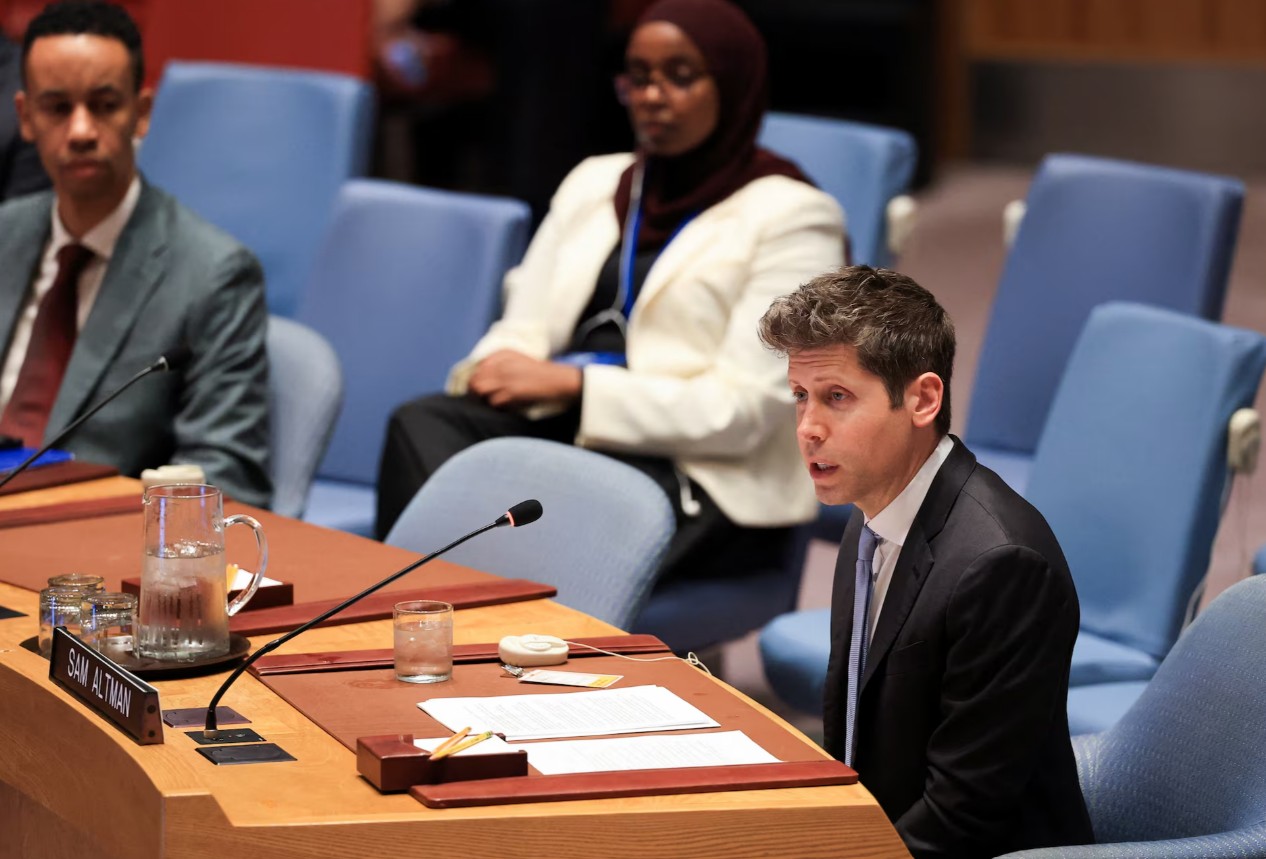
In his recent book The Infinity Machine: Demis Hassabis, DeepMind, and the Quest for Superintelligence, Mallaby profiles the key figures in the race. If Sam Altman of OpenAI is a “skilled negotiator” and Dario Amodei of Anthropic is an “ethics-focused innovator,” then Demis Hassabis emerges as a “genius visionary.”
Hassabis himself, according to Mallaby, is driven not by money or power but by a desire for “scientific enlightenment.” He wants to understand the structure of the universe, to approach “what could be called God.”
However, Mallaby draws an unsettling parallel between Hassabis and Robert Oppenheimer. “He wants to do good, but can he be good? He understands the dangers of AI, but what can he do to contain them?” the author asks, hinting that creators may lose control over their creation.
According to Mallaby, the world has entered an era where “a new kind of intelligence is being called into being by a very small number of people.” But instead of continuing a meaningless race that only threatens to accelerate risks, the US and China must sit down at the negotiating table and establish common safety rules. Without this, “the race nobody can win” risks becoming a catastrophe for all.