NEW DELHI (Realist English). Six words posted on social media in a moment of irritation transformed a 30‑year‑old Boston University graduate into the face of the largest street protest against Prime Minister Narendra Modi’s government since he came to power in 2014.
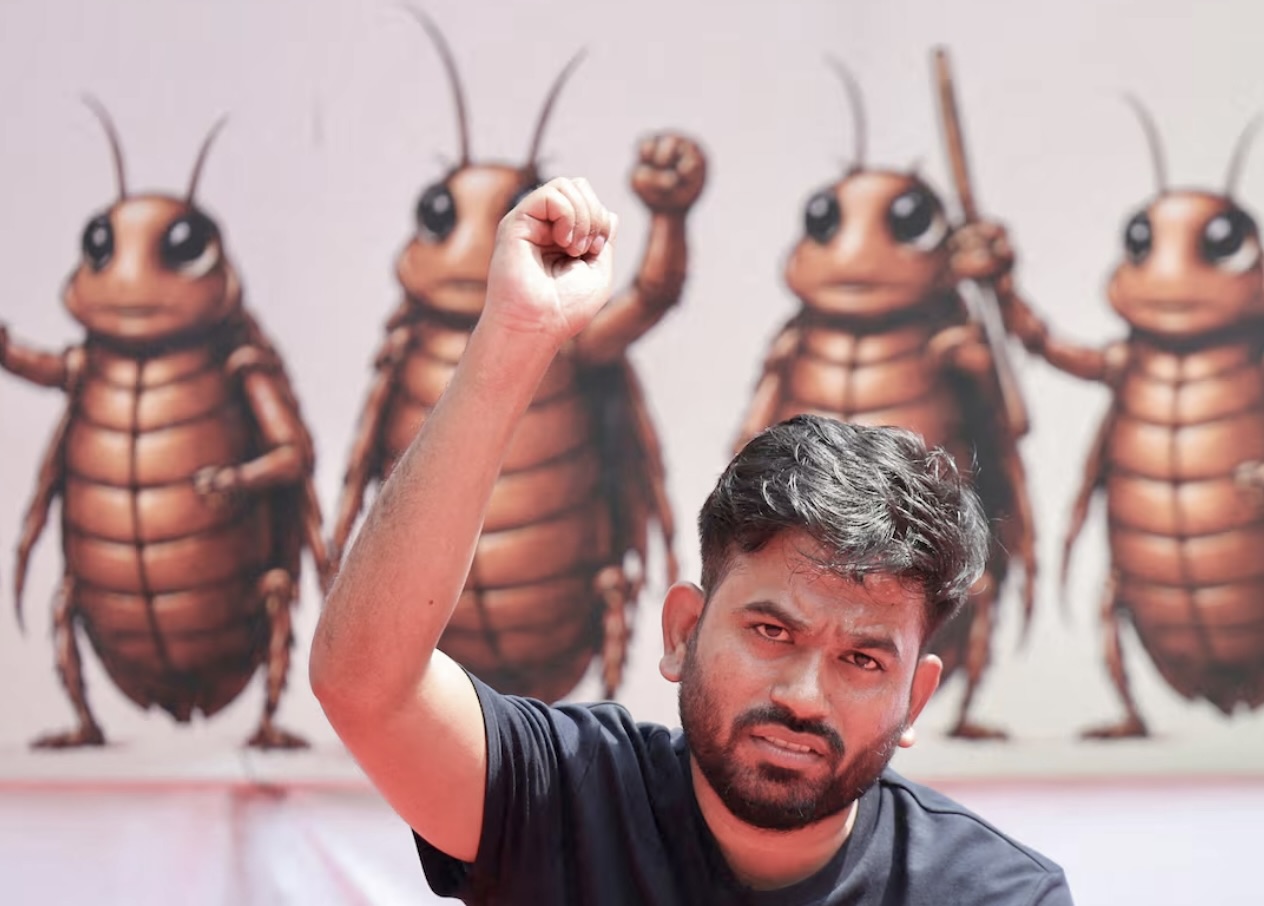
Abhijeet Dipke, the founder of the satirical “Cockroach Janta Party” (CJP), led a movement that forced the government to make concessions and secured the resignation of the education minister.
How the ‘cockroaches’ took over the streets
It all started on 16 May 2026. Chief Justice of India Surya Kant, during a hearing, compared unemployed young people interested in journalism and activism to “cockroaches” and “parasites” (he later clarified that he meant holders of “fake degrees,” but it was too late).
Dipke, who was playing FIFA on his PlayStation, read the news and posted on X: “What if all the cockroaches get together?” The post went viral, racking up hundreds of thousands of views and responses, particularly from Gen Z.
“There were a lot of memes and jokes, and many people wrote that we should create our own platform, maybe even a party. And I thought: why not, let’s do something crazy,” Dipke told the BBC.
Thus the Cockroach Janta Party (CJP) was born – a satirical project parodying the name of the ruling Bharatiya Janata Party (BJP). Within days, the platform had collected tens of thousands of followers through a Google form, and the hashtag #MainBhiCockroach (“I am also a cockroach”) went viral.
By the end of the first week, CJP’s Instagram account had overtaken the BJP’s official account, amassing more than 10 million followers. At the peak of the protests, CJP’s Instagram audience exceeded 23 million.
From memes to barricades: protests in 40‑degree heat
The trigger for taking to the streets was a scandal involving the leak of materials for the medical entrance exam (NEET-UG) in May 2026, which jeopardised the future of about 2 million students. Dipke called for the resignation of Education Minister Dharmendra Pradhan.
On 6 June, Dipke arrived in Delhi and began a protest at the Jantar Mantar observatory in the heart of the capital. Hundreds, then thousands of young people – many in cockroach costumes – gathered in the scorching 40‑degree heat. Protesters brought Indian flags, copies of the constitution, as well as plates and spoons – mocking Modi’s pandemic‑era call to clang utensils. On one day, participants were asked to bring diapers and write their demands for Pradhan’s resignation on them – a satirical jab at the government’s inability to prevent leaks.
Clashes with police and escalation
On 20 July, thousands of CJP supporters attempted to march to parliament despite a ban by authorities. Police used batons and tear gas. According to Delhi Police, about 180 people were injured in the crackdown, including both protesters and law enforcement officers.
Dipke called the authorities’ actions “brutal.” “The blood of students was spilled on the streets on 20 July. It was horrific. Isn’t that enough?” he said. The protesters did not disperse. Dipke, who became the constant face of the movement, appealed to the authorities: “These students are not terrorists. They are the future of our country.”
Victory: ministerial resignation and government admission
On 25 July, Education Minister Dharmendra Pradhan resigned. For Modi’s government, which prides itself on cabinet stability (ministers had not changed since 2018), this was a strong blow. On 31 July, when asked whether the Jantar Mantar protest had been successful, a government spokesperson admitted: “Yes, I would say so.”
Critics noted that the CJP, despite its satirical nature, represents a serious force: it has given a voice to millions of disillusioned young Indians. Opposition politicians, including Mahua Moitra and Kirti Azad, expressed support for the movement. However, there were also sceptics: they pointed to Dipke’s experience in the social media team of the AAP party and called the CJP “digital politics” rather than a spontaneous revolt.
Who is Abhijeet Dipke?
Dipke was born in Aurangabad (Maharashtra) into a Dalit family – one of India’s most marginalised communities. He studied journalism in Pune, then earned a master’s degree in public relations from Boston University. From 2020 to 2023, he worked in the AAP party’s social media team.
His Dalit background shaped his political views: when he arrived in Delhi on 6 June, he held a book by B. R. Ambedkar – the architect of India’s constitution and a champion of Dalit rights. After an incident in which a woman threw blue ink on him, Dipke posted a video with the caption: “Blue is my colour” – a reference to the Ambedkarite movement.
Dipke has promised that the movement will not stop: “If necessary, we will launch a new action on a much larger scale.” The CJP’s impact on India’s political landscape remains unclear, but the movement has already made history as the first Gen Z protest to force Modi’s government to back down.