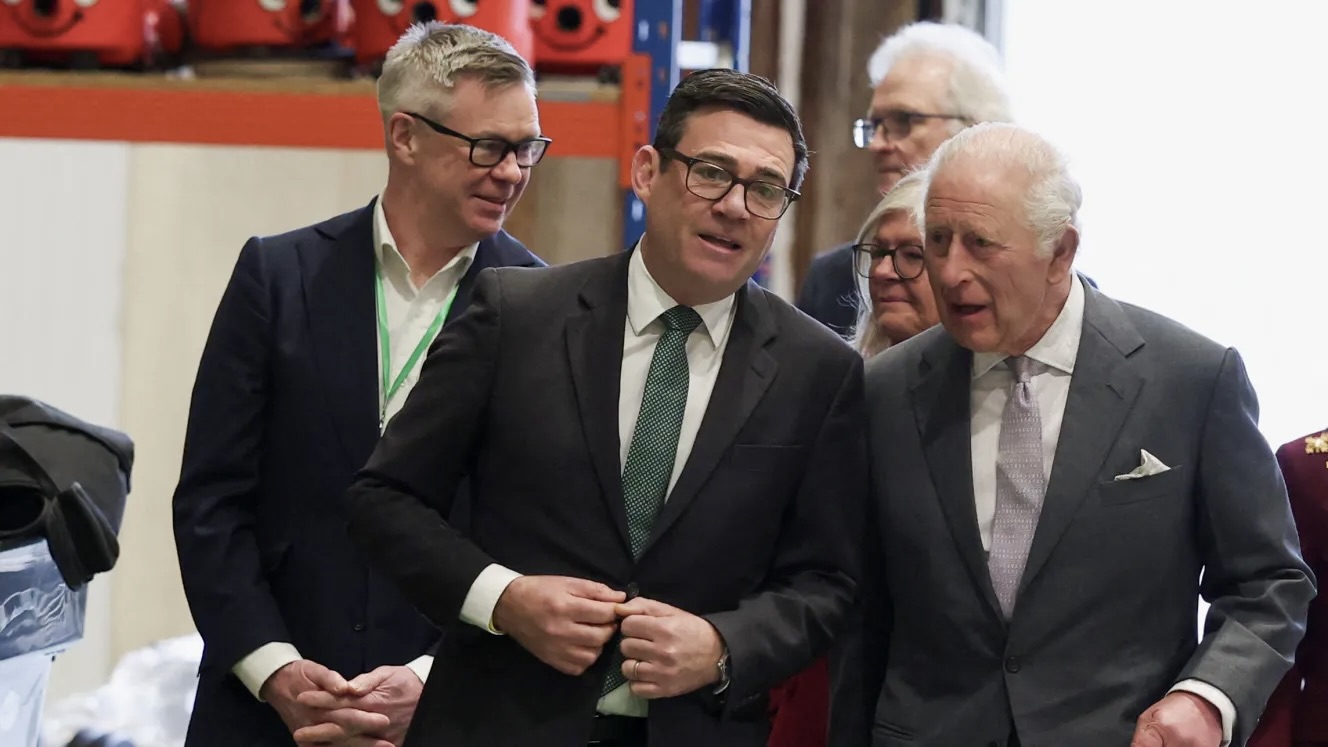
LONDON (Realist English). On July 20, Andy Burnham officially became the 59th Prime Minister of the United Kingdom. The handover ceremony took place at Buckingham Palace, where King Charles III accepted Keir Starmer’s resignation and entrusted Burnham with forming a new government.
Burnham becomes the seventh UK prime minister in ten years and the fourth in the last four years — reflecting the period of political instability that began after the 2016 Brexit referendum.
Handover Ceremony
The transfer of power followed the traditional script. First, Keir Starmer left his residence at 10 Downing Street, where he gave a farewell speech, saying he was stepping down “with goodwill and a smile.” He then travelled to Buckingham Palace to formally tender his resignation to the King.
Burnham then arrived at the palace. During a private audience, the monarch asked him to form a new administration. Buckingham Palace issued an official statement: “His Majesty received the Right Honourable Andrew Burnham, Member of Parliament, and asked him to form a new administration. The Right Honourable Andrew Burnham accepted His Majesty’s offer and kissed the monarch’s hand upon his appointment as Prime Minister and First Lord of the Treasury.”
Path to Power: The “King of the North” Returns to London
Burnham, nicknamed the “King of the North” for his years as Mayor of Greater Manchester, only returned to Parliament a month ago in a by‑election in the Makerfield constituency, organised by his supporters.
Before that, he spent nine years leading the Greater Manchester Combined Authority, transforming the region into one of the fastest‑growing in the UK.
Burnham’s political career spans more than two decades. He was an MP from 2001, served as Health Secretary, and twice ran unsuccessfully for the Labour Party leadership — in 2010 and 2015. In 2017, he left Westminster to head the Greater Manchester authority.
Starmer’s decision to resign was announced in June 2026, after which Burnham entered the leadership race. By July 17, he had become the sole candidate, securing the backing of 379 Labour MPs and all 11 trade unions affiliated with the party.
First Steps and Plans of the New Prime Minister
Immediately after his appointment, Burnham headed to Downing Street, where he delivered his first speech as prime minister. His first task is to appoint a Cabinet. Key ministerial posts are expected to be announced by Monday evening. Justice Minister Lord Timpson has already resigned, signalling the start of the reshuffle.
In his first speech, Burnham promised to give Britons “breathing room” and restore trust in government. According to his aides, he will say that political stability must deliver tangible results in people’s lives. Reuters reports that Burnham intends to “rewire” the country, focusing on the issues that matter to citizens: the cost‑of‑living crisis and ineffective public services.
The new prime minister is expected to adjust some aspects of his predecessor’s agenda. In particular, he will adopt a more pragmatic stance on North Sea oil and gas extraction. Additionally, according to The Guardian, Burnham plans to scrap Starmer’s plans for digital identity cards. Among his pledges is devolving more powers to regional communities.
Burnham’s appointment has drawn mixed reactions. Conservative leader Kemi Badenoch warned that the new prime minister is taking office “without a government plan and without a mandate” for his tax‑raising proposals.
US President Donald Trump welcomed the change, saying residents of Aberdeen in Scotland were “dancing in the streets” over Burnham’s promise to “open up” the North Sea for oil drilling.
Some critics note that Burnham became prime minister without a general election and without a full competitive leadership contest. However, Burnham, as the leader of the ruling party, is entitled to take the helm, and he could remain in power until the next general election, scheduled for 2029.