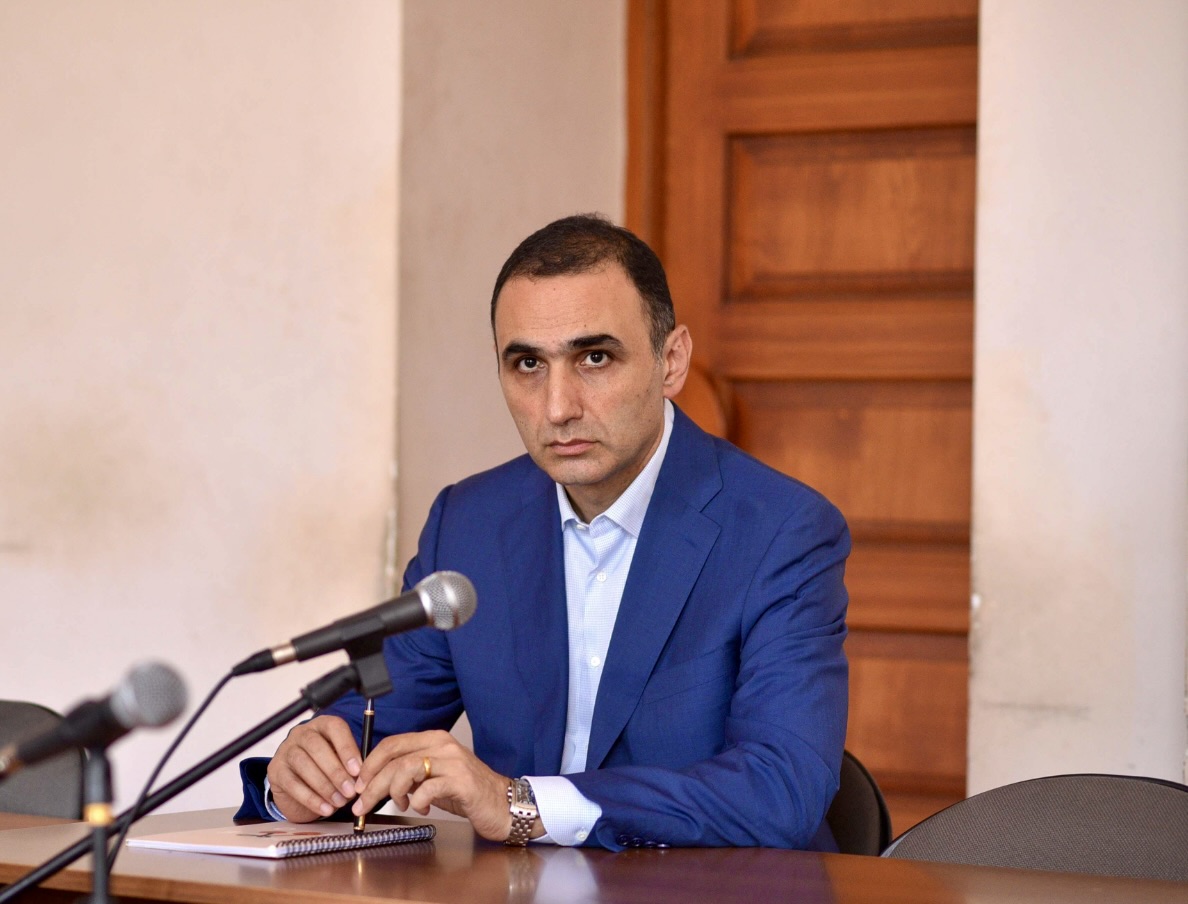
YEREVAN (Realist English). On 4 August, a statement was issued from the “Armavir” penal institution by Avetik Chalabyan, coordinator of the national‑civic association “Ayakve.”
The political prisoner responded to debates in Armenia’s newly elected National Assembly, where a deputy from the ruling Civil Contract party, Arman Yeghoyan, framed what he called the parliament’s main contradiction: “whether we want to see a sovereign and independent Armenia or a state dependent on and directed by Russia.”
Chalabyan called this framing “convenient for Civil Contract, but fundamentally false.” According to him, the real dilemma for Armenia is different: “Do we want to see ourselves integrated into the Turkic world, into a nationless semi‑state entity, or do we want to build a national state, relying on the support of both Russia and our other natural allies?”
Chalabyan’s arrest: a chronology of persecution
The coordinator of “Ayakve” was arrested on 24 June 2026 for two months. According to Armenia’s Investigative Committee, the grounds for detention were Chalabyan’s trip in May 2026 to another country, where he allegedly “by persuasion induced officials to obstruct the free exercise of citizens’ voting rights” in the 7 June parliamentary elections.
Chalabyan’s defence team called the prosecution’s motion insufficient to justify detention. The politician’s wife, Anahit Adamyan, stated that a search of the family apartment, where children live, was conducted at 7:15 a.m., with security forces seizing a phone and detaining Chalabyan. Human rights defenders described the events as “clear political persecution.”
This is not Chalabyan’s first arrest. In 2022, he was detained for two months over an alleged attempt to bribe the chairman of the student council at the Agrarian University to mobilise students for protests. In December 2023, a court found him guilty and banned him from participating in or organising protests for two and a half years, as well as from leaving his place of residence without permission. His defence called the case politically motivated.
The ‘toxic narrative’ about Russia
In his statement, Chalabyan addressed the historical roots of Armenian‑Turkish antagonism. He noted that the “anti‑Turkish sentiment among Armenians was instilled by the Russian Empire” — a thesis he said is persistently promoted by Civil Contract.
The political prisoner cited three facts that, in his view, refute this version: the Ottoman Turks conquered the Middle East and treated Christian peoples “as slaves”; the Ottoman administrative system was “shamefully backward and corrupt,” forcing Armenians to rebel against lawlessness; and in the later period, having lost European territories, the Turks turned their gaze eastward to Turan, seeing Armenians as the “greatest obstacle” to their expansion.
“For the last 150 years — whether it was the Hamidian massacres of 1894–1896, the 1915 Genocide, the invasions of Eastern Armenia in 1918 and 1920 with the aim of genocide, the devastation of Artsakh in 2023, or the silent devastation of Nakhichevan during the Soviet years — all these actions pursued one goal: to destroy the Armenian buffer between Turkey and Turan,” Chalabyan wrote.
A ‘bridge’ to the Turkic world: the question of survival
The key question Chalabyan posed to his compatriots is demographic. He presented a calculation: today Turkey has about 85 million people, and the five Turkic states of Turan have roughly the same number. Armenia has about 3 million.
“If we become a bridge on Turkic territory with a population of 170 million, will we not sooner or later dissolve into it and become Turks ourselves? Or, while trying to remain Armenian and Christian, will we return to the slave status of 200 years ago?” the political prisoner asked.
He called on every Armenian to answer the question: “What future do you envision for your children — Turkified and entrusted to Turkish mercy, or one of struggle and defending freedom to the end?”
248 political prisoners in Armenia
Chalabyan’s statement came amid a growing number of political prisoners in Armenia. According to human rights activists, as of June 2026, there were 248 political prisoners in the country. Larisa Alaverdyan, executive director of the organisation “Against Legal Arbitrariness,” noted that before 2018 (the year of the “velvet revolution”), there were isolated cases of political persecution, but now they have “become systemic.”
Among those arrested are Prosperous Armenia leader Gagik Tsarukyan, “Mother Armenia” party leader Andranik Tevanyan, his associate Aregnaz Manukyan, and Avetik Chalabyan. Some political prisoners are subject to bans on communication with their minor children.
Amid systemic political repression, human rights defenders plan to submit data on political prisoners to the UN, the Council of Europe and the EU. However, as Larisa Alaverdyan notes, “Armenian society is still not in the habit of going to court,” and the judicial system, in her words, “has been usurped by the authorities.”
In his statement, Chalabyan outlined what he sees as the choice facing Armenia: dependence on the Turkic world or resistance to Turkic expansion with support from Iran, India, China and all those “who see us Armenians as natural allies.”
“God helps those who struggle, so do not hesitate to choose the path of struggle,” the political prisoner concluded.