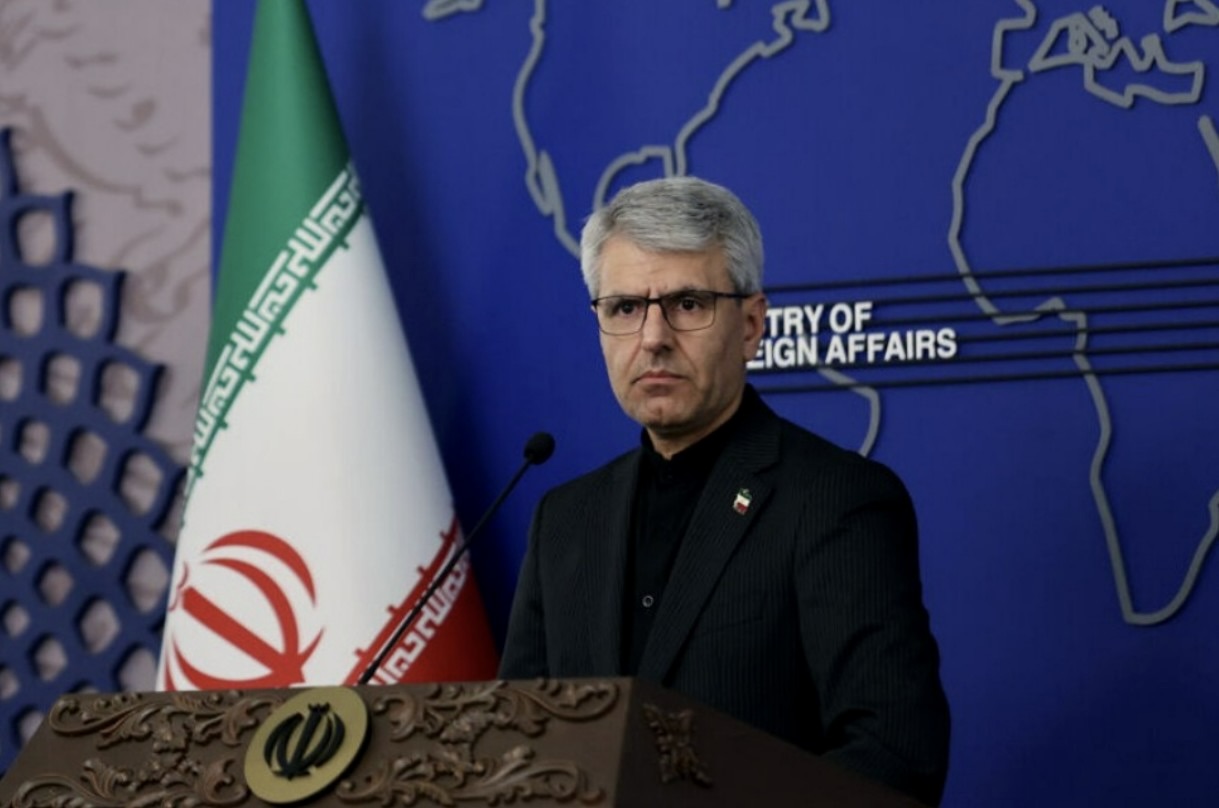
TEHRAN (Realist English). Iran has categorically rejected US President Donald Trump’s claims that direct talks are underway between Tehran and Washington. Iranian Foreign Ministry spokesman Esmaeil Baghaei stated at a briefing on 3 August: “At present, we are not conducting any negotiations with the United States.
Talks are being held with Oman to reach an agreement on a route that will ensure safe shipping through the Strait of Hormuz.” Earlier, Trump announced that talks with Iran would begin on 3 August and that he had agreed to cancel planned massive strikes on Iran – claims that Tehran completely rejects.
Tehran’s denial: ‘No talks with the US’
Speaking to journalists, Baghaei stressed that Iran’s current contacts are limited exclusively to bilateral dialogue with Oman. “We are working on creating a temporary route in cooperation with Oman to ensure the safety of shipping in the Strait of Hormuz as soon as possible,” the Iranian diplomat said. He also reported that the talks are “constructive” in nature and are being conducted at both technical and political levels.
At the same time, Iran insists on the bilateral nature of the negotiations. “These negotiations are bilateral between two coastal states. What happens next must be decided,” Baghaei emphasised.
Agreement with Oman no guarantee of reopening the strait
A key element of Tehran’s position: even reaching an agreement with Muscat will not automatically lead to the reopening of the strait. Baghaei called a safe shipping agreement a “necessary but not sufficient condition.”
“The strait was closed not because of disagreements between Tehran and Muscat, but because of US and Israeli aggression against Iran,” the Foreign Ministry spokesman stated. According to him, the situation in the Strait of Hormuz “will not change as long as the US continues its acts of aggression and blockade.”
This position was confirmed on 5 August by an informed source from Iranian state television IRIB: “If US violations continue, the Strait of Hormuz will not be opened, even if Iran and Oman reach an agreement. The opening of the strait depends on a change in US behaviour.” Baghaei expressed a similar view: as long as the naval blockade of Iranian ports continues, “the situation in the Strait of Hormuz will remain unchanged.”
Washington’s optimism: ‘Progress being made, but no deal yet’
Despite Tehran’s statements, Washington remains optimistic. US Secretary of State Marco Rubio said on 4 August that the US is participating in the talks between Oman and Iran and that “progress has been made, but a final agreement has not yet been reached.”
US Treasury Secretary Scott Bessent expressed even greater confidence, stating that an agreement could be reached “today or tomorrow.” The Treasury chief also said the sides are “very close” to a deal. Trump, for his part, said the US is having “very good discussions” with Iran, but warned that Tehran will be “hit hard” if the strait is not opened “very soon.”
Qatar, acting as a mediator, confirmed that the talks have reached “very advanced stages.” At the same time, Qatari Prime Minister’s adviser Majed Al‑Ansari stated that Doha, Pakistan and Oman are closely coordinating their efforts to facilitate indirect contacts between Washington and Tehran.
Possible terms of the deal: Iranian control and ‘service fees’
According to The New York Times, Iran and Oman are close to an agreement that could formalise Tehran’s control over the strait. Under the plan under discussion, vessels entering the Persian Gulf would follow a channel controlled by Iran off its coast, while vessels leaving the gulf would follow a channel off Oman’s coast.
Iranian officials have stated that no transit fee will be charged, but the agreement provides for a “service fee” to cover environmental, security and administrative costs. Revenues would be split equally between Iran and Oman.
At the same time, some senior Pentagon officials are sceptical of such an arrangement, calling it a “US capitulation.” A US official, speaking on condition of anonymity, said Washington still seeks to restore the status quo in which “neither side controls traffic lanes or the ability to transit through them.”
War, blockade and stakes
The Strait of Hormuz is one of the world’s most strategically important waterways, through which about 30% of global seaborne oil passes. The strait was an open international waterway until 28 February 2026, when the US and Israel attacked Iran.
Between 8 and 24 July 2026, the US and Iran exchanged military strikes: Washington attacked targets inside Iran, while Tehran responded with strikes on US military facilities in Jordan, Bahrain and Kuwait. The escalation followed a memorandum of understanding signed in June and the start of talks on a final agreement. The talks later stalled due to disagreements over security guarantees and freedom of navigation through the Strait of Hormuz.
A new agreement between Iran and Oman, if reached, could represent a significant strategic victory for Tehran, formalising its control over the strait. However, Iran’s position remains tough: even technical agreements with Oman will not lead to the reopening of the strait as long as the US does not change its behaviour in the region.
The divergence in rhetoric between Washington and Tehran is reaching its peak: the US speaks of progress and an imminent deal, while Iran insists on the absence of contacts with the Americans and ties the opening of the strait to an end to “aggression.” Technical talks with Oman continue, but even their successful completion, according to Tehran, does not guarantee the unblocking of the strait. The question is whether Omani and Qatari diplomacy can bridge the gap between the two sides – or whether the logic of war will once again prevail.