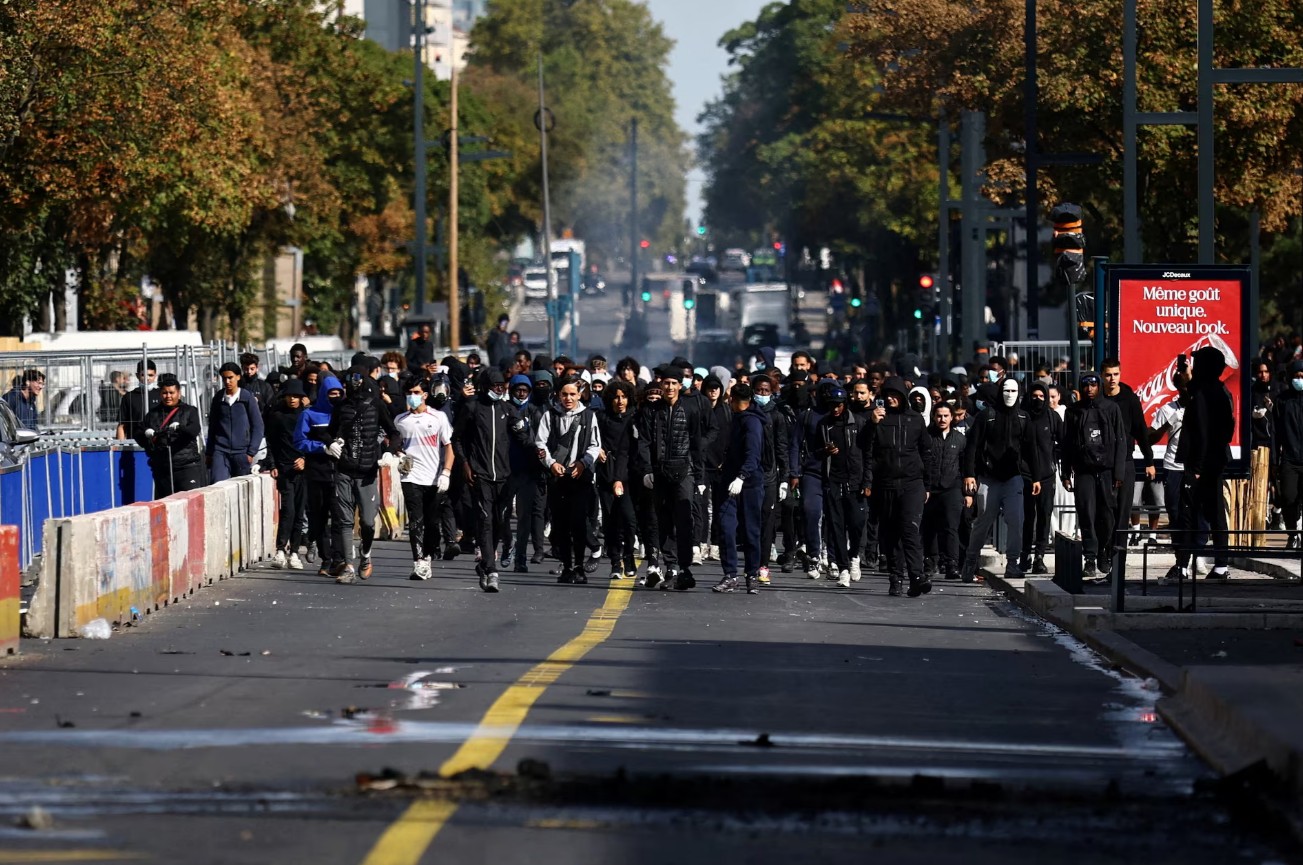
PARIS (Realist English) . On October 6, tens of thousands of people will take to the streets of Paris. France’s largest trade unions are joining the wave of high school student protests for the first time. Authorities have deployed about 2,000 police officers and gendarmes in Paris.
Scale and demands of the protests
French high school students began protesting in late September. The movement initially started at the Saint-Exupéry lycée in the Paris suburb of Créteil, then rapidly spread across the country. Key student demands include: teacher shortages and lack of substitutes, overcrowded classes, dilapidated school buildings, overloaded schedules, and the opacity of the Parcoursup university admissions system.
As of October 5, classes were suspended in 589 of the country’s 3,700 lycées, with another 32 universities affected. In the Île-de-France region, more than 160 schools were blocked or operating intermittently. On October 5, protests affected about 400–500 schools, where classes were fully or partially suspended.
Trade unions and parties join
The General Confederation of Labour (CGT) — its General Secretary Sophie Binet announced that union members would take to the streets to “protect high school students.” CGT members will participate in the march in red vests. CGT also called on parents to join in protecting students.
The education union alliance (SNES-FSU, SNUEP-FSU, SNEP-FSU) called for a strike in support of the student movement, demanding “resources for public education.” The Peasant Confederation (Confédération paysanne) also called on farmers to join blockades with tractors; at least 10 departmental branches responded.
Left-wing parties also joined: “Unsubmissive France” (LFI) declared “full” support for the mobilization, with Jean-Luc Mélenchon calling October 6 a “starting point.” The Socialist Party — its First Secretary Olivier Faure stated that “socialists will stand alongside high school students.” The Communist Party — its National Secretary Fabien Roussel also called on social media for people to take to the streets on October 6.
Data on violence and casualties
Serious clashes erupted during the protests. According to government data, since the movement began:
— 215 students have been injured, including a 15-year-old in Lens whose left hand was torn off by a police grenade explosion on October 5;
— 715 police officers and gendarmes have been injured;
— 85 education system employees have been injured — the education minister called this “unprecedented”;
— more than 5,000 people have been detained, 87% of them minors;
— 24 schools have been burned or looted.
On October 5, a lycée in the 13th arrondissement of Paris was set on fire. Damage in 468 lycées in the Île-de-France region is estimated at no less than 7 million euros; in the Auvergne-Rhône-Alpes region, damage to more than 300 lycées is estimated at 25–30 million euros.
Police investigation and criticism
Interior Minister Laurent Nunez stated that police have launched 10 internal investigations into allegations of excessive use of force. A number of unions and human rights organizations accuse police of “excessive use of force.” Amnesty International on the evening of October 5 called on French authorities to “stop the excessive police repression witnessed in recent days during student protests.”
The government, in turn, accuses the far-left “Unsubmissive France” of orchestrating the movement behind the scenes. The Prime Minister’s office stated that the movement has “degenerated into urban violence” and called for a return to “structured, legal, and democratic forms of opposition.”
Government response
Prime Minister Sébastien Lecornu demanded that seven ministers present a “roadmap” prioritizing solutions to long-term teacher absences and vacant positions, as well as promoting the renovation of dilapidated school buildings.
The government is also pushing a bill requiring those who damage public property to pay for repairs themselves — funds could be deducted from family allowances and housing subsidies, while maintaining a minimum income. CGT General Secretary Binet criticized the bill, stating it would “ultimately hit the most vulnerable families.”
Political background
The unrest is occurring several months before the 2027 presidential election. Macron has already served two terms and cannot run again; the election of his successor will take place next year. The continued development of the student movement could become an important political variable ahead of the elections.