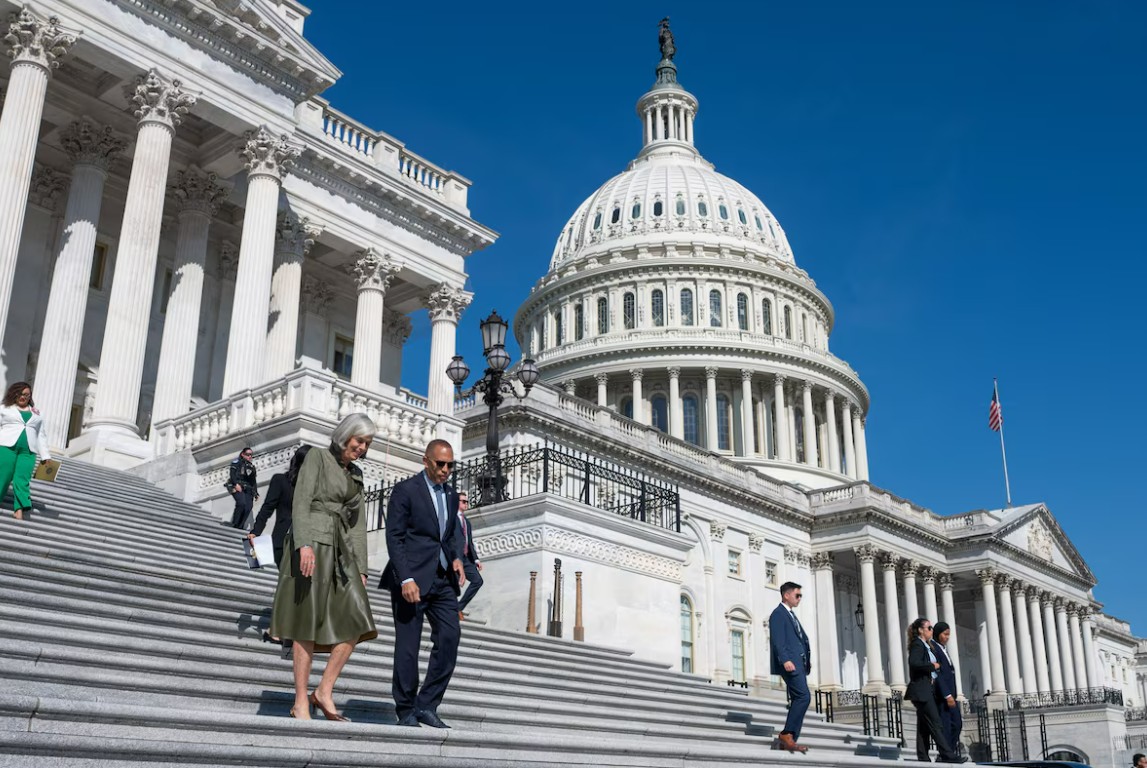
WASHINGTON (Realist English). The US Congress is on the brink of a fourth shutdown during Donald Trump’s second presidential term. The stumbling block has been disagreements over the war with Iran and the president’s demand to allocate an additional $350 billion to the Pentagon, Reuters reports.
The Deadline and Senate Arithmetic
Current funding for federal agencies expires on December 11. Lawmakers have three weeks left to agree on a budget, and in the 100-seat Senate, 60 votes are required to pass any funding. This gives Democrats, who will take control of both chambers in January, leverage in the current composition of Congress.
The Democrats’ Demand: Do Not Fund the “War of Choice”
A group of Democrats led by Senator Chris Van Hollen (Maryland) is demanding that any temporary funding agreement include a provision prohibiting the Trump administration from using federal funds to continue the military campaign against Iran. They are joined by Bernie Sanders, Michael Bennet, and Tammy Duckworth.
“We should not accept a short-term deal that continues to allocate billions of additional dollars to the war of President Trump’s choosing,” their joint statement of November 12 reads.
Split Within the Democratic Party
However, the initiative met resistance within the party itself. Senators Jeanne Shaheen, John Hickenlooper, and Cory Booker warned against a strategy that could lead to a shutdown on the eve of the holidays — and just weeks before Democrats formally take control of Congress.
Senator Peter Welch (Vermont) framed the dilemma: “The main obstacle is that we don’t want to fund the war, but we don’t want to shut down the government either. How do you solve that? It’s a Gordian knot.”
Congresswoman Rosa DeLauro, the senior Democrat on the House Appropriations Committee, came out against a shutdown: “Shutting down the government won’t stop the war.”
The Republicans’ Position
Senate Majority Leader John Thune stated: “The American people don’t need another shutdown. I think it would be a colossal mistake and a real disservice to the people of this country.”
Republicans also failed to agree on how to meet Trump’s $350 billion request. Instead, they are conducting bipartisan negotiations on a $1.1 trillion defense budget that includes only $69 billion of the president’s supplemental request. At the same time, the possibility remains of using budget reconciliation to approve spending without Democratic votes, which could complicate bipartisan negotiations.
The Third Shutdown and the Elections
Democrats have already initiated three shutdowns since Trump returned to power in January 2025, including the longest in US history. Earlier this year, they blocked funding for the Department of Homeland Security after two US citizens were killed by federal immigration agents in Minneapolis.
The Democrats’ position is reinforced by the midterm election results: a Reuters/Ipsos poll showed that 71% of respondents, including 93% of Democrats and 51% of Republicans, want Congress to pass a law ending the conflict. However, some Democrats fear that a shutdown before the holidays could result in political damage.
As observers note, the key feature of the situation is the gap between the anti-war mandate Democrats received in the elections and the risks of a shutdown, which voters may perceive as political calculation.
For the budget process, the immediate effect will be visible primarily in whether the parties can agree on a short-term funding extension without tying it to the war, or whether Democrats will escalate — and that is precisely where the balance between the anti-war agenda and responsibility for keeping the government running is most sensitive.