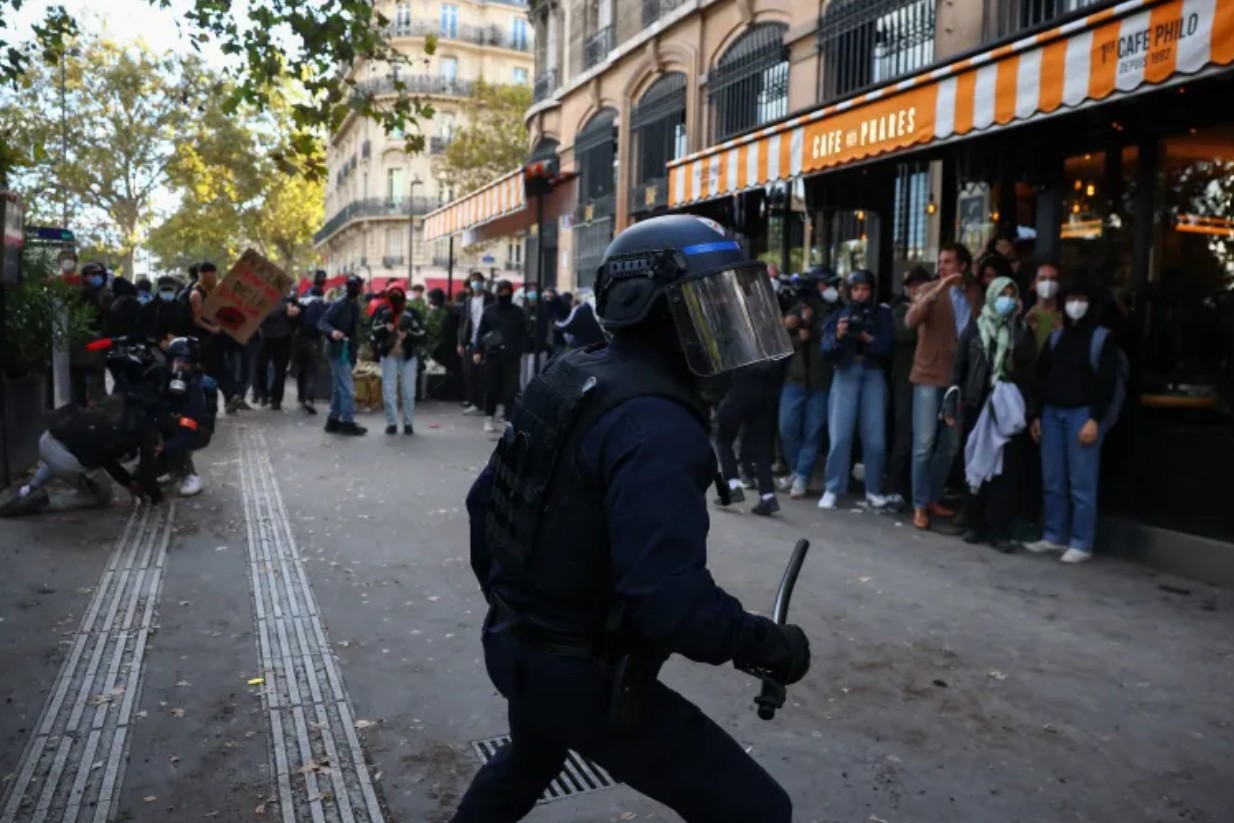
PARIS (Realist English). French merchants and small business owners are bracing for a new wave of protests scheduled for October 24, just a week after the October 17 unrest, which descended into some of the most destructive in recent years.
Scale of damage
According to the French Ministry of Economy, damage from the violence and unrest of October 17–18 is estimated at “tens, and possibly hundreds, of millions of euros.” Trade and Small Business Minister Serge Papin said at least 3,000 shops were damaged or looted.
The country’s largest retail chain, Carrefour, about 50 of whose stores were attacked, warned that its operating profit could fall by €80–200 million, and the company’s shares dropped more than 13%. According to DBRS Morningstar estimates, the total bill for insurers could reach €1.2 billion, making this unrest one of the most costly incidents of its kind in France.
How merchants are preparing
In central Paris, Lyon, Lille, and Toulouse, shop owners are hastily taking measures. Storefronts are being covered with wooden panels and steel grilles. Some are installing iron barricades, as luxury brand stores on the Champs-Élysées have done. In Lyon, one manager invested €20,000 in iron grilles. Others are hiring private security with dogs or, in isolated cases, acquiring self-defense items such as tear gas.
The owner of a computer accessories shop in Paris plans to move most of his inventory out on the evening of October 23 and keep the shop closed on October 24, monitoring the situation via cameras. “We will pray,” Franceinfo quoted him as saying.
Government response measures
President Emmanuel Macron announced a ban on “illegal” protests in the coming days. Demonstrations organized by trade unions will be permitted, but their routes may be changed. All other actions not organized by unions will be “fully banned wherever possible.”
Authorities imposed bans on demonstrations in Marseille and Lyon on October 24, and in Paris banned protests in central areas, including the Champs-Élysées and the Louvre area. Interior Minister Laurent Nuñez announced the deployment of army forces from Operation Sentinelle to guard key sites, and the total number of security forces on October 24 will be 20% higher than on October 17. Prime Minister Sébastien Lecornu promised a “massive” police presence and will hold a meeting with unions.
For the French economy, a new wave of unrest could be a serious blow. Merchants are already suffering losses not only from direct damage but also from forced closure on October 24 — traditionally one of the most profitable shopping days.
“We haven’t worked on Saturdays, including October 24, for three weeks out of fear of demonstrations,” Franceinfo quoted a representative of the Rhône clothing federation as saying. The Auvergne-Rhône-Alpes region has already allocated €15 million to help merchants strengthen security.
For the government, this is also a political challenge: banning protests and deploying the military may reduce the risk of renewed riots but at the same time reinforce accusations of excessive use of force and restrictions on the right to demonstrate. The question is whether the authorities can maintain a balance between ensuring security and preserving public dialogue, especially amid ongoing student and social protests.