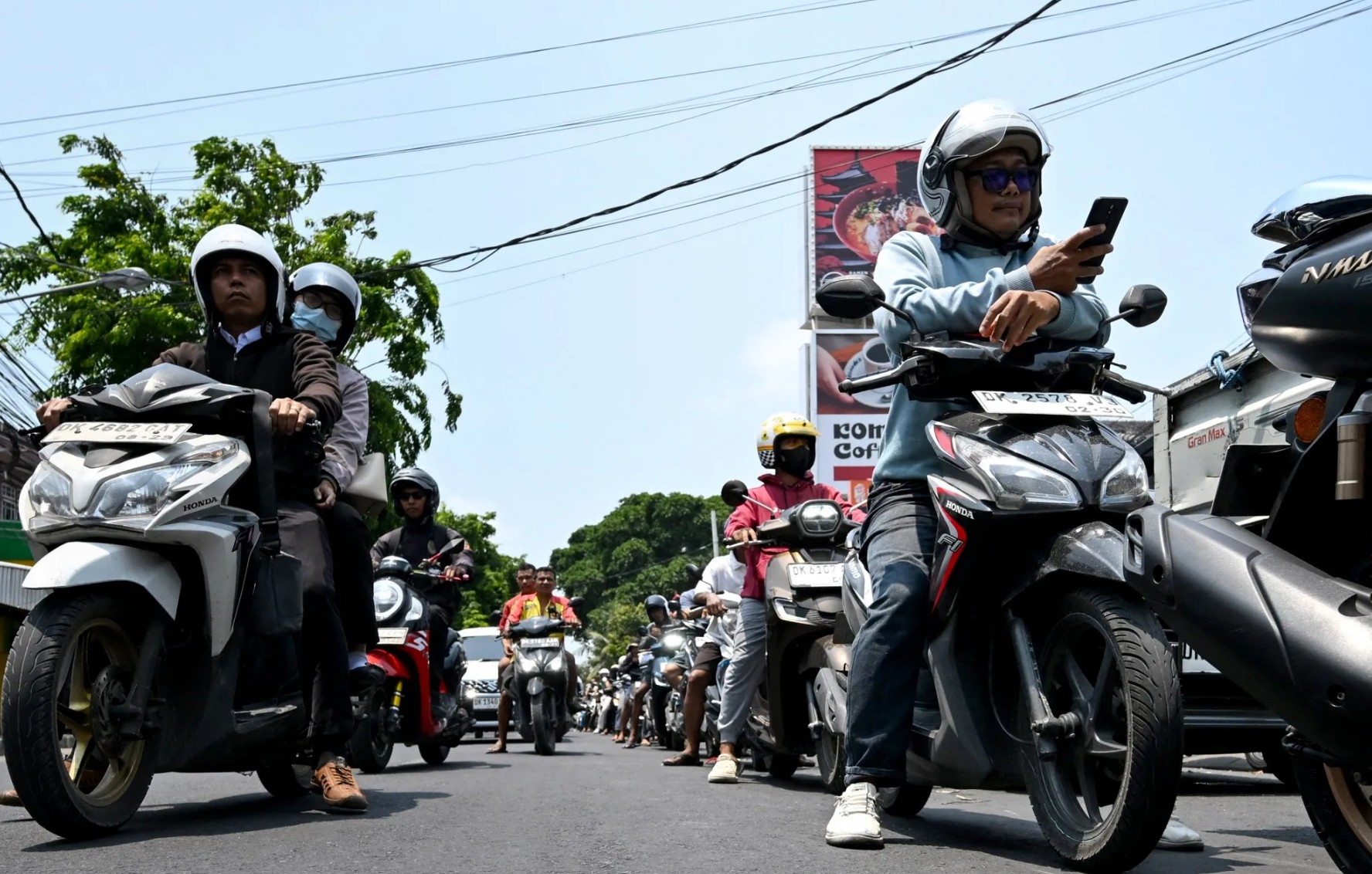
JAKARTA (Realist English). Indonesia’s resort island of Bali and several other provinces are facing fuel shortages, with hours-long queues forming at gas stations. State oil company Pertamina attributes the situation to a technical delay in unloading a tanker and a sharp rise in demand for subsidized fuel. The broader context is the Middle East conflict, which has cost Indonesia 25% of its import sources.
What happened
Since October 12, queues have appeared at gas stations in several tourist areas of Bali, including Denpasar, Badung, Uluwatu, and Ubud. In some places, they stretched more than a kilometer; motorcyclists in Kerobokan stood in line until late at night.
A Russian tourist told RIA Novosti that after waiting in a long queue at one station, he was advised to “better go to another one,” where he was then told he needed to go to the north of the island. Bali Governor I Wayan Koster acknowledged that panic buying may have exacerbated the shortage.
Official explanation
Pertamina President Simon Aloysius Mantiri, in a statement on October 14, disclosed the immediate cause: a fuel tanker encountered technical difficulties at the anchorage, delaying unloading from 06:30 to 22:00 — approximately 15.5 hours.
He apologized to Bali residents but stressed that “this incident cannot be an excuse for service disruptions.” At the same time, demand for Pertalite (subsidized gasoline) rose by approximately 2,200 kiloliters per day; Pertamina acknowledged that the price difference between subsidized and unsubsidized fuel is encouraging a shift in consumption.
Scale beyond Bali
According to monitoring by Indonesia’s Ombudsman, summarized on October 13, fuel disruptions affected at least 11 provinces: Bali, West Papua, Banten, West Kalimantan, West Sumatra, North Sumatra, West Sulawesi, North Sulawesi, Southeast Sulawesi, Aceh, and West Java.
In West Sumatra, waiting times reached 2–3 hours; in West Papua, night and morning queues exceeded one kilometer; in North Sulawesi, the queue for Pertalite reached 300–500 meters; in Banten, on the Merak–Tangerang highway, the diesel queue was about one kilometer. At some stations, diesel or Pertalite sold out, including in Aceh, Riau, West Kalimantan, South Sulawesi, North Sulawesi, and Yogyakarta.
Root cause: shrinking import sources and rising prices
After the Middle East conflict began, Indonesia lost 25% of its fuel import sources. Laode Sulaeman, Director General of Oil and Gas at the Ministry of Energy and Mineral Resources, said the mechanism for purchasing fuel through tenders now “attracts few participants,” and the government is forced to directly “seek” alternative supplies from countries with surplus stocks, even if the price may be higher.
Indonesia’s crude price (ICP) surged to $112.81 per barrel in September, up $23.38 from August’s $89.43; Brent rose to $102.02 per barrel over the same period.
Fiscal pressure and response measures
Deputy Finance Minister Juda Agung on October 13 clearly promised not to raise subsidized fuel prices or expand the budget deficit, but said the government would recalculate economic assumptions and “more precisely target” subsidies.
The government is preparing to restrict Pertalite sales, targeting households in the top decile (desil 10). By the end of August, actual spending on subsidies and compensations reached 331.4 trillion Indonesian rupiah, up 52.1% year-on-year; each dollar increase in ICP is estimated to add 6.8 trillion rupiah to the deficit. The 2026 budget deficit is expected to widen to 2.85% of GDP due to rising oil prices — above the original target of 2.68%.
What this means
The queues in Bali are not just a logistical failure but a manifestation of structural vulnerability. Indonesia, despite being an oil-producing country, still depends on imports of refined products — especially gasoline — and the Middle East conflict has simultaneously cut off supply sources and driven up global prices.
The government’s promise not to raise prices protects purchasing power in the short term, but at the cost of sharply rising subsidies and a widening deficit. Restricting Pertalite sales may compress demand, but the difficulty of enforcement lies in the fact that middle- and low-income groups dependent on motorcycles are the main consumers of subsidized fuel.
If the Middle East situation drags on, Indonesia will face not a one-time queue problem but a fundamental test of the sustainability of its entire subsidy system. Pertamina has already sent additional tens of millions of liters of fuel to Bali and extended the operating hours of 92 stations to 24 hours, but analysts note that until import source and price problems are resolved, disruptions may recur in other regions.