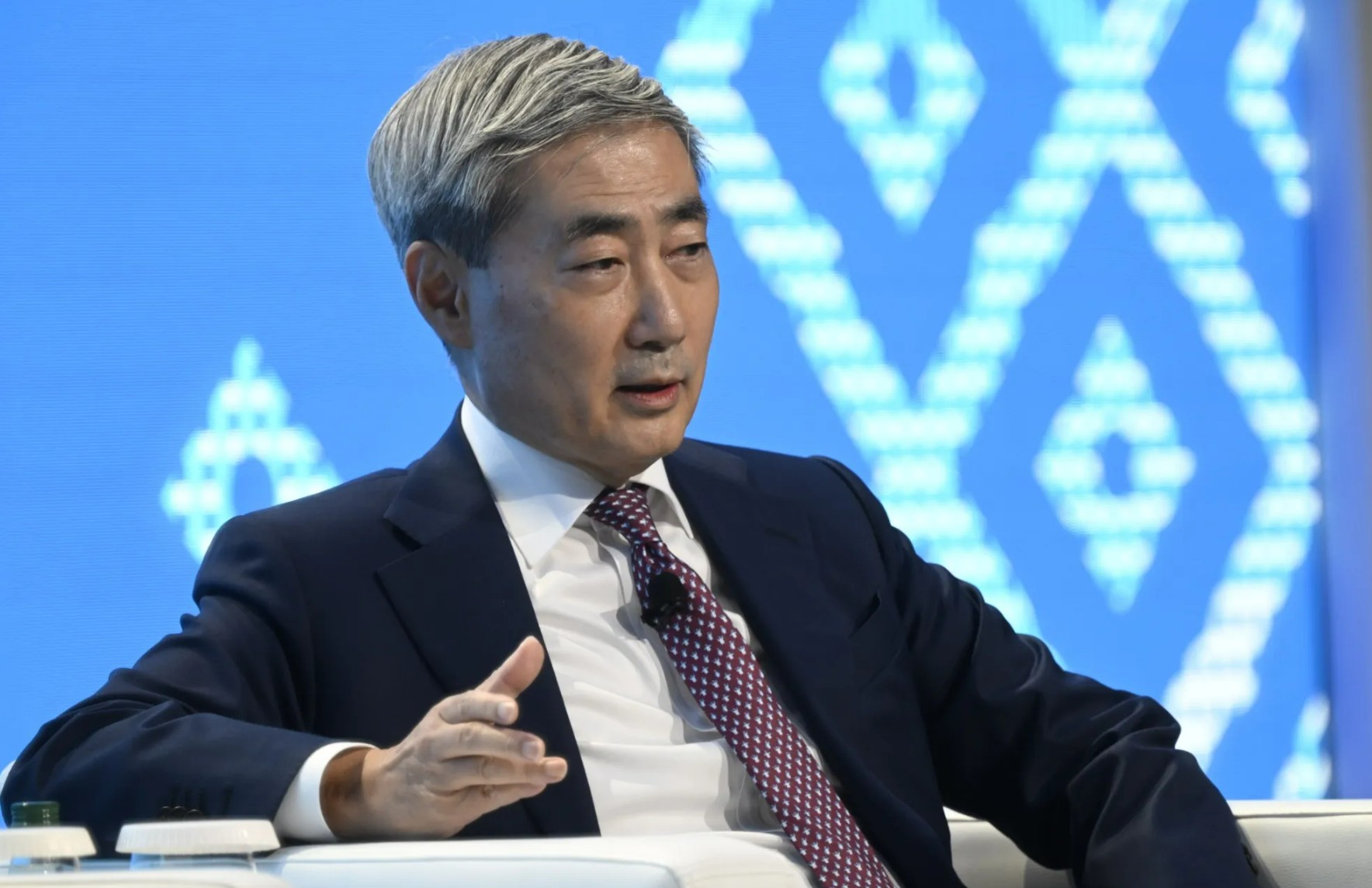
SEOUL (Realist English). Bank of Korea Governor Shin Hyun-song said further strengthening of the won would be desirable and confirmed his intention to maintain restrictive monetary policy until inflation approaches the 2% target. He made the remarks on October 13 at the annual IMF and World Bank meetings in Bangkok in a conversation with Krishna Srinivasan, Director of the IMF’s Asia and Pacific Department.
Tightening course
“We will maintain restrictive monetary policy until we are confident that inflation will converge with our target in a timely manner,” Shin said. He stressed that all three key variables — inflation, the won’s exchange rate, and financial stability — point in the same direction, which simplifies decision-making. “Chasing two rabbits running in different directions is difficult, but when they run in the same direction, policy decisions become much easier.”
The Bank of Korea raised its benchmark rate twice in a row in July and August — to 3.00% per annum, an unprecedented step. Shin called it a “pre-emptive” measure that bought time amid the Fed’s tightening in September. “We set the direction a little earlier than other major countries. I believe we gained a bit of time,” he said.
Won: “there is room to strengthen”
The won’s exchange rate against the dollar fell to 1,335.1 won per dollar on October 12 — a nearly two-year low — and briefly reached 1,331.3. Shin said the rate is “above the usual levels of past years” and “there is room to go lower, the won can strengthen further.”
The central bank chief linked this to policy tightening and called the won’s strengthening a positive factor: it reduces import costs and boosts household purchasing power. At the same time, Shin warned that the won’s strengthening does not remove the risk of demand-side inflation: nominal GDP grew 26.4% year-on-year, meaning rising incomes and potential pressure on prices.
Inflation above target
Consumer prices rose 2.9% year-on-year in September, while core inflation was 2.8% — both remain above the 2% target. Shin expects inflation to “remain above the target level for a considerable period” due to accumulated cost pass-through and growing demand-side pressure.
The Bank of Korea raised its core inflation forecast for 2026 and 2027 to 2.5%. Shin stressed: “Pre-emptive control of core inflation is a very important preliminary step toward achieving our goal.”
What’s next
The next rate meeting is on October 22. Most analysts expect a pause after two consecutive hikes: the market will assess the effect of tightening and its impact on consumption. “October is a comma,” noted Kim Ji-na of Eugene Investment & Securities. However, a November hike to 3.25% is seen as the base-case scenario, with a possible peak at 3.50% in the first quarter of 2027.
What this means
The Bank of Korea is among the few central banks that began tightening before the Fed. This gave Seoul rare freedom of maneuver: a stronger won reduces import costs, but rising household incomes create new inflationary pressure. Shin is balancing between two risks — premature easing and excessive tightening that could dampen consumption. While the market bets on a pause in October and a hike in November, the key question is whether the Bank of Korea can keep inflation under control without harming growth, which remains fragile due to its concentration in semiconductor exports.