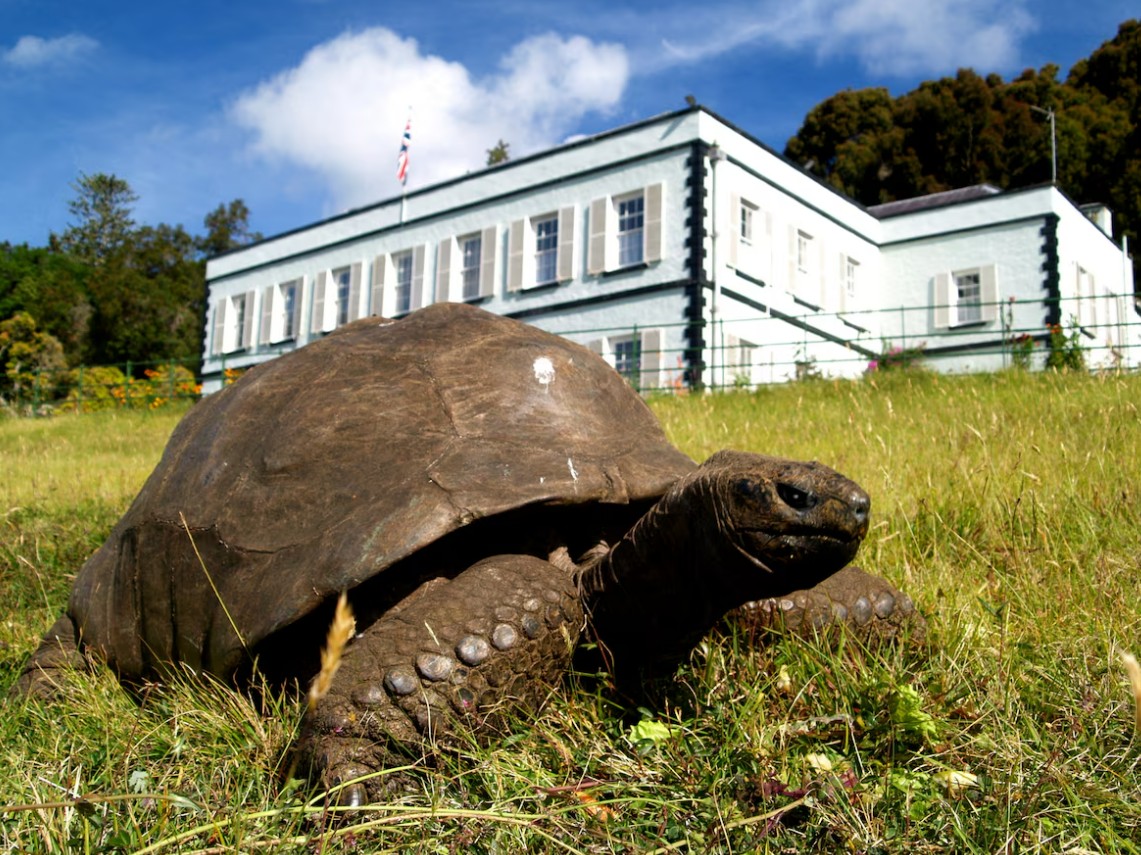
LONDON (Realist English). An international team of researchers has for the first time sequenced the genome and epigenome of the giant tortoise Jonathan — the oldest living land animal, estimated to be around 194 years old. The work has been published in the journal Science Advances and, according to scientists, could provide a key to understanding the mechanisms of human aging.
Who is Jonathan
Jonathan is an Aldabra giant tortoise (Aldabrachelys gigantea) living on the island of Saint Helena in the South Atlantic. He was brought there in 1882 as an adult, as a gift to the island’s governor. In a photograph from that time, he appears fully formed, meaning he was at least 50 years old. Researchers therefore estimate his age at 194 years, with an official birthday of December 4, 1832.
The average lifespan of Aldabra tortoises is about 80 years, and the maximum is about 96. Jonathan has exceeded this mark by more than a century.
Why blood was not taken
Due to the risk of infection, the authorities of Saint Helena prohibited taking blood from Jonathan. Veterinarian Joe Hollins, who has cared for the tortoise since 2009, collected saliva and cheek cell samples by distracting Jonathan during feeding. The first attempt yielded mostly bacterial DNA, but a repeat collection provided sufficient material.
What was found in the genome
The team led by Dr. Stephen Clark of the non-profit organization Kallel identified 287 unique genetic variants not found in other studied tortoises. These genes are linked to key bodily processes:
- DNA damage repair — the ability to correct errors accumulated with age in the genetic code.
- Insulin regulation — control of blood sugar levels.
- Tumor suppression — protection against cancer.
- Reduction of inflammation.
- Telomere function — protective regions at the ends of chromosomes that shorten with age.
Main discovery: mitochondria and the epigenome
The key difference between Jonathan and other tortoises was found not in the genes themselves, but in the epigenome — chemical marks that turn genes on and off.
With age, these marks become chaotic — a phenomenon scientists call “methylation entropy.” In most of Jonathan’s tissues, exactly this age-related disorganization was observed. However, in regions linked to the function of mitochondria — the cell’s power stations — the marks remained surprisingly orderly.
Co-author Justin Gerlach of the University of Cambridge explained: “The gene regulators responsible for energy production and DNA repair remained incredibly stable in Jonathan for nearly two centuries.” According to him, in these regions Jonathan’s epigenome corresponds to that of a 5-year-old tortoise.
Scientists suggest that efficient mitochondrial function provides cells with sufficient energy for high-quality DNA repair, which in turn slows the accumulation of age-related damage.
Link to humans
The results echo studies of supercentenarians — people who have passed the 110-year mark. In particular, a study of a 117-year-old woman found unusually efficient mitochondrial function.
“Aging is the main risk factor for virtually all chronic diseases,” noted Stephen Clark. “Our goal is to use these evolutionary mechanisms and turn them into practical and accessible treatments for ordinary people as quickly as possible.”
Limitations of the study
Scientists emphasize that the work does not prove a causal link between the found features and Jonathan’s exceptional age. The study is based on a single animal, and blood samples, which could not be obtained, are needed for a complete picture.
Professor of Biology Vincent Lynch of the University at Buffalo, who was not involved in the work, urged caution: “Perhaps Jonathan is just very good at aging.”
What this means
Jonathan is not just a record-holder but a living experiment set up by nature. His genome shows that extreme longevity may be linked not only to the presence of “good genes” but also to the ability to preserve the youth of regulatory systems — the very switches that become chaotic with age.
If the mechanism maintaining order in mitochondrial genes can be reproduced pharmacologically, it could become the basis for therapies that slow age-related diseases. For now, Jonathan continues to eat pears and cucumbers from his veterinarian’s hands, remaining a symbol that aging is not a sentence but a biological mystery yet to be solved.