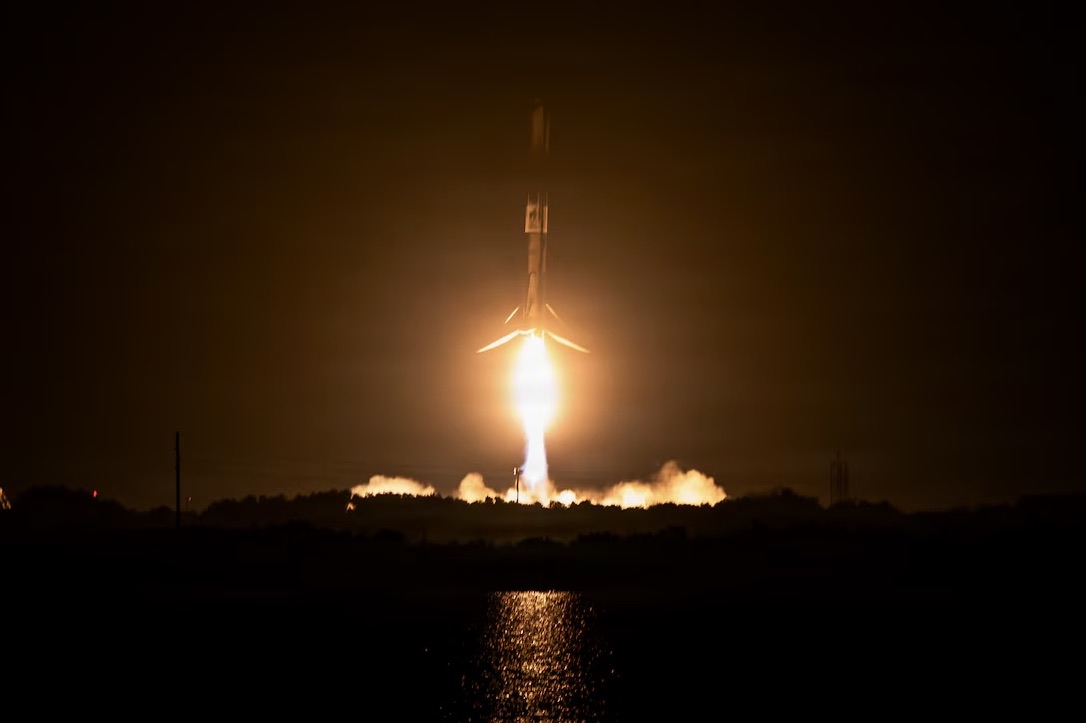
CAPE CANAVERAL (Realist English). On August 30 at 7:26 a.m. Eastern Time, a SpaceX Falcon Heavy rocket is scheduled to lift off from Launch Complex 39A at the Kennedy Space Center. Its payload is the Nancy Grace Roman Space Telescope – which scientists have already dubbed a “discovery machine.”
The bus‑sized spacecraft, developed over more than a decade at a cost of $4.3 billion, will position itself 1.6 million kilometres from Earth and, over five years, fundamentally reshape humanity’s understanding of the cosmos.
“An observatory like Roman is, in its essence, a discovery machine,” said Julie McEnery, the project’s senior scientist at NASA. “We will find rare things, unusual things, new things, surprising things.”
What Makes Roman Unique
The new telescope’s key advantage over its predecessors is speed and field of view. Roman can scan the sky more than 1,000 times faster than Hubble, with a field of view 100 times wider. Like the James Webb Space Telescope, it operates in the infrared spectrum, but its scientific goals are fundamentally different.
| Characteristic | Roman Telescope | Hubble |
| Scanning speed | 1,000+ times faster | — |
| Field of view | 100+ times wider | — |
| Orbit | 1.6 million km from Earth (Lagrange point L2) | 540 km |
| Daily data volume | 1–1.3 TB | ~0.1 TB |
| Cost | $4.3 billion | ~$16 billion (including servicing) |
As NASA Administrator Jared Isaacman explained, “Roman will deliver a new atlas of the universe to Earth.” The telescope will work in tandem with Hubble and Webb, complementing their observations.
The Three Primary Science Goals
Roman’s science programme covers three key areas that could revolutionise modern astrophysics.
1. Dark Matter and Dark Energy. These two substances are estimated to make up about 95% of the universe. Dark matter acts as a gravitational “glue” holding galaxies together, while dark energy is a repulsive force accelerating cosmic expansion. Roman will measure gravitational lensing over vast distances and create a three‑dimensional map of dark matter distribution. “We’re not measuring the properties of something in the universe,” McEnery explained. “We’re understanding how the universe we live in fundamentally works.”
2. The Hunt for Exoplanets. Roman is expected to detect up to 200,000 new planets beyond our solar system — a colossal leap from the current tally of about 6,300 confirmed exoplanets. The telescope will use two methods: the transit method (when a planet eclipses its star’s light) and microlensing (gravitational bending of a star’s light by a planet). This will allow the detection of planets smaller than Mercury, and even free‑floating rogue planets not orbiting any star.
3. Coronagraph and the Search for Life. As part of the mission, a coronagraph will be tested — an instrument capable of blocking a star’s blinding light to reveal much fainter planets orbiting nearby. Its mirrors can change shape in real time, compensating for vibrations and temperature fluctuations. The success of this technology will be a stepping stone toward the “Habitable Worlds Observatory,” which will search for Earth‑like planets and chemical signatures of potential life in their atmospheres.
What Scientists Are Saying
The scientific community is eagerly awaiting data from Roman — not only because it promises new discoveries, but because it could overturn established theories.
“Recent observations hint that our standard model of the universe is wrong,” Julie McEnery said at an August 29 press conference. “Roman will definitively tell us: yes, the model works, or no, it doesn’t. And if it doesn’t, that will give us the precision and quality of data to start distinguishing between alternatives.”
Dominic Benford, NASA’s Roman programme scientist, added: “Part of what Roman is meant to do as a discovery machine is to give people the ability to ask the universe questions we haven’t even thought of yet.”
The Road Ahead
After launch, the telescope will take about three months to reach the L2 Lagrange point — a gravitationally stable region 1.6 million kilometres from Earth. During that time, engineers will test the instruments and deploy the data transmission antenna.
Roman will send about 1 terabyte of data to Earth every day — the equivalent of streaming 1 million songs. The first images are expected in January 2027, with full‑scale sky surveys commencing thereafter.
All data will be made available to the scientific community and the public. As Roman’s technical manager Dave Content warned, the data volume will be staggering: “This will be the largest catalogue of astronomical objects ever created, and it will help us understand how common solar systems like our own really are.”
A New Hubble or the End of the Standard Model?
The Nancy Grace Roman Space Telescope is more than just another spacecraft. It is an attempt to answer questions humanity has asked since first gazing at the night sky. What is dark matter? Why is the universe expanding at an accelerating rate? Are there other Earths? And perhaps the most profound question of all: do we truly understand the architecture of the cosmos?
If the standard model — built on dark matter and dark energy — proves incorrect, as McEnery hinted, Roman will be not merely a “discovery machine” but an instrument that rewrites physics textbooks. If the model is confirmed, the telescope will still provide an unprecedented wealth of data for refining it.
Yet open questions remain. Will Roman’s coronagraph become a prototype for future life‑seeking missions? Will the telescope find truly Earth‑like planets? And most importantly — is humanity ready for the answers the “discovery machine” might bring, if they turn out to be not what we expected?
As NASA prepares for launch and Falcon Heavy awaits its moment on the pad, one thing is certain: five years from now, our view of the universe will never be the same.